

The true value of a garment isn't found on a silk-screened logo or a seasonal mood board. It exists in the structural integrity of a full-canvas construction and the tactile weight of Super 150s worsted wool. For the discerning professional, asking is luxury fashion worth the investment requires looking past the label toward the discipline of construction. You've likely felt the sting of paying for a heritage name only to watch the fabric pill or the shoulders sag before the year is out. It's a common frustration in a market where a Chanel Small Classic Flap now commands $11,300 despite the increasing noise of trend-driven cycles.
This editorial audit provides a rigorous framework for identifying true luxury by examining the technical nuances of the atelier. We'll analyze why specific construction methods and the provenance of fibers transform apparel into a permanent asset. From the placement of horn buttons to the precision of a hand-finished lapel, we're defining the Fora Leonara standard for a wardrobe that retains its aesthetic and structural soul. Substance over spectacle. This is the foundation of material capital.
Article Audit: Defining Material Capital
• Evaluate the technical architecture of a garment, prioritizing full-canvas construction and the superior drape of Super 150s worsted wool over seasonal aesthetics.
• Reframe your perspective on whether is luxury fashion worth the investment by analyzing the intrinsic value of the European atelier and its commitment to slow fashion.
• Move beyond the noise of logo-centric branding to identify the markers of true provenance, ensuring every piece in a permanent wardrobe retains its structural soul.
• Contrast the professional ROI of precision tailoring against the rapid depreciation of trend-driven apparel.
• Recognize the quiet authority of hand-finishing and genuine horn buttons as the final signatures of uncompromised quality.
The Shift from Consumption to Capital: Defining True Luxury Investment
The narrative of modern retail often prioritizes the spectacle of the new over the substance of the enduring. This creates a cycle of consumption that treats apparel as a disposable commodity. To truly understand if is luxury fashion worth the investment, one must reframe the wardrobe as a portfolio of high-quality material assets. There's a vital distinction between "quiet luxury" as a marketing trend and "investment dressing" as a discipline of longevity. The permanence associated with the "old money aesthetic" is not a result of social standing. It is the direct consequence of a garment’s silhouette remaining unchanged by time or cleaning. One is a costume; the other is a legacy.
The Concept of Cost-Per-Wear vs. Asset Preservation
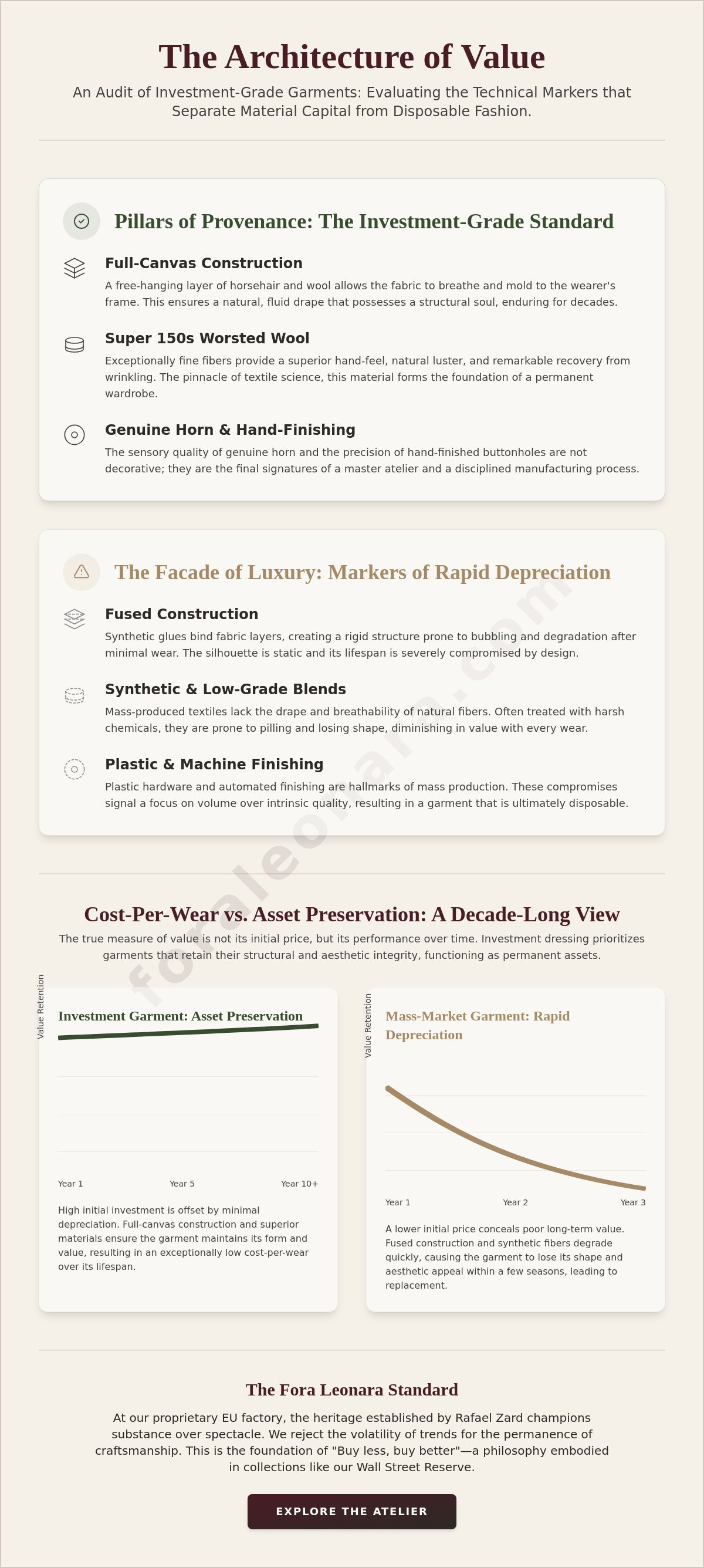
Calculating the true value of a garment requires a decade-long lens. While mass-produced items lose their shape after a single season, apparel built with full-canvas construction adapts to the wearer. This structural integrity prevents the physical depreciation that plagues fused alternatives. A jacket rendered in Super 150s worsted wool possesses a natural drape that synthetics cannot replicate. Investment dressing is the disciplined acquisition of garments characterized by technical longevity and aesthetic restraint, ensuring each piece remains a functional asset across decades.
Rejecting the Logo Tax for Intrinsic Value
A significant portion of a luxury price tag often funds global advertising rather than the material itself. A sophisticated understanding luxury goods allows the discerning professional to identify where the capital is actually allocated. True value lives on the atelier floor, not in a billboard campaign. At Fora Leonara, the heritage established by Rafael Zard focuses on our proprietary EU factory and the meticulous process of slow fashion. There's a profound psychological ease in wearing garments, such as those in the Wall Street Reserve collection, that require no logo to signal their excellence. The quality of the dark navy wool flannel and the weight of the horn buttons speak with a quiet, authoritative confidence.
This philosophy of "Buy less, buy better" is a necessary reaction to the volatility of modern production. It's a return to foundational principles. When we invest in the provenance of a garment, we're choosing a permanent uniform that mirrors our own commitment to precision. Quality is the only true capital.
The Architecture of Value: Technical Markers that Define Longevity
The physical reality of a garment is its most honest attribute. While marketing creates a halo of prestige, the technical architecture determines whether a piece survives the decade or dissolves after a season. To decide if is luxury fashion worth the investment, one must look past the silhouette to the canvas beneath. Fused construction, common in premium-tier tailoring, relies on synthetic glues that inevitably bubble and degrade. In contrast, full-canvas construction utilizes a free-hanging layer of horsehair and wool. It allows the fabric to breathe. It ensures the jacket molds to the wearer's frame over time. The result is a silhouette that possesses a natural, fluid drape. It's a garment that grows with you.
Materiality remains the second pillar of this audit. The hierarchy of fabrics begins with standard wool and ascends to the rare refinement of Super 150s worsted wool. These fibers are exceptionally fine, providing a natural luster and a superior hand-feel that synthetic blends cannot mimic. Scholarly analysis regarding the value of luxury brands suggests that while brand imaging drives initial desire, it's this intrinsic material quality that sustains long-term asset value. Beyond the fabric, the sensory quality of genuine horn buttons and hand-finished buttonholes serves as the final signature of a master atelier. These aren't merely decorative. They're indicators of a disciplined manufacturing process that refuses to cut corners.
Materiality and the Science of Extraordinary Fabrics
High-twist yarns in professional shirting offer remarkable recovery. They resist wrinkling naturally, avoiding the harsh chemical coatings found in mass-market "non-iron" alternatives. European material sourcing ensures a provenance that respects the integrity of every fiber. This commitment to materiality creates a sophisticated, logo-free aesthetic defined by texture and substance. It's quality that doesn't need to shout to be recognized.
The Precision of Atelier Construction
Proprietary manufacturing is the hallmark of the Fora Leonara philosophy. By operating our own EU factory, Rafael Zard maintains a standard of precision that third-party wholesale simply can't match. Hand-finishing on buttonholes and seams provides a flexibility that rigid machine stitching lacks. It prevents the structural tension that leads to premature wear. You'll find selvedge details in our trouser construction, a mark of slow-loom production that preserves the fabric's natural edge. These technical markers are best observed in the curated selections of our permanent collection, where every stitch is an exercise in restraint and excellence.
Apparel vs. Accessories: Why Tailoring is the Superior Asset
The prevailing narrative in the secondary market suggests that investment capital is best allocated toward leather accessories. This perspective often prioritizes speculative resale over the daily ROI of professional presence. When determining if is luxury fashion worth the investment, we must consider the functional superiority of the silhouette. A precision-cut suit acts as a permanent uniform, offering a level of social capital that a logo-heavy bag can never replicate. Tailoring is an intentional choice. It signals a mastery of one’s own image. While a handbag remains an external attachment, a full-canvas jacket becomes an extension of the wearer. It provides the structural foundation necessary for a decade of wear.
Longevity is also a matter of material maturity. High-grade natural fibers like Super 150s worsted wool and vegetable-tanned leathers possess the ability to develop a refined patina over time. They age with grace. Conversely, the synthetic coatings and glues found in many mass-market accessories eventually crack or peel. They're designed for the short term. At Fora Leonara, our commitment to slow fashion ensures that every garment is built to endure. The technical mastery of our proprietary EU factory allows us to prioritize the life of the seam and the resilience of the fiber. We value the substance of the garment over the spectacle of the brand name.
The Social Capital of the Uniform
The Wall Street Reserve philosophy embodies the discipline of dressing for the position you hold, not the trend you follow. By utilizing dark navy wool flannel and suede elbow-patch jackets, this collection creates a narrative of quiet confidence. It's a rejection of the frantic energy found in modern retail. For women, the Dune Veil Dress provides a similar strategic advantage. It transitions across social spheres with an effortless grace that requires no external validation. This is the power of a refined silhouette.
Resale Value vs. Utility Value
The utility of a perfectly fitting suit far outweighs the speculative nature of the resale market. While a handbag might retain a percentage of its price, it offers no functional benefit to your professional performance. The rarity of high-end tailoring in the secondary market is a clear indicator of its enduring value; owners simply don't part with pieces that fit this well. The structural permanence of a hand-finished suit offers a decade of service, while a trend-driven bag often fades into aesthetic obsolescence within three seasons. True capital is found in utility and restraint.
Choosing to invest in the atelier is a choice to prioritize the intrinsic over the extrinsic. It's an understanding that the most valuable asset in your wardrobe is the one that enhances your presence every day. Quality is a silent partner in your success.
The Audit of Excellence: How to Evaluate a Garment’s Provenance
The provenance of a garment is often reduced to a simple "Made in" tag. This is a surface-level metric. To truly understand if is luxury fashion worth the investment, the discerning collector must look deeper into the specific atelier where the work is performed. A label stating a European country of origin is merely the beginning of the narrative. The true audit begins with the factory’s standards. Rafael Zard founded Fora Leonara on the principle that quality cannot be outsourced to the highest bidder. By maintaining a proprietary EU factory, we ensure that the vision of the founder is translated directly into the stitch. You can read more about this commitment to slow fashion on the Fora Leonara Our Story page.
Sourcing and the Ethics of the Atelier
A proprietary factory allows for uncompromising quality control. It bridges the gap between the bespoke spirit of traditional tailoring and the accessibility of ready-to-wear. Transparency is the new gold standard. When a brand owns its production line, it eliminates the variance found in third-party wholesale. This discipline is particularly evident in the hand-feel of knitwear and the substantial weight of luxury shirting. A high-quality shirt should possess a certain density. It shouldn't feel flimsy or transparent. It's about the density of the weave and the caliber of the yarn. It's about the integrity of the process.
A Checklist for the Discerning Collector
Evaluating a garment’s integrity requires a tactile approach. Start with the interior of the jacket. Perform the "pinch test" on the chest. If you can feel a third layer of fabric between the outer shell and the lining, you've found a full-canvas construction. This layer of horsehair is what provides the garment its soul and its ability to breathe. Next, inspect the pattern alignment. At the shoulder seams and pockets, the lines of a check or stripe should meet with mathematical precision. This level of detail is impossible in mass production. Finally, look for the subtle irregularities of hand-finishing on buttonholes and the presence of genuine horn buttons. These are the signatures of a master. They're the markers that separate consumption from capital.
The audit of excellence is a personal discipline. It requires a rejection of the frantic and a return to the foundational. Every piece you acquire should be a testament to this rigor. View our complete archive of material capital to see these principles in practice.
The Fora Leonara Standard: Investing in the European Atelier
The question of whether is luxury fashion worth the investment finds its definitive answer in the alignment of design and execution. At Fora Leonara, this alignment is achieved by bridging a strategic analytical discipline with the generational heritage of the European atelier. It's a rejection of the fragmented third-party wholesale model. By maintaining a proprietary factory, Rafael Zard ensures that the preservation of master tailoring is a lived reality, not a marketing slogan. Every garment is an exercise in material capital. We don't chase the frantic energy of the runway. We cultivate the permanence of the archive.
The Wall Street Reserve collection serves as a primary case study in investment-grade menswear. Here, the focus remains on the tactile integrity of dark navy wool flannel, cashmere shirts, and suede elbow-patch jackets. These pieces don't rely on the volume of a fleeting trend. They rely on the weight of Super 150s worsted wool and the structural soul of a full-canvas construction. Similarly, our womenswear follows a strict architectural logic. The Dune Veil Dress and the Celestial Glow Jumpsuit are designed to provide a structural foundation for the discerning professional. They're built to endure. They're built to command a room without saying a word.
The Mastery of the Fora Leonara Atelier
Ownership of the manufacturing process allows for an extraordinary level of fabric selection. When the atelier is your own, the provenance of every fiber is verified. We prioritize high-twist yarns and selvedge details that define our permanent collection. These pieces aren't designed for a single season. They're intended to belong to a lifelong portfolio. By choosing this model, you're voting for a system that values the life of the seam and the resilience of the fiber over the speed of the supply chain. It's a commitment to the discipline of slow fashion.
A Philosophical Close on the Future of Fashion
The modern market is increasingly noisy. In this environment, the return to foundational principles is the only logical path for the professional who views clothing as capital. We believe that the ultimate luxury isn't found in a logo. It's found in the time and discipline required to create a perfect garment. It's the patience to source genuine horn buttons. It's the rigor of hand-finishing every buttonhole to ensure it develops a beautiful patina over decades of use. This is the definition of quiet excellence. It's an invitation to buy less and buy better. We invite you to explore the entire collection and experience the standard for yourself.
The Future of the Permanent Wardrobe
The transition from consumption to capital requires a fundamental shift in perspective. It's a movement away from the ephemeral and toward the structural. We've examined the technical markers that define longevity, from the internal architecture of full-canvas construction to the refined hand-feel of Super 150s worsted wool. These aren't merely details. They're the foundational principles of a wardrobe built to endure. Determining if is luxury fashion worth the investment depends entirely on the integrity of the atelier. When a brand controls its own European manufacturing, the result is a level of precision that third-party production cannot replicate.
Rafael Zard founded Fora Leonara with a singular commitment to slow fashion. This philosophy ensures that every garment, from our precision-cut suits to our meticulously draped dresses, retains its soul over time. The ultimate luxury is the peace of mind that comes from owning material assets that age with a graceful patina. We invite you to move beyond the noise of the modern market and embrace the discipline of quality. Refine your wardrobe with investment-grade pieces from our latest collection. Excellence is a standard worth maintaining.
Frequently Asked Questions
Is full-canvas construction really worth the extra cost compared to half-canvas?
Full-canvas construction is essential for those who prioritize structural longevity and a superior drape. Unlike half-canvas or fused alternatives, the horsehair canvas extends the entire length of the front panel. It allows the garment to breathe and mold to your frame over time. This structural integrity ensures the jacket retains its silhouette for decades. It's a permanent asset rather than a seasonal purchase.
How can I tell if a luxury brand is using high-quality wool or just a brand name?
Discerning if is luxury fashion worth the investment requires examining the technical specifications of the fiber. High-quality worsted wool is often categorized by Super numbers, such as Super 150s, which indicate the fineness of the yarn. Look for a natural luster and a resilient hand-feel. True luxury wool recovers its shape quickly after being squeezed. If a brand hides these details behind a large logo, the value is likely in the marketing.
Does luxury fashion have a good resale value compared to other investments?
Resale value varies significantly by category, with iconic accessories showing the highest appreciation. Research from 2025 indicates that Hermès Birkin 30 bags in Togo leather appreciated at an average of 8.4% per year. Similarly, Rolex implemented price increases in early 2026, with stainless steel models rising by 5-6%. While tailoring offers immense utility value, accessories from specific heritage houses function more like traditional financial assets in the secondary market.
What are the most important technical details to look for in a designer shirt?
A designer shirt should be evaluated by the precision of its hand-finishing and the quality of its materiality. Look for high-twist yarns that offer natural wrinkle resistance without synthetic coatings. The presence of genuine horn buttons, rather than plastic, indicates a commitment to substance. Inspect the gussets at the side seams and the density of the stitching. These small markers define the structural soul of the piece.
Why is European atelier production considered superior to outsourced manufacturing?
European atelier production is superior because it maintains a proprietary link between design and execution. At Fora Leonara, founded by Rafael Zard, we operate our own EU factory to ensure uncompromising quality control. Outsourced manufacturing often leads to a variance in standards and a loss of technical heritage. An atelier environment fosters the mastery of craft required for intricate details like hand-rolled hems and selvedge finishing.
How do I care for investment-grade garments to ensure they last for decades?
Preservation of investment-grade garments begins with rotation and proper storage. Avoid over-cleaning, as harsh chemicals degrade the natural oils in worsted wool and cashmere. Use wide, contoured hangers to maintain the shoulder’s structural integrity. Steaming is preferred over ironing to protect the fibers. Storing knitwear flat and using cedar blocks will prevent damage and maintain the garment’s patina for decades of service.
What defines the 'Quiet Luxury' aesthetic in modern professional menswear?
The quiet luxury aesthetic is defined by a focus on material capital and an absence of conspicuous branding. In modern professional menswear, this manifests as a wardrobe of precision-cut basics like those found in the Wall Street Reserve collection. It's a discipline of restraint. The value is communicated through the drape of the fabric and the precision of the fit rather than a loud logo. It's an authoritative yet understated presence.
Can a capsule wardrobe of luxury basics actually save money in the long run?
A capsule wardrobe of luxury basics often results in a lower cost-per-wear than frequent purchases of mass-market apparel. High-quality garments from a European atelier are built to survive the volatility of trend cycles. By investing in a few superior pieces, such as a full-canvas suit or a versatile Dune Veil Dress, you reduce the need for constant replacement. It's a strategic approach that prioritizes asset preservation over mindless consumption.
