

A high price tag is frequently a payment for a marketing budget rather than a mastery of craft. You likely recognize that true luxury isn't found in a logo but in the silent integrity of the garment's internal engineering. It's a common grievance to invest capital in a designer label only to realize the interior is a stiff, fused construction that will inevitably lose its shape. Discerning the authentic signs of a well-made suit requires an eye for the technical nuances that define the Fora Leonara philosophy of quiet luxury. Substance over spectacle.
This article provides a masterclass in evaluating investment-grade tailoring. You'll gain the confidence to identify the hallmarks of superior garments, from the provenance of the fiber to the precision of hand-finishing. We'll explore twelve definitive indicators, including the necessity of full-canvas construction, the weight of genuine horn buttons, and the elegant drape of Super 150s worsted wool. We examine how the Wall Street Reserve collection honors these foundational principles within the European atelier. This is an education in permanence.
Key Takeaways
• Understand the critical distinction between the rigid compromise of fused jackets and the fluid, adaptive nature of full-canvas construction.
• Master the hierarchy of textiles by identifying why Super 150s worsted wool and fiber provenance dictate the garment's longevity.
• Identify the subtle signs of a well-made suit through tactile markers; prioritize genuine horn buttons and the intentional irregularities of hand-finishing.
• Evaluate the technical engineering of the shoulder and the precise alignment of patterns across seams crafted in a European atelier.
• Learn to view tailoring as capital rather than consumption by prioritizing garments that offer superior drape and lasting value.
The Internal Foundation: Full-Canvas Construction and Drape
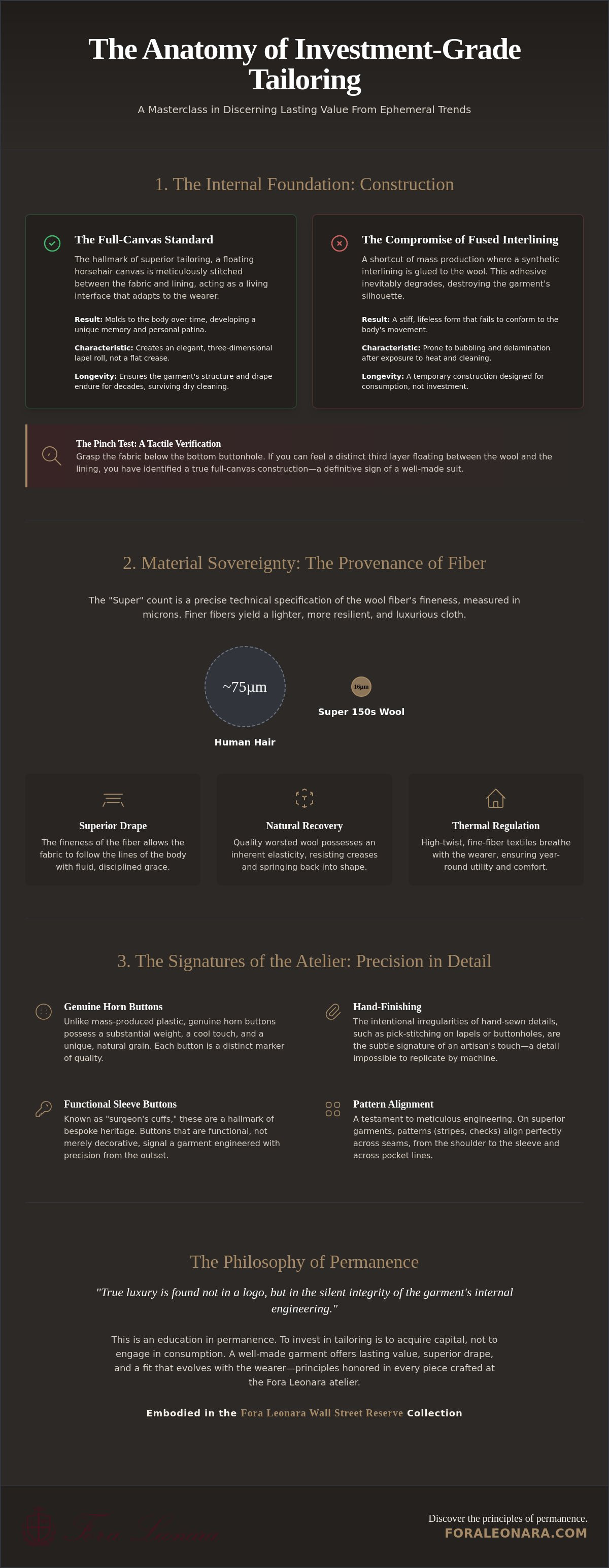
Tailoring is fundamentally an exercise in hidden engineering. While the eye is drawn to the luster of the fabric or the cut of the lapel, the true integrity of the garment resides within. The most significant of the signs of a well-made suit is its internal architecture. Most commercial garments rely on a fused construction, where a synthetic interlining is glued to the outer wool. It's efficient for mass production but detrimental to the wearer. Over time, the adhesive degrades, leading to bubbling and a stiff, lifeless silhouette that fails to respond to the body's movement. A superior garment demands more than mere utility.
The Fluidity of the Full-Canvas
Superior tailoring rejects the shortcut of glue in favor of a floating horsehair canvas. This layer, meticulously hand-stitched between the fabric and the lining, acts as a living interface. It doesn't fight the wearer; it adapts. Through a process of heat and moisture from the body, the canvas develops a unique memory, molding itself to your specific proportions over years of wear. This standard is a cornerstone of Bespoke tailoring and remains the benchmark for any garment claiming the title of luxury. Full-canvas is the structural spine that prevents the garment from becoming lifeless after dry cleaning. At the Fora Leonara atelier, this commitment to internal permanence is absolute. Every piece in the Wall Street Reserve collection employs this method to ensure the suit evolves with the man, gaining a personal patina of fit that no industrial machine can replicate.
Assessing the Drape and Roll
The external manifestation of this internal labor is the drape. A well-constructed suit hangs with a disciplined grace, neither clinging nor collapsing. You can identify this quality through the lapel roll. In a fused jacket, the lapel is pressed flat, meeting the chest with a sharp, artificial crease. In contrast, a hand-set canvas allows the lapel to curve outward in a three-dimensional arc, rolling softly toward the buttoning point. It's a subtle depth that signals technical mastery. To verify this yourself, perform the pinch test. Grasp the fabric just below the bottom buttonhole. If you can feel a distinct third layer floating between the wool and the lining, you've found one of the definitive signs of a well-made suit. It's the difference between a garment that is merely consumed and one that serves as enduring capital.
Material Sovereignty: Worsted Wool and Fiber Provenance
Material is the silent protagonist of tailoring. While construction provides the bones, the fabric provides the soul. One of the most immediate signs of a well-made suit is the tactile and visual signature of its cloth. Fora Leonara prioritizes worsted wool of exceptional provenance, specifically Super 150s, to ensure that every garment functions as a long-term investment. Identifying superior quality is often a matter of details, starting with the very fibers woven into the textile. Quality is not an accident. It's a deliberate choice of raw material.
The Science of the Super 150s
The "Super" count is frequently misunderstood as a mere marketing label. In reality, it is a precise technical specification. A Super 150s designation indicates that the wool fibers measure approximately 16 microns in diameter. For context, a human hair is roughly 75 microns. These ultra-fine fibers allow for a fabric that is exceptionally light yet remarkably resilient. High-twist worsted wool provides several advantages for the modern professional:
Superior Drape
The fineness of the fiber allows the fabric to follow the lines of the body with fluid grace.
Natural Recovery
Quality wool possesses an inherent elasticity, springing back into shape and resisting creases throughout a long day.
Thermal Regulation
These textiles breathe with the wearer, making them suitable for year-round utility.
Beyond the Label: Sourcing and Sustainability
Provenance is the ultimate luxury. Knowing where your wool was shorn and woven is as important as the tailor who cuts it. Fora Leonara sources textiles exclusively from heritage European mills that have spent centuries perfecting their craft. This commitment to origin ensures that the selvedge of the cloth carries a history of excellence and ethical stewardship. It's the foundation of our "Buy less, buy better" philosophy. When you choose a garment from the Wall Street Reserve collection, you're not just purchasing a suit. You're acquiring a piece of textile heritage. We believe that material integrity is non-negotiable. Explore the men's collection to experience the sensory difference of investment-grade worsted wool firsthand. A suit should feel as good as it looks. Anything less is a compromise.
The Precision of Detail: Hand-Finishing and Functional Hardware
The distinction between industrial production and artisanal tailoring is often found in the millimeters. While the internal canvas provides the necessary structure, the finishing details provide the character. These elements are the most tactile signs of a well-made suit, offering a sensory confirmation of the garment's pedigree. True luxury is felt in the weight of a button and seen in the slight, intentional irregularity of a stitch. It's a language of restraint. It's a refusal to compromise on the invisible.
The Authority of Horn and Silk
Plastic buttons are the hallmark of the disposable. In contrast, Fora Leonara utilizes genuine horn buttons, harvested as a natural byproduct and polished to a subtle luster. Unlike synthetic alternatives, horn possesses a unique grain and depth. It develops a rich patina over years of use, becoming smoother and more distinguished with age. Each button is secured with a thread shank, a small pillar of thread that allows the button to sit slightly above the fabric. This prevents tension on the wool and ensures the jacket fastens without pulling. The buttonholes themselves are a testament to the atelier's discipline. We use high-tensile silk thread to hand-sew each opening. This ensures the buttonhole remains resilient against the friction of daily wear while providing a refined sheen that catches the light. Functional hardware, such as surgeon's cuffs, allows for a level of utility that mass-market garments simply cannot provide. It's a subtle signal to those who understand the craft.
The Nuance of Hand-Stitching
Look closely at the lapel of a Wall Street Reserve jacket. You'll notice a faint, rhythmic indentation along the edge. This is the pick stitch. While modern machines attempt to simulate this effect, they lack the soul of the artisan's hand. Authentic hand-finishing involves a needle passing through multiple layers of fabric to keep the edges crisp and prevent the worsted wool from rolling or bubbling. These stitches are not perfectly uniform. That very imperfection is the signature of a human touch. The artisan's hand applies varying tension to every stitch, a nuance that a machine cannot replicate. This creates a garment that feels alive, responding to the wearer's movements with a fluidity that defines quality. Hand-finishing is the soul of the atelier process, transforming technical specifications into a garment with a pulse.
This level of detail isn't about vanity. It's about longevity. When every button is anchored with a shank and every seam is reinforced by hand, the suit becomes a form of durable capital. It's a commitment to the "Buy less, buy better" ethos. Fora Leonara ensures that these subtle markers of quality are present in every piece, from our structured suits to our refined knitwear. Precision is our standard. It's the foundation of a wardrobe built to last decades rather than seasons.
The Engineering of Fit: Shoulder Expression and Pattern Alignment
The shoulder is the anatomical anchor of the jacket. It serves as the "hanger" upon which the entire garment's drape depends. If the shoulder construction is flawed, the integrity of the silhouette is compromised beyond repair. One of the most sophisticated signs of a well-made suit is how the artisan manages this transition from the neck to the arm. It's a matter of technical discipline. It's where the atelier's expertise becomes visible to the discerning eye.
The Mastered Shoulder
Shoulder expression defines the garment's regional heritage and the wearer's comfort. A soft, "spalla camicia" or shirt-like shoulder is characterized by a lack of heavy padding, allowing the worsted wool to follow the natural contour of the body. This construction offers a superior range of motion. In contrast, a structured British shoulder provides a more formal, architectural line. The hallmark of quality in either style is the hand-set sleeve. Look for the "grinze," those subtle, rhythmic ripples at the sleevehead. These indicate that the sleeve was eased into a smaller armhole by hand rather than forced by an automated machine. This manual process ensures the sleeve hangs perfectly while providing the necessary volume for movement. Precision is non-negotiable. Comfort is the result of structure.
Symmetry and Pattern Discipline
Visual harmony requires a commitment to waste. Achieving perfect pattern alignment across seams is a labor-intensive process that demands more fabric and significantly more time during the cutting stage. A primary indicator of signs of a well-made suit is whether a pinstripe or check remains unbroken across the shoulder-to-sleeve transition. This discipline must extend to the pocket flaps and the center back seam. If the pattern breaks, the garment's visual flow is interrupted. Such meticulous attention to detail is a defining characteristic of the Wall Street Reserve collection. Each piece is cut with a focus on absolute symmetry, ensuring the Super 150s fibers present a unified front. It's a silent testament to the artisan's patience. It's the difference between a garment that is merely assembled and one that is engineered.
True luxury is found in the refusal to take shortcuts. When the shoulder is set by hand and the patterns align with mathematical precision, the garment transcends its material components. It becomes a form of sartorial capital. We invite you to experience the architecture of the Wall Street Reserve and discover the impact of uncompromising fit. A suit should be a sanctuary of precision. Anything less is a failure of craft.
The Philosophy of the Atelier: Investing in Capital, Not Consumption
Clothing is often treated as a fleeting commodity, yet a suit engineered with discipline serves as a form of enduring capital. The primary signs of a well-made suit are not found in the volume of its marketing but in the silence of its longevity. To the discerning professional, luxury isn't the act of spending; it's the wisdom of preservation. We reject the frantic cycle of seasonal trends in favor of garments that retain their relevance and structural integrity for decades. It's a commitment to substance. It's a refusal to participate in the waste of the modern retail machine.
The European Atelier Advantage
The provenance of a garment is the ultimate indicator of its value. Fora Leonara operates through a proprietary European factory founded by Rafael Zard, ensuring that every stitch is governed by direct oversight rather than distant outsourcing. This atelier model allows for a methodical, steady communication flow between design and execution. "Made in Europe" remains the gold standard because it represents a heritage of technical mastery and ethical production. When manufacturing is proprietary, there's no incentive to cut corners. Every full-canvas construction and hand-finished buttonhole is a deliberate act of craft. This is slow fashion in its most potent form. It's a standard that respects both the artisan and the wearer.
The Quiet Confidence of Investment Dressing
We invite you to explore the foundations of superior tailoring and the heritage of our proprietary construction at foraleonara.com. Discover a collection where every piece is an investment in the art of the possible.
Cultivating a Wardrobe of Permanent Value
Mastering the technical nuances of tailoring is a skill that pays dividends over a lifetime. You now possess the analytical tools to identify the definitive signs of a well-made suit, moving beyond surface-level aesthetics to evaluate the internal full-canvas construction and the precise provenance of Super 150s worsted wool. These markers separate the ephemeral from the enduring. True luxury requires the steady hand of a master. Under the guidance of Rafael Zard, our proprietary European atelier maintains a standard of excellence that rejects the compromises of mass production. Every hand-finished buttonhole and perfectly aligned pattern represents a commitment to the discipline of slow fashion. It's a refusal to accept anything less than perfection.
We invite you to explore the technical mastery of the Wall Street Reserve collection at Fora Leonara. By prioritizing substance over spectacle, you're building a collection of garments that offer a superior drape and a lasting patina. Your pursuit of excellence deserves a sartorial foundation that is equally uncompromising. Step into a world where quality is the only metric that matters.
Refining the Sartorial Perspective: Frequently Asked Questions
Is a more expensive suit always better made?
High retail prices are frequently a result of brand markup and advertising rather than intrinsic value. You must evaluate the technical specifications to identify the true signs of a well-made suit. A garment utilizing a fused construction with a luxury label is worth significantly less in the long term than a full-canvas piece from a disciplined atelier. Capital should be invested in construction, not logos.
What is the difference between half-canvas and full-canvas?
Full-canvas construction involves a horsehair interlining that extends from the shoulder to the hem, whereas half-canvas only covers the chest and lapel. The full-canvas approach allows the entire jacket to drape naturally and mold to your body over time. Half-canvas is a compromise. It offers structure at the chest but leaves the lower half of the jacket feeling stiff and artificial.
Why are horn buttons preferred over plastic or resin?
Genuine horn buttons are selected for their durability and natural aesthetic depth. Unlike plastic or resin, which feel hollow and look uniform, horn possesses a unique grain and weight. It develops a refined patina with age, reflecting the longevity of the garment. It's a small but significant marker of a tailor's commitment to material sovereignty.
How can I tell if a suit is hand-stitched just by looking at it?
Look for the pick stitch along the lapel and the slight, intentional irregularities of the buttonholes. Machine-made stitches are perfectly uniform and often look flat. Hand-finishing results in subtle variations in tension and spacing, giving the garment a "pulse." These imperfections are the signature of an artisan's hand and a hallmark of quality that machines cannot replicate.
Does a high Super number mean the suit will last longer?
A high Super number indicates fiber fineness, not necessarily durability. While Super 150s worsted wool offers an extraordinary drape and hand-feel, ultra-high numbers can be quite delicate and prone to wear. The goal is to find a balance where the fiber is fine enough for elegance but resilient enough for regular use. Quality is about performance, not just a number.
What should I look for in the lining of a well-made suit?
The lining should be crafted from breathable, natural fibers like Bemberg rather than synthetic polyester. A well-made suit often features a bellows pleat in the center back of the lining to allow for a greater range of motion. Check the hand-felling where the lining meets the wool. A clean, hand-sewn finish indicates that the atelier has not prioritized speed over precision.
Are surgeon’s cuffs a definitive sign of quality?
Functional surgeon's cuffs were once a definitive indicator of high-end tailoring, but they are now occasionally found on mass-produced garments. While they signal a commitment to detail, they must be viewed alongside other signs of a well-made suit, such as internal canvassing. In a quality garment, they allow for practical adjustment and reflect a tradition of artisanal utility.
Why does the provenance of the atelier matter in modern luxury?
Provenance ensures that the garment was produced under the direct oversight of a master such as Rafael Zard. A proprietary European atelier guarantees ethical labor practices and a methodical approach to slow fashion. When you know where and how a suit is made, you're investing in a legacy of craft rather than a disposable commodity. Knowledge is the ultimate luxury.
