

Price is an unreliable narrator in the narrative of modern luxury. In a trust economy where marketing often masks mediocrity, the discerning eye must look past the label to the literal architecture of the thread. You've likely experienced the frustration of an expensive garment pilling or losing its intended drape. This is the inevitable result of prioritizing aesthetic over substance. To build a wardrobe of permanence, one must understand how to spot high quality fabrics through a lens of technical precision.
This editorial guide provides the framework to distinguish between fleeting trends and true material excellence. We will explore the nuances of long-staple fibers, the significance of Super 150s worsted wool, and why weave density determines a garment's longevity. By mastering these markers, you move beyond simple consumption. You begin to curate a collection defined by provenance and the disciplined standards of the atelier. With the 2026 EU Ecodesign requirements now emphasizing product durability, the ability to identify superior textiles is no longer just a matter of taste; it's a necessary expertise for the modern professional.
Key Takeaways
• Understand the objective metrics of luxury by decoding how micron counts and Super numbers influence the sensory hand of worsted wool.
• Distinguish between marketing narratives and material reality by analyzing the structural drape and natural patina of high-density weaves.
• Refine your ability of how to spot high quality fabrics by evaluating the provenance of the weave and the disciplined standards of the European atelier.
• Adopt the philosophy of investment dressing, focusing on material permanence to build a wardrobe that functions as capital rather than mere consumption.
• Apply technical insights to curate a collection of substance, utilizing the material standards of the Wall Street Reserve as a benchmark for extraordinary wool flannel and cashmere.
The Fundamental Composition: Why Quality Begins with Fiber Origin
Quality isn't a vague sentiment. It's the disciplined intersection of raw material purity and mechanical precision. In a market saturated with ephemeral trends, the concept of material permanence serves as a necessary rebellion. It demands a return to foundational principles where substance dictates form. To achieve this, the Fora Leonara proprietary European atelier enforces rigorous standards, ensuring every thread meets the threshold of investment dressing. Mastering how to spot high quality fabrics begins with an uncompromising look at the source.
Developing a foundational understanding of textile fibers reveals that serviceability depends on the physical characteristics of the raw harvest.
Long-Staple Fibers vs. Short-Staple Compromises
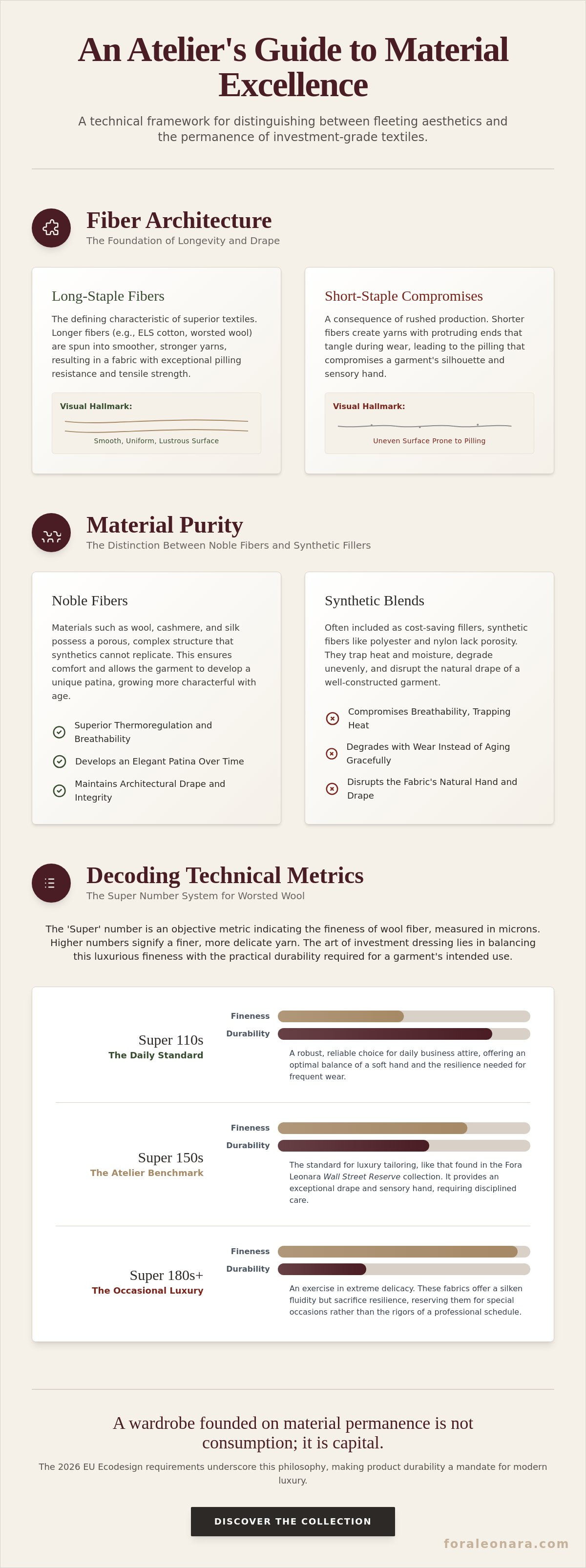
The length of a fiber determines its destiny. Extra-Long Staple (ELS) cotton and long-staple worsted wool allow for the creation of exceptionally smooth, fine yarns. Short staples are the byproduct of rushed production. They leave tiny ends poking out from the yarn's surface. These ends eventually tangle, creating the unsightly pilling that ruins a garment's silhouette. Long-staple fibers are the primary indicator of tensile strength and pilling resistance.
To verify this in the field, use the snap test. Gently pull a single thread from an inconspicuous seam. A high-quality fiber will resist breaking and possess a uniform, lustrous appearance. It's a simple act of discernment when learning how to spot high quality fabrics. This visual uniformity is a hallmark of slow fashion, where the fiber's maturity is respected over the speed of the harvest.
The Myth of the Synthetic Blend
Luxury is defined by what is absent as much as what is present. Many modern labels utilize polyester or nylon under the guise of performance or durability. In reality, these are often cost-saving fillers that compromise the garment's soul. Synthetic fibers lack the porous nature of natural materials. They trap heat and moisture, disrupting the body's thermoregulation. It's a compromise that a discerning professional should never accept.
True excellence favors pure compositions or functional, traditional blends like silk-mohair. These pairings enhance the drape and luster without sacrificing integrity. A natural fabric develops a unique patina over time, growing more characterful with age. Synthetics don't age; they merely degrade. At Fora Leonara, the focus remains on noble fibers that respect the wearer's skin. This commitment to purity ensures that a suit or dress retains its architectural integrity for decades.
Mastering the Technical Metrics: Super Numbers and Micron Counts
Technical metrics offer the only objective framework for evaluating the substance of wool and cashmere. While the sensory experience is paramount, understanding micron counts allows a professional to quantify why one fabric feels superior to another. A micron represents one-millionth of a meter. The lower the count, the finer the fiber. This fineness directly dictates the hand of the fabric, transforming raw wool into something that rivals silk in its fluidity. However, this refinement comes with a caveat. Higher numbers require more disciplined care and specific construction techniques, such as full-canvas construction, to provide the necessary internal support for the delicate cloth.
There is a distinct point of diminishing returns. While ultra-fine fibers are a marvel of the modern atelier, they often sacrifice the resilience required for daily wear. A professional must balance aesthetic vanity with the principles of investment dressing. When considering the ethical and sustainable aspects of different fabrics, longevity remains the ultimate metric of value. A garment that fails after a dozen wears is never a sustainable choice, regardless of its fiber origin. Identifying the balance between fineness and durability is a core skill when learning how to spot high quality fabrics.
Decoding the Super 150s and Beyond
The Super grading system, established by the International Wool Textile Organisation, measures the diameter of the wool fibers. A Super 110s wool is a robust choice for daily business suits, offering a balance of softness and durability. In contrast, a Super 180s is an exercise in extreme delicacy, reserved for occasional wear rather than the rigors of travel. A Super rating only measures the fineness of the fiber, not the density of the weave or the inherent strength of the staple. For those learning how to spot high quality fabrics, the number on the label is only the beginning of the investigation. It requires a deeper look at the mechanical integrity of the yarn itself.
Worsted Wool and the Discipline of the Weave
The worsted process is an exercise in exclusion. It involves combing the wool to remove short fibers and align the long ones, resulting in a yarn that is crisp, smooth, and remarkably strong. This differs from woolen yarns, which are carded to retain shorter fibers for the fuzzy, insulating texture found in traditional flannels. To assess the integrity of the weave, hold the cloth against a steady light source. Look for a consistent, tight grid. Any irregularities or gaps suggest a lack of discipline at the loom. Fora Leonara utilizes these technical benchmarks to ensure every piece in our men's tailoring collection meets the standard of material permanence.
True luxury is found in the harmony between technical specifications and artisanal execution. Explore our full range of garments to see how these metrics translate into exceptional drape and longevity.
The Sensory Audit: Assessing Hand, Drape, and Patina
The sensory audit is the final arbiter of excellence. While technical labels provide the data, your fingertips provide the truth. Hand refers to the tactile personality of a textile. It ranges from the dry, crisp snap of a high-twist worsted wool to the oily, decadent softness of rare cashmere. Drape is equally critical. It is the architectural way a fabric falls and responds to the body's movement. A superior cloth possesses a weight that feels intentional, never flimsy. This is a vital skill when mastering how to spot high quality fabrics.
Natural fibers are living materials. They evolve. High-quality wools and silks develop a unique patina over years of wear, gaining a subtle depth that synthetic substitutes cannot replicate. Be wary of a fabric that feels unnaturally smooth or slippery at a lower price point. Mass-market manufacturers often apply chemical silicone finishes to mimic the hand of premium fibers. These coatings disappear after the first dry cleaning, revealing a brittle, inferior base. True quality is intrinsic, not applied.
Scientific research into objective measurements for fabric quality confirms that mechanical properties like shear and bending rigidity define how a garment holds its shape. These metrics explain why a well-constructed jacket maintains its silhouette while a lesser garment collapses.
The Weight of Substance: Understanding GSM and Ply
Grams per Square Meter (GSM) dictates the seasonal utility and structural presence of a garment. A higher GSM in a winter flannel ensures the trousers retain their crease. In shirting and knitwear, the ply of the yarn is the true marker of substance. 2-ply or 3-ply yarns involve twisting multiple strands together before weaving. This process increases tensile strength and prevents the garment from losing its form. When assessing a piece, gently squeeze the fabric. It should spring back instantly. This elasticity indicates the use of long-staple fibers with high natural crimp.
Detecting the Natural Lustre of Silk and Mohair
Lustre is not shine. Real silk possesses a deep, oily glow that seems to emanate from within the fiber. Rayon and polyester exhibit a harsh, metallic shine that reflects light superficially. Mohair, often utilized in the Fora Leonara Wall Street Reserve for its resilience, offers a crisp lustre that remains vibrant even in humid conditions. This visual depth is often supported by the use of natural dyes in a traditional atelier. These pigments saturate the fiber more thoroughly than synthetic alternatives, ensuring the color develops a rich character. Understanding these visual cues is essential for anyone refining their knowledge of how to spot high quality fabrics.
Provenance and the Ethics of the European Atelier
The provenance of a textile is not merely a matter of geography; it's a testament to the discipline of the weave. While the raw fiber provides the foundation, the manner in which it's spun and finished determines its ultimate character. In the pursuit of how to spot high quality fabrics, one must recognize that the origin of the weave is as critical as the origin of the fiber itself. High-speed mass production often stresses these delicate materials. It forces fibers through high-tension looms at speeds that strip away their natural elasticity. This mechanical trauma leads to a fabric that feels brittle and lacks the resilient drape of a superior cloth.
A commitment to heritage is central to the Fora Leonara story. Our proprietary factory operates with a reverence for traditional speeds. We understand that time is a necessary ingredient in the creation of substance. Every roll of fabric is a result of meticulous process, ensuring that the final piece functions as long-term capital for the wearer. When you prioritize provenance, you aren't just buying a garment. You're investing in the technical mastery of an atelier that refuses to compromise.
Why Geographical Origin Dictates Material Excellence
Geographical origin dictates material excellence through environmental nuances that cannot be replicated in a laboratory. The soft water of the Italian Alps is legendary for its role in finishing fine woolens. It allows the fibers to open and absorb dyes with a depth that harder water cannot achieve. Similarly, the specific humidity of traditional French silk regions ensures the threads retain their necessary moisture during the weaving process. This local craftsmanship is the invisible hand behind the longevity of the final garment. These regions have spent centuries refining their relationship with the material, creating a standard of excellence that defines the old money aesthetic.
Identifying Selvedge and Traditional Loom Integrity
Selvedge represents the finished edge of quality weaving. It's an indicator that the cloth was produced on a traditional shuttle loom rather than a modern air-jet loom. These older machines move with a deliberate, rhythmic pace. This slow-speed weaving preserves the integrity of the yarn, allowing for a more irregular, soulful texture. It also enhances the breathability of the finished cloth. Air-jet looms may be efficient, but they produce a sterile uniformity that lacks the "spring back" essential for a superior drape. Identifying these subtle markers is a key component of how to spot high quality fabrics in a market saturated with industrial shortcuts.
To experience the difference that authentic European craftsmanship makes, we invite you to invest in garments of true provenance.
Investment Dressing: Curating a Wardrobe of Extraordinary Fabrics
Fabric discernment is the ultimate tool for the quiet luxury practitioner. It's the silent language of the elite, allowing the wearer to bypass the noise of branding in favor of intrinsic value. Understanding how to spot high quality fabrics transforms the act of shopping into a strategic acquisition of capital. When you prioritize the architecture of the material, you build a wardrobe that doesn't just last; it matures. This is the essence of investment dressing. It's a refusal to participate in the cycle of disposable fashion, opting instead for a permanent aesthetic grounded in substance.
Before committing to a new piece, perform an immediate tactile assessment. A superior garment reveals its soul through a series of sensory markers. Use this checklist to verify the integrity of the cloth:
The Resilience Test
Squeeze the fabric firmly. High-quality natural fibers should spring back without deep creasing.
The Density Check
Hold the material to the light to ensure a tight, consistent weave without irregular gaps.
The Surface Audit
Look for the absence of pilling or loose fiber ends, which indicates long-staple yarn.
The Drape Observation
Observe how the fabric falls. It should move with a fluid, architectural weight.
The Mastery of Flannel and Cashmere
The Wall Street Reserve collection serves as a definitive case study in material selection. The dark navy wool flannel utilized in this collection is prized for its specific density and soft, matte finish. It offers a subtle texture that communicates authority without the need for logos. Similarly, our cashmere shirts represent the pinnacle of transitional material science. They provide exceptional thermoregulation and a hand that grows softer with every wear. These pieces embody the old money aesthetic, where the quality of the worsted wool and the precision of the atelier speak for themselves. This is how to spot high quality fabrics in their most refined form.
Building Longevity through Material Discipline
Material excellence requires a commitment to discipline. To maintain the integrity of noble fibers, one must allow garments to rest. Natural materials need at least twenty-four hours between wears to shed moisture and recover their natural shape. This rotation is essential for preventing premature wear. Furthermore, the longevity of these fabrics is supported by the internal skeleton of the garment. Fora Leonara utilizes full-canvas construction to ensure the cloth is never stressed, allowing the natural drape to remain uncompromised over decades. You can learn more about these standards on our official site.
Adopting a "Buy less, buy better" philosophy is a lifestyle choice that rejects the frantic energy of modern retail. A garment should be a vessel for heritage and personal capital. It's a reflection of intentionality and a respect for the meticulous process of the atelier. By choosing substance over spectacle, you ensure that your wardrobe remains a testament to quiet excellence and uncompromising taste.
Refine your collection with the technical mastery of Fora Leonara at foraleonara.com.
Cultivating a Legacy of Material Substance
Mastery over your wardrobe begins with the realization that every thread is a choice. You've learned that the distinction between fleeting consumption and permanent capital lies in the technical nuances of the weave. By understanding how to spot high quality fabrics, you move beyond the surface level of marketing to the foundational truth of the garment. It's about the marriage of long-staple fibers and the disciplined pace of a traditional loom. This knowledge acts as your filter, ensuring only the most essential pieces enter your collection.
At Fora Leonara, we source our textiles from the world’s most prestigious mills, ensuring every piece reflects a commitment to excellence. Our proprietary European atelier utilizes full-canvas construction to honor the natural integrity of these noble materials. This isn't merely clothing; it's a curated investment in craft. Your journey toward a more intentional wardrobe is a return to foundational principles that prioritize substance over spectacle. Experience the extraordinary materiality of the Fora Leonara collections.
Frequently Asked Questions
What exactly does the Super number on a suit label indicate?
The Super number indicates the fineness of the wool fibers used in the weave, specifically measuring the fiber's diameter in microns. While a higher number signifies a finer thread, it doesn't account for the density of the weave or the length of the staple. True quality requires a balance between this fineness and the structural integrity provided by a full-canvas construction. It's a technical benchmark for worsted wool refinement.
How can I tell the difference between 100% silk and a synthetic imitation?
Authentic silk possesses a deep, multidimensional lustre that reflects light with an oily glow. Synthetic imitations, such as polyester or rayon, exhibit a harsh, metallic shine that feels cold to the touch. You'll also notice that real silk warms quickly against the skin, whereas synthetics retain a synthetic chill. Learning how to spot high quality fabrics involves recognizing this organic warmth and visual depth.
Is a heavier fabric always indicative of higher quality?
Weight is a measure of seasonal purpose, not a definitive indicator of excellence. A high Grams per Square Meter (GSM) count is appropriate for winter flannels, but it can hide inferior, short-staple fibers. Conversely, a lightweight Super 150s worsted wool can be technically superior to a heavy, coarse woolen blend. Quality is found in the purity of the fiber and the precision of the atelier, regardless of the cloth's heft.
What is the "burn test" and is it reliable for identifying fibers?
The burn test is a traditional method for identifying fiber content by observing how a thread reacts to flame. Natural fibers like wool and silk smell like burning hair and crumble into a fine ash. Synthetics melt into a hard, plastic bead and emit a chemical odor. While it's a reliable technical indicator, it's a destructive process that's often impractical when evaluating a finished garment in a retail environment.
Why do some high-quality wools still pill over time?
Pilling occurs when friction causes fiber ends to tangle into small spheres. While long-staple fibers significantly reduce this risk, ultra-fine wools and cashmeres are naturally delicate. Even the most prestigious weaves can experience minor pilling in high-friction areas. This is often a result of the fiber's softness rather than a lack of quality. Regular maintenance with a specialized comb ensures the garment's patina remains pristine.
How does the ply of a yarn affect the longevity of a shirt?
The ply of a yarn refers to the number of strands twisted together to create a single thread. 2-ply or 3-ply yarns provide significantly more structural integrity than single-ply alternatives. This prevents the fabric from warping or thinning over time, especially in shirts and knitwear. It's a core component of investment dressing, ensuring the garment retains its intended silhouette through years of professional wear.
What should I look for on a fabric label to ensure it is sustainably sourced?
To ensure a fabric is sustainably sourced, look for verified certifications such as GOTS or OEKO-TEX Standard 100 on the label. The 2026 EU Textile Labeling Regulation has also introduced updated rules to support digital transparency. These labels provide a clear window into the provenance of the material and the chemicals used during production. It's an essential step for those researching how to spot high quality fabrics with an ethical conscience.
Can you spot high-quality fabric without touching it?
One can often identify superior textiles through visual cues alone. Look for the way the fabric responds to gravity; a high-quality drape is fluid and intentional. Observe the lustre of the surface, as natural fibers reflect light with a subtle, organic depth. A disciplined weave will also appear perfectly consistent even under close inspection. These visual markers are the hallmarks of a garment produced in a master atelier.
