

A high price tag is often a poor proxy for permanence. Many discerning professionals have felt the quiet frustration of a garment losing its form or pilling after minimal wear; it's a betrayal of the promise of quality. You likely understand that price does not always equate to durability. True value lies in identifying investment grade fabrics through the technical nuances of the weave and the provenance of the fiber.
This guide establishes a rigorous framework for evaluating textile quality, teaching you to distinguish between mere surface softness and the structural integrity required for a generational wardrobe. By mastering these principles, you'll gain the confidence to calculate the long-term value of every piece you acquire. It's about shifting the perspective from temporary consumption to the strategic accumulation of clothing capital.
We will explore the essential metrics of textile longevity, from the resilience of high-micron fibers to the disciplined construction of worsted wool. You'll learn how the proprietary atelier utilizes materials like Super 150s to create silhouettes that maintain their drape for decades. We'll also examine specific examples from the Wall Street Reserve collection to illustrate how superior materiality serves as the foundation of the modern professional's aesthetic legacy.
Key Takeaways
• Distinguish between seasonal consumption and capital-based dressing by identifying textiles engineered to retain their original form, color, and drape over decades.
• Identify the technical markers of fiber resilience, such as the natural elasticity found in high-micron worsted wool and the superior durability of heavy-weight silk.
• Analyze how weave architecture and internal construction influence a garment's resistance to abrasion and its structural movement on the body.
• Apply a quantitative cost-per-wear formula to evaluate investment grade fabrics as a tangible financial asset rather than a fleeting expense.
• Understand how direct oversight within a proprietary European atelier eliminates the quality inconsistencies common in outsourced luxury manufacturing.
The Philosophy of Material Permanence: Beyond the Surface
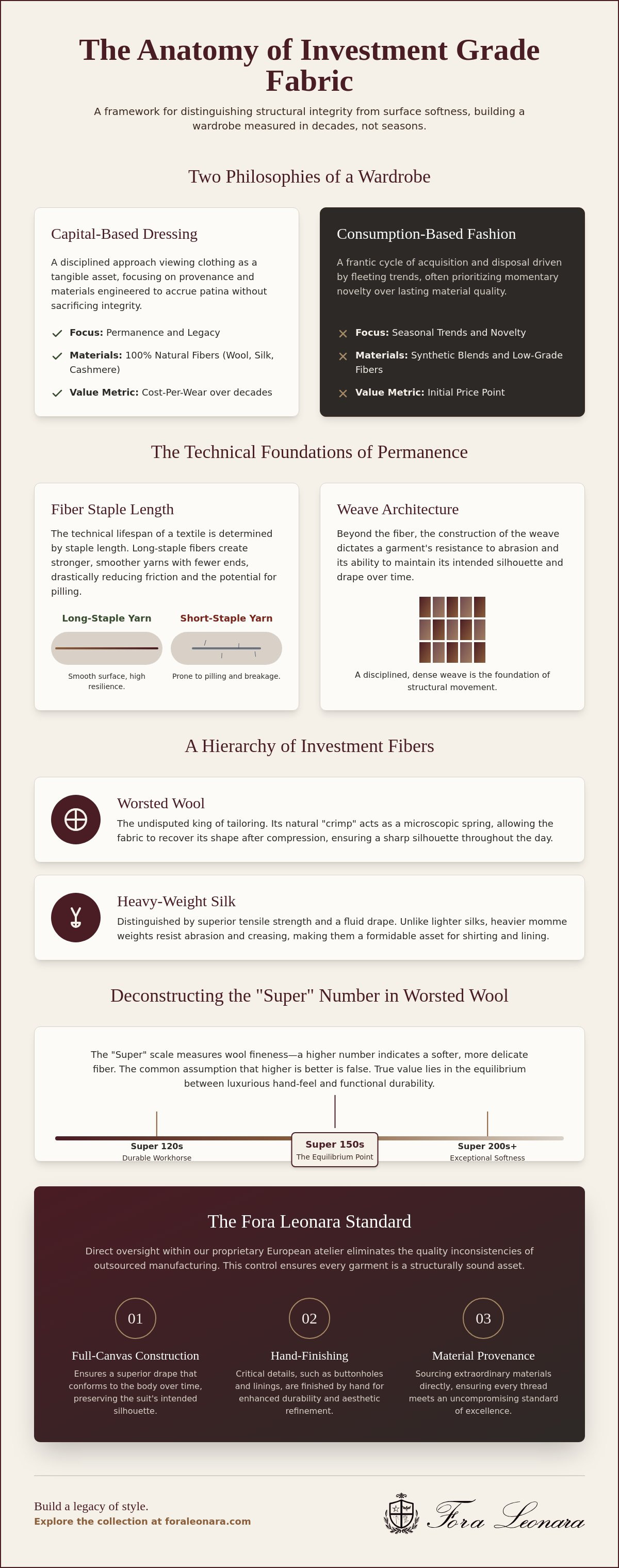
True luxury is measured in decades, not seasons. Within the context of a refined wardrobe, investment grade fabrics are defined by their capacity to retain original form, saturated color, and fluid drape long after the initial purchase. This isn't a matter of aesthetic preference; it's a matter of structural engineering. While the modern market often conflates price with quality, the discerning collector understands that a garment is only as permanent as the fibers from which it's woven. At Fora Leonara, we view clothing as capital. It's a tangible asset that should accrue a certain patina over time without sacrificing its foundational integrity.
The distinction between consumption-based fashion and capital-based dressing lies in the intention of the wearer. Consumption is frantic; it's a cycle of acquisition and disposal driven by fleeting trends. Capital dressing is disciplined. It requires a deep understanding of provenance and a commitment to materials that survive the rigors of daily life. This philosophy begins with a baseline requirement: 100% natural fibers. Synthetic blends may offer temporary convenience, but they lack the breathability, resilience, and restorative properties of high-register wools and silks. Understanding the evolution of textile production methods is essential for any collector who wishes to move beyond surface-level aesthetics toward true material mastery.
The Buy Less, Buy Better Mandate
Adopting a slow fashion perspective is both a financial strategy and an environmental necessity. It requires a psychological shift from the dopamine hit of trend-chasing to the quiet satisfaction of curating a permanent uniform. This transition reduces the noise of the modern world, allowing the quality of the subject matter to speak for itself. Investment dressing is the deliberate rejection of planned obsolescence. By focusing on pieces like those found in our Wall Street Reserve collection, such as dark navy wool flannel or cashmere shirts, the professional builds a legacy of style that remains immune to the whims of the calendar.
The Role of Fiber Staple Length
The technical lifespan of a textile is largely determined by staple length. Long-staple fibers, such as those found in premium worsted wool or Giza cotton, possess fewer ends per inch of yarn. This reduces the friction that leads to pilling and breakage. It's a simple equation of physics. When these long fibers are spun into high-micron yarns, like a Super 150s, the resulting fabric gains a remarkable degree of structural resilience. The fiber dictates the life of the garment. It's that simple. By sourcing extraordinary materials through our proprietary European atelier, Rafael Zard ensures that every thread meets a standard of uncompromising excellence, providing the strength required for full-canvas construction and hand-finished details.
The Hierarchy of Natural Fibers: Selecting for Longevity
Longevity in a garment begins at the microscopic level. It's found in the inherent resilience of the fiber itself. While mass-market retail prioritizes surface-level softness, investment grade fabrics are selected for their structural integrity. Worsted wool remains the undisputed king of tailoring, primarily due to "crimp." This natural, three-dimensional waviness in the wool fiber acts as a microscopic spring, allowing the fabric to recover its shape after being stretched or compressed. It's the foundation of a garment that looks as sharp at the end of a long day as it did in the morning.
Worsted Wool and the Super Number Myth
The "Super" scale, ranging from 100s to 200s, measures the fineness of the wool fiber. A common misconception suggests that a higher number always denotes a better garment. This is false. While a Super 200s is exceptionally soft, it's often too delicate for regular wear. For the discerning professional, Super 150s represent the ideal equilibrium. This grade offers the exquisite drape and luster of luxury while maintaining the tensile strength required for daily life. At the Fora Leonara atelier, we prioritize this balance, ensuring our suits and trousers retain a crisp silhouette through years of movement.
Beyond wool, the weight of the weave dictates the lifespan of the piece. Consider these specific markers of fiber longevity:
Worsted Wool
High crimp count for natural elasticity and recovery.
Heavy-Weight Silk
40mm (momme) weight or higher to prevent seam slippage and fraying.
High-GSM Linen
Dense, heavy weaves that provide structural rigidity and long-term abrasion resistance.
Camel Hair
Exceptional thermal properties combined with high structural density to prevent stretching.
Heavy-weight silk provides a substantiality that lighter alternatives lack. It resists the fraying that plagues standard silk garments. Similarly, high-GSM linen debunks the myth of fragility. When woven with high density, linen becomes one of the most durable textiles in existence, developing a beautiful patina rather than breaking down over time. You can explore our full range of masterfully constructed pieces in our curated collection.
The Resilience of Protein Fibers
Protein-based fibers like wool and silk possess a remarkable ability to self-repair. Their natural moisture-wicking properties prevent the accumulation of oils and perspiration that degrade fibers over time. These materials naturally shed wrinkles when hung correctly; it's a testament to their biological engineering. We source our materials from European mills that emphasize fiber health and animal welfare, ensuring the raw capital of our garments is of the highest possible register. When these fibers are sourced with integrity and finished by hand, they transition from seasonal purchases to generational investments.
Weave Architecture and Internal Construction
The architectural integrity of a garment is fundamentally defined by its weave. While fiber provenance establishes the baseline, the specific interlacing of threads dictates how investment grade fabrics respond to the stresses of daily wear. A plain weave, though breathable, often lacks the density required for true longevity. Twill weaves, defined by their characteristic diagonal ribbing, offer a depth and density that plain weaves cannot match. This structure provides superior abrasion resistance and a visual depth that masks the minor imperfections of age, allowing a garment to develop a dignified patina.
Drape is the physical manifestation of weave architecture. It's the way a fabric's weight influences its movement and its ability to return to a neutral state after the body has moved. Heavier fabrics, often those with a higher gram weight per square meter (GSM), possess a natural gravity that prevents the permanent creasing common in lighter, lower-quality textiles. This gravitational pull ensures the garment maintains its intended silhouette. The presence of a clean selvedge finishing on high-end trousers isn't merely a stylistic choice; it's a marker of edge durability that prevents the internal fraying typical of mass-produced apparel.
The Full-Canvas Distinction
True permanence is achieved through the interplay between the exterior textile and the internal structural elements. Full-canvas construction utilizes a floating interlining of horsehair and wool that sits between the outer fabric and the lining. This internal scaffolding allows the garment to mold to the wearer's body over time without losing its original shape. Unlike fused alternatives that rely on adhesives, a floating canvas prevents the outer fabric from stretching or distorting. For a deeper technical analysis of these methods, we invite you to read our feature on How a Suit Is Made: Understanding Quality and Construction.
Twill, Gabardine, and Serge: The Durable Weaves
Gabardine has a storied history in high-end outerwear and tailoring, prized for its tightly woven, steep-angled twill that naturally repels water and resists tearing. It's a foundational choice for any serious collection. The diagonal rib of a twill weave is more than an aesthetic detail. It creates a surface that hides wear and resists stains far better than flat, plain alternatives. When evaluating investment grade fabrics for the 2026 professional, the choice of weave must align with the intended environment and frequency of use.
| Weave Type | Durability | Breathability | Formality |
|---|---|---|---|
| Twill / Serge | High | Moderate | High |
| Plain / Poplin | Moderate | High | Moderate |
| Gabardine | Very High | Low | High |
Technical mastery is the hallmark of the Fora Leonara atelier. By selecting weaves that prioritize density and internal structural integrity, we ensure that every piece transitions from a seasonal purchase to a generational asset. The focus remains on substance. The quality of the construction is allowed to speak for itself through the quiet confidence of a perfect drape.
The Cost-Per-Wear Formula: A Quantitative Guide to Value
The true value of a garment is rarely found on the price tag. For the discerning professional, clothing is an investment of capital, and its worth is calculated through the cost-per-wear formula. This objective framework allows one to look past the initial expenditure to the long-term utility of the piece. The formula is straightforward: combine the initial price with the projected cost of maintenance, then divide that sum by the estimated number of wears. Maintenance includes the necessary professional care and occasional hand-finished repairs that preserve the integrity of investment grade fabrics over time. It's a shift from consumption to curation.
A mass-market suit, often constructed with fused interlinings and short-staple fibers, may only survive ten wears before losing its shape or showing signs of degradation. Conversely, a suit from the Fora Leonara atelier, featuring full-canvas construction and premium worsted wool, is engineered for two hundred wears or more. As these high-register materials age, they develop a unique patina. This subtle evolution in texture and character increases both the aesthetic and psychological value of the garment. It's a quality entirely absent in synthetic alternatives. Quality improves with age; it doesn't just endure.
Step-by-Step: Calculating Your Wardrobe Capital
Step 1: Audit the material composition.
Avoid synthetics and low-grade blends that lack the resilience of natural fibers.
Step 2: Evaluate the construction.
Inspect the garment for markers of quality such as genuine horn buttons and meticulous hand-finishing.
Step 3: Estimate the life span.
Base your projection on technical metrics like weave density and the staple length of the fibers.
Step 4: Execute the math.
Determine the true price of the garment over its entire lifecycle to confirm its status as an asset.
The Aesthetic Longevity of Quiet Luxury
The discipline of restraint is essential for maximizing the wear cycle. Minimalist designs that eschew logos and fleeting trends possess an inherent timelessness, ensuring they remain relevant across decades. This approach is central to the Fora Leonara philosophy of material permanence. By choosing pieces that prioritize substance over spectacle, you ensure that every acquisition serves as a foundational element of your aesthetic legacy. Choosing better means buying less. It's a principle that naturally lowers the cost-per-wear of your collection while maintaining an uncompromising standard of dress. You may begin building your legacy by exploring our investment-grade wardrobe essentials.
The Fora Leonara Standard: Atelier-Grown Excellence
The integrity of a garment is inextricably linked to its origin. For Rafael Zard, the founder of Fora Leonara, the path to material permanence required more than just sourcing; it demanded a return to the foundational principles of the atelier. By establishing a proprietary factory in Bulgaria, the brand reclaimed the manufacturing process from the quality lottery of global outsourcing. This direct oversight ensures that every roll of investment grade fabrics is cut and sewn under the watchful eye of master craftspeople who understand the technical nuances of full-canvas construction and hand-finishing. It's a rejection of the fragmented supply chain in favor of a singular, uncompromising standard.
Ownership of the production cycle allows for a level of precision that is typically reserved for bespoke tailoring. It's here that the technical potential of Super 150s worsted wool and heavy-weight silks is fully realized. Every horn button is secured with a deliberate hand-stitch; every selvedge edge is finished to prevent the degradation that plagues mass-market apparel. This isn't just manufacturing. It's the stewardship of a legacy. By maintaining control over the entire process, we ensure that the provenance of our garments is as clear as the quality of the finished piece.
The Wall Street Reserve: Engineered for the Professional
The Wall Street Reserve collection serves as a definitive study in this philosophy. Utilizing dark navy wool flannel and exceptionally dense cashmere, these pieces are designed for the professional who views clothing as a long-term asset. The inclusion of suede elbow-patch jackets and refined cashmere shirts demonstrates a mastery of texture and utility. These aren't merely garments; they're instruments of discipline. By merging the convenience of ready-to-wear with the structural integrity of bespoke-level quality, the collection offers a seamless transition into a permanent wardrobe. The drape of the flannel and the resilience of the wool ensure that each piece maintains its sharp silhouette through years of intensive use.
A Philosophical Close on Quality
True luxury is found in the quiet confidence of a garment that survives the noise of the modern world. It's a commitment to the essential and the permanent. When you choose pieces constructed from investment grade fabrics, you're making a statement about your values and your vision for the future. Style shouldn't be a fleeting pursuit but a grounded, intentional practice. The patina of a well-worn, high-quality coat tells a story of substance and refined taste. We invite you to discover the art of investment dressing and explore the technical mastery of our atelier at foraleonara.com.
The Future of Your Aesthetic Capital
Mastering the technical nuances of textiles is the final step in transitioning from a consumer to a curator. You've seen that durability isn't a matter of ruggedness but of fiber resilience and weave density. Identifying investment grade fabrics requires looking past the label to the provenance of the mill and the integrity of the construction. It's a commitment to substance over spectacle.
The Fora Leonara standard is built on this transparency. By utilizing full-canvas construction and sourcing materials from world-renowned mills, our proprietary European atelier ensures that every piece remains a permanent asset. It's a return to foundational principles where the quality of the subject matter is allowed to speak for itself. True value is realized over decades of wear rather than in the fleeting moment of acquisition. Precision is our ultimate durability feature.
Your wardrobe should be a reflection of your discipline and your taste. It's an investment in your legacy. Discover the art of investment dressing and begin building a collection that reflects a commitment to quiet excellence and enduring sophistication. Build for permanence.
Frequently Asked Questions
Is 100% cotton more durable than a polyester blend for professional shirts?
100% long-staple cotton is the only choice for a serious professional. Synthetic blends lack the breathability and structural memory of natural fibers; they often develop a permanent sheen or trap odors that degrade the textile. A high-register cotton shirt develops a soft patina over time. It retains its crispness through countless launderings while maintaining its structural integrity.
What is the most durable fabric for a high-end professional suit?
A heavy-weight worsted wool in a gabardine or serge weave offers the greatest resistance to the rigors of travel and daily wear. These investment grade fabrics utilize a dense interlacing of yarns that protects against abrasion. The natural crimp of the wool provides a built-in elasticity. This prevents the permanent bagging and distortion found in lesser materials over years of use.
Does a higher Super number in wool mean the suit will last longer?
A higher Super number indicates finer fibers, but it doesn't translate to increased longevity. In fact, Super 180s or 200s are often too delicate for anything beyond occasional wear. For a garment intended to last decades, a Super 150s provides the perfect equilibrium between an exquisite hand-feel and the tensile strength required for a full-canvas construction.
How does full-canvas construction affect the lifespan of a luxury jacket?
Full-canvas construction acts as the internal scaffolding of a jacket, significantly increasing its lifespan. Unlike fused jackets that use adhesives that eventually bubble and delaminate, a floating canvas of horsehair allows the outer fabric to breathe and move. It ensures the jacket molds to your form. This prevents the structural distortion that leads to the premature disposal of the garment.
Are luxury fabrics like silk and cashmere too delicate for regular wear?
Luxury fibers are not inherently fragile if they possess sufficient density and weight. A 40mm heavy-weight silk or a high-GSM cashmere knit is engineered for resilience. These materials require a disciplined rotation to allow the fibers to rest and recover. When sourced from world-renowned mills, they offer a level of durability that far exceeds mass-market alternatives.
What role does the weave type play in fabric durability?
The weave architecture dictates how a fabric manages tension and friction. Twill weaves, characterized by their diagonal ribs, are naturally more durable and stain-resistant than plain weaves. This density provides a structural depth that maintains the garment's drape. It ensures the piece remains a permanent asset in your collection rather than a seasonal purchase.
How can I tell if a garment is made from high-quality long-staple fibers?
Identifying long-staple fibers requires an eye for luster and surface clarity. High-quality yarns have fewer exposed ends, which results in a smooth, pill-resistant surface. You can often feel the difference in the snap of the fabric. It should return to its original shape immediately after being bunched in the hand, showing its superior resilience.
Why is European atelier construction considered superior for longevity?
European atelier construction is synonymous with longevity because it prioritizes meticulous process over volume. At the Fora Leonara facility in Bulgaria, hand-finishing and direct oversight eliminate the inconsistencies of mass production. This bespoke-level attention ensures that details like horn buttons and selvedge edges are executed with a precision that guarantees a lifetime of regular wear.
