

Why does a four-figure price tag so often yield a garment that loses its soul after a single season? The modern market is saturated with labels that prioritize the volume of their marketing over the quiet discipline of the atelier. You've likely felt the frustration of an expensive acquisition that failed to endure, realizing that the distinction between price vs value in clothing has been intentionally obscured. It's a common struggle to separate genuine craftsmanship from the frantic energy of retail hype.
This exploration provides a rigorous framework for the discerning professional who views a wardrobe as capital rather than consumption. You'll master the cost per wear formula and learn to identify the technical markers of excellence, from the structural integrity of full-canvas construction to the refined drape of Super 150s worsted wool. We'll examine how to invest with intention, drawing from the standards of the Wall Street Reserve collection, ensuring every piece you acquire gains a storied patina rather than losing its shape. The result is a mastery of investment dressing that rejects wasteful patterns in favor of permanent, grounded quality.
Key Takeaways
• Discern the distinction between price vs value in clothing by viewing garments as capital investments rather than transient transactions.
• Identify superior materiality through technical markers like Super 150s worsted wool and hand-finishing. Quality begins with the fiber.
• Apply a sophisticated Cost Per Wear framework that includes the maintenance multiplier. Calculate the true lifecycle cost of an acquisition.
• Recognize the structural superiority of full-canvas construction and horn buttons. These details ensure a garment gains character over time.
• Evaluate the provenance of the atelier to ensure every piece possesses a refined drape. Heritage remains the ultimate benchmark.
The Fallacy of the Label: Distinguishing Price from Value
Price is a static figure on a tag. It represents a momentary exchange of currency for cloth. Value, by contrast, is the amortized cost of excellence over time. In the current economic climate, where market volatility remains a constant, the discerning professional views their wardrobe as capital rather than consumption. Understanding the nuance of price vs value in clothing requires a departure from the frantic energy of retail hype. It demands a return to the discipline of the atelier. At Fora Leonara, we recognize that true luxury is found in the quiet details that many overlook.
The "Quiet Luxury" perspective posits that the absence of a visible logo actually increases a garment's intrinsic value. When a brand removes the spectacle of branding, the quality of the subject matter must speak for itself. It forces a focus on the technical mastery of the construction. Investment dressing serves as a deliberate reaction against the noise of disposable retail. It's an intentional choice to prioritize substance over fleeting trends. This is the foundation of wardrobe capital in 2026. It's a collection of pieces that offer a permanent sense of grounded authority.
The Transaction vs. The Investment
A high-quality suit often proves significantly "cheaper" than a low-cost alternative when measured over a decade of wear. The difference lies in the architecture. A garment featuring full-canvas construction and hand-finishing will adapt to the wearer's body, gaining a refined character with every season. The inexpensive counterpart, typically relying on fused interlinings, will lose its silhouette after a few cycles of dry cleaning. This is the core of the old money aesthetic. It's not about the initial spend. It's about the commitment to longevity. This philosophy is deeply rooted in the Slow Fashion Movement, which prioritizes meticulous process over rapid production cycles. The shift from consumption to curation requires a disciplined eye.
The Hidden Costs of Inexpensive Apparel
Sacrifices in provenance are the invisible price of low-cost production. Beyond the immediate lack of durability, there is a significant environmental and ethical toll associated with the cycle of replacement. Poor construction mandates frequent repurchasing, creating a pattern of wasteful consumption that the modern connoisseur rejects. Rafael Zard founded our house on the principle that true luxury requires a transparent lineage from the raw fiber to the final stitch. Value is the precise intersection of durability, drape, and timelessness. Whether you are examining the dark navy wool flannel of our Wall Street Reserve collection or our hand-finished knitwear, the evidence of quality should be palpable. Real value doesn't shout. It endures.
Discover the uncompromising standards of our proprietary EU atelier at foraleonara.com.
The Anatomy of Value: Materiality and Provenance
Materiality is the primary ledger of quality. It's the difference between a garment that merely exists and one that lives. When evaluating price vs value in clothing, the fiber is the first point of truth. Standard wool often lacks the resilience and luster of high-grade worsted wool. It feels brittle and lacks life. Worsted fibers are meticulously combed to remove short staples, leaving only the long, strong strands that create a smooth, durable finish. This process ensures the fabric maintains its integrity over years of wear.
High-register textiles like Super 150s provide a liquidity of movement and a refined drape that lesser fabrics cannot replicate. This isn't merely aesthetic; it's functional. The Super number denotes the fineness of the wool. Super 150s means the fibers are approximately 16.25 microns in diameter, making them incredibly fine yet surprisingly resilient. Current data on consumer spending on apparel suggests a pivot toward these higher-quality acquisitions. Professionals are increasingly seeking to exit the cycle of disposable fashion in favor of substance.
Provenance remains the ultimate guarantor of precision. Our proprietary EU factory operates as a modern atelier, where every seam is a testament to heritage. Rafael Zard founded Fora Leonara on the belief that a garment's life is defined by the hands that shaped it. Hand-finishing at the armholes and lapels ensures a flexibility that machine-stitched alternatives lack. It's a commitment to the craft that rejects the frantic pace of mass production, focusing instead on the disciplined pursuit of excellence.
The Superiority of Natural Fibers
Natural fibers possess a biological intelligence. Cashmere and high-twist wools breathe and adapt to the environment. Beyond the textile, consider the secondary markers of uncompromising standards:
• Genuine horn buttons that offer unique tonal variations and durability.
• Silk linings that facilitate a seamless drape against the body.
• Selvedge edges that signify a slower, more intentional weaving process on traditional looms.
These elements don't just justify the price. They create a garment that develops a storied patina over decades, becoming more personal with every wear.Full-Canvas vs. Fused Construction
The soul of a suit is its internal architecture. Fused garments rely on heat-activated glue to bond the outer fabric to the lining. It's a shortcut. This method inevitably leads to "bubbling" after dry cleaning, a terminal condition for any jacket. The garment becomes stiff and loses its ability to move with the wearer. It's a failure of construction that renders the initial "savings" irrelevant.
True value resides in full-canvas construction. A floating horsehair canvas is hand-stitched between the layers, allowing the garment to mold to your frame over time. It becomes an extension of the wearer, improving with age. For a granular look at this process, examine our guide on the Architecture of a Suit. Mastering these technical nuances is the only way to truly understand price vs value in clothing. Explore the technical mastery within our Wall Street Reserve collection, where dark navy wool flannel meets the meticulous standards of our atelier.
Calculating Your Wardrobe Capital: The Cost Per Wear Formula
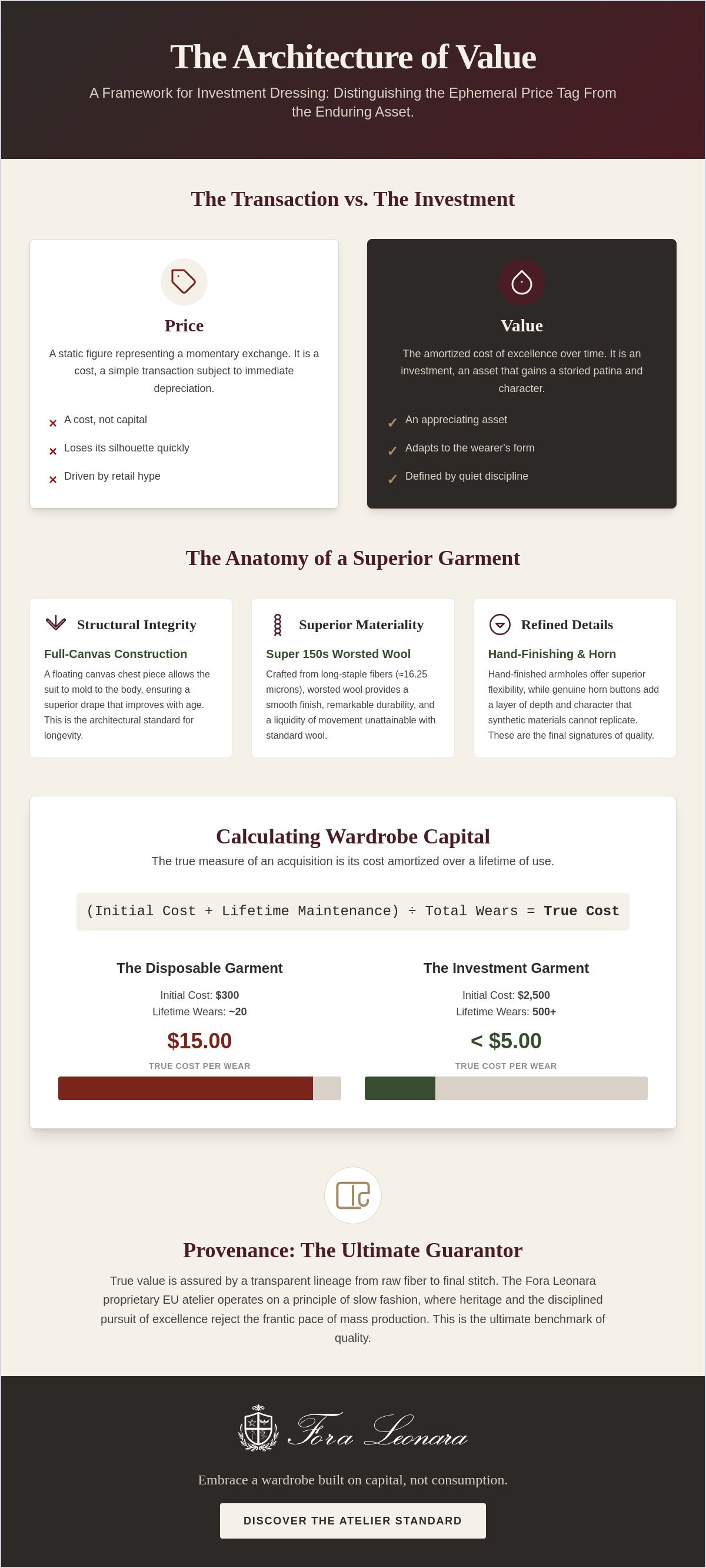
Precision in acquisition requires more than intuition; it demands a rigorous mathematical framework. To truly master the balance of price vs value in clothing, the discerning professional must adopt the Cost Per Wear (CPW) framework. This is the sophisticated metric used by the modern connoisseur to justify the initial capital outlay for superior garments. It transforms a purchase from a transient expense into a long-term asset. With clothing prices in the U.S. rising 4.2% as of April 2026, the necessity of a disciplined value assessment has never been more acute. Random consumption is no longer sustainable.
A common error in standard fashion commentary is the omission of the "Maintenance Multiplier." A garment's true value isn't just its sticker price divided by wears. It must account for the preservation of its structural integrity. A suit featuring full-canvas construction requires specialized pressing to maintain its sculpted drape, while Super 150s worsted wool demands gentle, intentional care. These costs aren't burdens; they're investments in the garment's ten-year horizon. When you factor in the rising costs of materials due to geopolitical shifts, the math of the minimalist becomes undeniable. Buying better is the only way to insulate oneself from the volatility of the primary fashion market.
The Advanced CPW Formula
The calculation of wardrobe capital follows a logical, three-step progression that accounts for the total lifecycle of the piece:
Step 1: The Initial Capital.
This is the acquisition cost, reflecting the provenance and materiality of the item.
Step 2: The Maintenance Multiplier.
Factor in the cost of professional hand-finishing, seasonal storage, and minor tailoring to ensure the piece evolves with you.
Step 3: The Lifecycle Dividend.
Divide the total by the estimated number of wears over a decade.
A curated capsule wardrobe of twenty high-value pieces yields a far lower CPW than a rotating collection of fifty mediocre items. This is the discipline of restraint. It's the rejection of the loud for the permanent.
Applying the Formula to Luxury Essentials
Consider the ROI of foundational pieces like trousers and Bermudas. A mass-market pair may seem economical at the point of sale, yet it lacks the selvedge detail or horn buttons that signify durability. At Fora Leonara, our shirts are engineered for the legacy factor. These aren't just garments; they're pieces that retain their shape and patina for the next generation. A shirt from our Wall Street Reserve collection, crafted from dark navy wool flannel or fine cashmere, maintains its stature long after a fused alternative has disintegrated. This is the calculus of quality. It's a commitment to a wardrobe that gains character rather than losing its form. Explore our full range of investment-grade apparel at foraleonara.com.
Beyond the Spreadsheet: The Intangible Assets of Quality
Quantitative metrics provide a necessary foundation, yet they fail to capture the entire narrative of excellence. The most profound markers of quality are often felt rather than calculated. The drape of a jacket is a silent communicator of authority. It speaks to the precision of the atelier without uttering a word. This is where the true distinction of price vs value in clothing becomes a sensory experience. A garment that moves with liquidity and grace conveys a level of quiet confidence that no spreadsheet can quantify. It's a mastery of form that transcends the transaction.
For items like our small leather goods, value is a long-term trajectory. A mass-market hide will inevitably crack and degrade, revealing its lack of substance. A high-grade, full-grain leather performs differently. It records the history of the wearer, developing a rich patina that only time and use can bestow. This evolution is detailed in our exploration of Quiet Luxury Leather Goods. Restraint becomes an aesthetic choice here. The power resides in the silhouette, not a logo. It's a rejection of the loud for the permanent.
The Mastery of the Silhouette
Hand-finishing creates a garment that feels alive. It breathes with the body. The Wall Street Reserve aesthetic is built on this discipline. It prioritizes dark navy wool flannel and suede elbow-patch jackets that offer a permanent sense of grounded authority. These pieces aren't designed to shout for attention. They're designed to endure. When the architecture of the garment is sound, the silhouette remains sharp for decades. This is the hallmark of the Fora Leonara atelier.
The Confidence of Quality
Choosing to buy less and buy better is the ultimate sustainable fashion statement. It's a rejection of the frantic cycle of disposal that characterizes the modern market. The sensory quality of selvedge edges and horn buttons provides a tactile reassurance of the garment's provenance. Whether you're wearing a Celestial Glow Jumpsuit or a cashmere shirt, the feeling of superior materiality is undeniable. It's a commitment to a wardrobe that gains character rather than losing its shape. To begin your journey toward a more intentional wardrobe, explore our curated investment pieces.
The Atelier Standard: Fora Leonara’s Commitment to Longevity
Rafael Zard established Fora Leonara with a singular intention. He sought to bridge the gap between the heritage of the European atelier and the pragmatic demands of the global professional. This vision is realized within our proprietary EU factory. Here, precision is not a metric; it is a discipline. Every garment undergoes a rigorous process where hand-finishing meets technical mastery. When one evaluates price vs value in clothing, the distinction is found in these silent hours of labor. A machine can replicate a stitch. It cannot replicate the soul of a garment shaped by hand. Our facility allows us to bypass the compromises of third-party wholesale, ensuring that every piece meets an uncompromising standard of excellence.
The Wall Street Reserve collection serves as a study in this commitment. It utilizes dark navy wool flannel and cashmere shirts to create a uniform that defies the seasonality of the modern market. These pieces are engineered for longevity. They are the physical manifestation of investment dressing. By maintaining control over the entire production cycle, we ensure that every suit possesses the structural integrity of full-canvas construction. This is the only way to guarantee a drape that remains impeccable over a ten-year horizon. It's a rejection of the loud for the permanent.
The Fora Leonara Philosophy
Our philosophy is grounded in the principle of slow fashion. We reject the frantic pursuit of trends in favor of a voice that sounds timeless and authoritative. Owning our manufacturing facility is what allows for the consistent use of Super 150s worsted wool and genuine horn buttons. We don't answer to shareholders demanding rapid growth; we answer to the standards of the craft. You can learn more about Our Story and our commitment to a more intentional way of dressing. We believe that substance should always precede spectacle.
Curating Your Collection
Transitioning from consumption to investment begins with foundational pieces. The essential white shirt and the navy suit are the cornerstones of wardrobe capital. These items should be selected with a focus on materiality and provenance. For the executive seeking a refined daily uniform, exploring the Wall Street Reserve collection offers a path toward a wardrobe that gains character over time. Consider the texture of suede elbow-patch jackets or the refined feel of selvedge trousers. These details are the markers of a life well-lived.
The garment is ultimately a vessel for the person wearing it. True value is not found in the transaction, but in the legacy of the pieces you choose to keep. It's a commitment to a life of discipline and refined taste. When you choose quality, you're not just buying a garment; you're securing a permanent asset. Discover the full collection of investment-grade apparel at foraleonara.com.
Securing Your Wardrobe Capital
The pursuit of an intentional wardrobe is a commitment to substance over spectacle. You've seen that the true measure of a garment resides in its architecture, from the resilience of full-canvas construction to the refined drape of Super 150s worsted wool. These aren't merely aesthetic choices. They're the markers of an asset that appreciates in character with every wear. Mastering the nuance of price vs value in clothing allows you to move beyond the noise of the primary market and toward a legacy of quiet authority.
Rafael Zard founded Fora Leonara to offer a sanctuary for the discerning professional. By maintaining our own proprietary EU atelier and focusing exclusively on natural fibers, we ensure every piece reflects the discipline of slow fashion. It's a return to foundational principles where the quality of the subject matter is allowed to speak for itself. You're now equipped with the mathematical and qualitative framework to curate a wardrobe that endures.
Invest in the Wall Street Reserve Collection and begin your transition from consumption to true investment dressing. Quality is the only permanent choice.
Frequently Asked Questions
What is the "cost per wear" formula for clothing?
The cost per wear formula is a sophisticated metric that divides the total investment, including the maintenance multiplier, by the estimated number of times a garment is worn. This calculation provides a rigorous framework for understanding the true price vs value in clothing over a ten-year horizon. It shifts the focus from the momentary transaction to the long-term dividend of quality and structural integrity.
Is a higher price tag always a guarantee of better value?
A premium price tag doesn't inherently guarantee superior value. In many instances, the cost reflects significant marketing budgets and logo placement rather than the technical mastery of the atelier. Discerning professionals focus on intrinsic markers like materiality, provenance, and construction. True value is found when the price is a direct reflection of superior fibers and hand-finished details.
How can I identify high-quality construction in a store?
High-quality construction is identified through a tactile inspection of the garment's internal architecture and finishing. Look for hand-finishing at the buttonholes and lapels, genuine horn buttons, and the presence of a floating canvas between the layers of fabric. A well-constructed piece will exhibit a refined drape and a sense of structural integrity that mass-produced, fused alternatives simply cannot replicate.
What materials offer the best value for money in luxury menswear?
Natural fibers such as Super 150s worsted wool and ethically sourced cashmere offer the most significant value for the modern connoisseur. These textiles possess a biological intelligence, offering breathability and a resilience that synthetic blends lack. Over decades of use, these materials develop a rich patina and maintain their shape, ensuring your wardrobe capital remains secure and your silhouette stays sharp.
Does "quiet luxury" actually have a better cost per wear than trend-based fashion?
Quiet luxury inherently possesses a superior cost per wear because it prioritizes permanent silhouettes over the frantic energy of seasonal trends. Pieces like the Celestial Glow Jumpsuit or dark navy wool flannel trousers are designed to endure both physically and aesthetically. This disciplined approach to acquisition ensures that each garment remains a staple of your uniform for decades, amortizing the initial capital more effectively.
How does full-canvas construction affect the long-term value of a suit?
Full-canvas construction significantly enhances long-term value by allowing the garment to mold to the wearer's frame over time. Unlike fused alternatives that degrade and "bubble" after dry cleaning, a floating horsehair canvas maintains the suit's drape for years. It's a commitment to construction that ensures the garment gains character and a personalized fit rather than losing its original shape.
Can tailoring and maintenance actually lower the cost per wear of a garment?
Proactive maintenance and precise tailoring lower the cost per wear by extending the garment's functional lifespan and aesthetic relevance. Investing in specialized cleaning and minor repairs preserves the integrity of the Super 150s wool and hand-finished seams. This discipline prevents the need for frequent replacements, ultimately reducing the total expenditure on your wardrobe capital while maintaining a sharp appearance.
Why should I prioritize European atelier production over mass-market luxury?
European atelier production ensures a level of precision and provenance that mass-market luxury often overlooks in favor of rapid scale. At Fora Leonara, our proprietary facility allows for uncompromising standards in every stitch, from selvedge details to the application of horn buttons. This commitment to slow fashion results in a garment that reflects the hand-finished mastery of an artisan rather than a factory line.
