

The most expensive garment in your wardrobe is the one that fails to survive its third season. You've likely felt the sting of a luxury knit pilling before the first frost or watched a structured jacket lose its silhouette to the heat of a single dry cleaning. Identifying good quality clothing brands in 2026 requires looking past the label to the technical architecture beneath—a principle exemplified by the craftsmanship of Gente Fina. It's a matter of discerning capital from consumption. The modern connoisseur understands that a high-register wardrobe isn't built on trends, but on the disciplined application of material science and craft.
This editorial framework provides the tools to audit a garment's integrity in seconds. At Fora Leonara, we believe that true value is found in the invisible architecture of the piece, specifically the provenance of its fiber and the discipline of the atelier. We'll explore the markers of true investment-grade apparel, from the structural necessity of full-canvas construction to the sensory weight of genuine horn buttons. You'll gain an understanding of the material excellence found in our European production, where Super 150s worsted wool and meticulous hand-finishing define a permanent wardrobe. It's a return to foundational principles. Quality speaks for itself.
Key Takeaways
• Discern the technical superiority of natural protein fibers and understand the structural significance of Super 150s worsted wool.
• Identify good quality clothing brands through an audit of the internal architecture, prioritizing full-canvas construction to ensure a permanent silhouette.
• Evaluate the provenance of a garment by assessing the role of the proprietary EU atelier in preserving traditional hand-finishing techniques.
• Execute a physical quality assessment using the cross-stitched horn button test and a disciplined analysis of seam tension.
• Explore the application of these standards within the Wall Street Reserve collection, specifically the material integrity of dark navy wool flannel and refined cashmere.
Beyond the Label: Why Materiality Dictates Quality
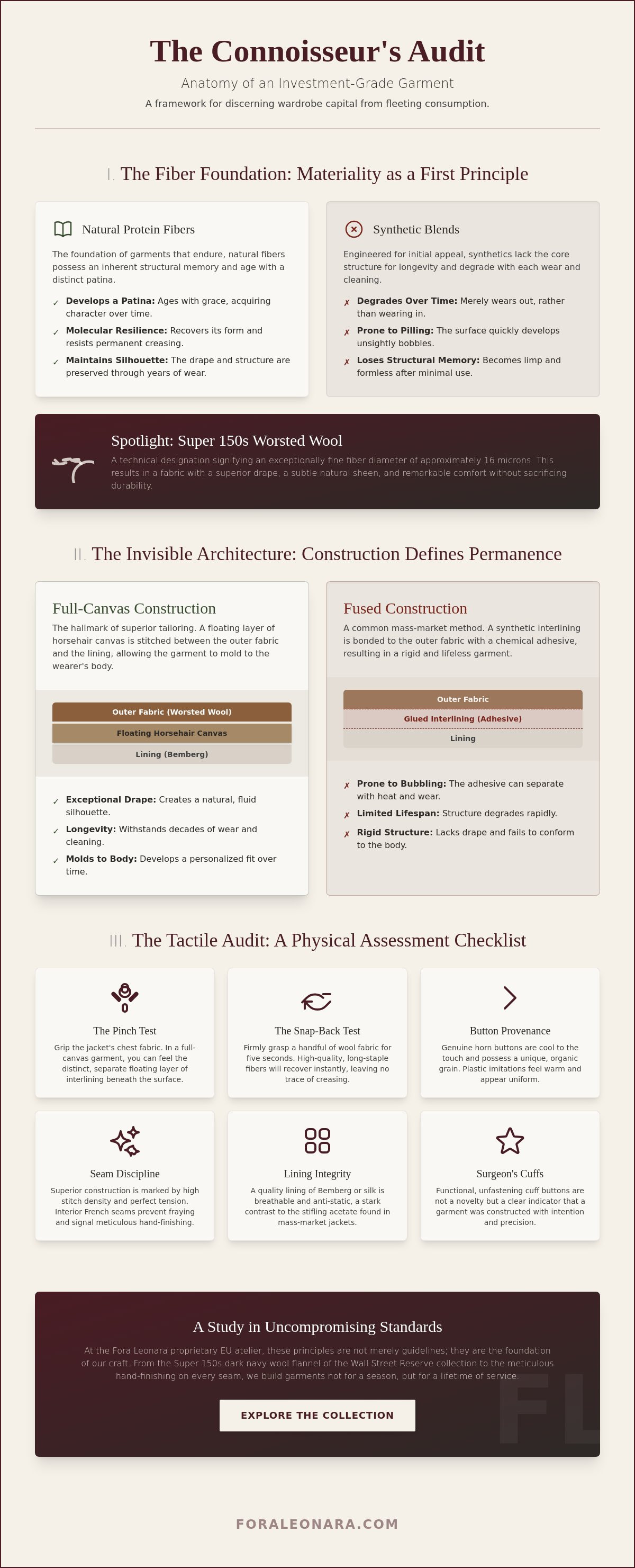
The label on the nape is rarely an honest narrator. True excellence resides in the raw fiber, long before it meets a needle or a pattern. Discerning good quality clothing brands requires a technical vocabulary that prioritizes materiality over marketing. Natural protein fibers, such as wool and silk, possess a molecular resilience that synthetic blends lack. While polyester additives might mimic a soft hand-feel initially, they lack the structural memory required to maintain a silhouette over time. A foundational step in understanding textile quality is recognizing that natural fibers age with a distinct patina, whereas synthetics merely degrade. They pill. They lose their luster. They become landfill.
In the hierarchy of worsted wool, the "Super" count is a precise measure of fiber fineness. A Super 150s designation signifies a fiber diameter of approximately 16 microns. It's remarkably fine. This creates a fabric with an exceptional drape and a subtle, natural sheen. However, the modern connoisseur knows that weight is a deceptive metric. A heavy fabric isn't inherently warmer or more durable than a finely woven high-micron wool. It's the density of the weave and the length of the staple that define longevity. Long-staple cotton, for instance, offers a smoothness and tensile strength that short-staple alternatives cannot match. It doesn't fray. It feels substantial yet breathable against the skin.
The Science of High-Register Textiles
The distinction between combed and carded yarns is vital for investment-grade knitwear. Combed yarns have had shorter, weaker fibers removed, leaving only the long, resilient strands. This process ensures a garment that retains its shape and resists pilling after years of wear. European mills, particularly those in Italy and England, maintain these rigorous standards through centuries of inherited expertise. At the Fora Leonara atelier, this commitment to provenance is non-negotiable. We source only from mills that respect the discipline of the craft.
Sensory Markers of Fabric Integrity
Perform a snap-back test. Grip a handful of the fabric firmly for five seconds and release it. High-quality wool should recover its form instantly without lingering creases. Inspect the hardware. Genuine horn buttons are cool to the touch and possess a unique, organic grain that plastic imitations lack. Finally, examine the lining. A Bemberg or silk lining is breathable and anti-static, providing a stark contrast to the stifling, opalescent acetate found in mass-market "luxury" jackets. It's about sensory precision. Excellence is quiet. It doesn't need to shout.
The Invisible Framework: Decoding Construction and Tailoring
The skeletal structure of a garment defines its lifespan. While the fiber provides the sensory experience, the internal architecture provides the permanence. Identifying good quality clothing brands requires a tactile investigation into what lies beneath the surface. Most mass-market tailoring relies on "fusing," which is a chemical adhesive used to bond the outer fabric to a synthetic interlining. It's rigid. It's prone to bubbling after a few trips to the dry cleaner. Conversely, investment-grade tailoring employs full-canvas construction. This involves a floating layer of horsehair and wool stitched between the fabric and lining. It allows the garment to mold to the wearer’s body over time. It creates a natural drape that a glued garment can never replicate.
The discipline of the seam is equally telling. Superior construction is marked by high stitch density and precise thread tension. A master tailor understands that a seam must be strong enough to hold, yet flexible enough to move with the wearer. Examine the interior of a jacket or a pair of trousers. Cleanliness here is paramount. French seams and piped edges are not merely aesthetic choices; they prevent fraying and indicate a level of care that machine-automation rarely achieves. This level of hand-finishing ensures that the garment remains a staple of your wardrobe rather than a fleeting acquisition.
The Anatomy of a Superior Suit
Perform the pinch test on the chest of a jacket. By gripping the fabric between the buttonholes, you can feel the separate floating layer of the canvas. This is the hallmark of a garment that will age with grace. Functional surgeon’s cuffs, buttons that actually unfasten, are another marker of quality. They signal a garment that has been constructed with intention. In the Fora Leonara atelier, we prioritize this horsehair interlining to ensure our suits maintain their silhouette through decades of wear. You can observe this structural integrity within our men's tailoring collection, where every piece is built to endure.
Precision in the Details
True mastery is found in the alignment of the grain. In a well-constructed garment, patterns like stripes or checks match perfectly at the shoulder seam and lapel. This is a deliberate, often wasteful process that requires more fabric, but it's essential for visual harmony. Hand-sewn buttonholes provide the final flourish. Unlike machine-stitched versions, they are finished with a silk thread that develops a subtle patina and remains steadfast against friction. These silent markers of craftsmanship are what define true capital in a wardrobe.
Provenance and the Private Atelier: Where Clothing is Born
Identifying good quality clothing brands requires a fundamental shift in perspective, often leading discerning shoppers to curated multi-brand boutiques like Rags Fashion that specialize in high-caliber Scandinavian and European labels. It's not about the retail facade, but the origin of the stitch. When a brand owns its factory, the relationship between design and execution becomes seamless. Proprietary manufacturing in the EU isn't a mere marketing claim. It's a logistical necessity for those who refuse to compromise on the discipline of the atelier. Outsourcing often dilutes standards as garments pass through various third-party hands. Ownership preserves them. It ensures that the technical mastery envisioned at the drafting table is exactly what arrives in the wearer's hands.
Bulgaria possesses a storied heritage in textile production that is often overlooked. It's a region where technical mastery is a generational inheritance, blending traditional craft with modern precision. By situating our production within this landscape, Rafael Zard ensured that every garment benefits from a slow fashion philosophy. This isn't high-output manufacturing designed for rapid turnover. It's a deliberate, methodical process where quality control isn't a final checklist, but a foundational principle present at every stage of the build.
The European Manufacturing Standard
The legacy of European-made luxury suits is rooted in the floating canvas and the hand-finished lapel. In a closed-loop system, the designer and the artisan exist in a constant dialogue. This proximity allows for the refinement of the drape and the precision of the selvedge in real-time. "Made in the EU" remains a hallmark of excellence because it represents a commitment to both technical precision and the ethical standards that define the modern industry. Precision is non-negotiable. It's the difference between a garment that lasts a season and one that lasts a lifetime.
The Fallacy of the Logo
A high-register brand is often defined by what it omits. Overt branding is a distraction from material integrity. The quiet luxury ethos of Fora Leonara rejects the spectacle of the logo in favor of the sensory weight of the garment. Whether it's the organic grain of a horn button or the provenance of a skin, the value is intrinsic. For those seeking depth in leathercraft, The Architecture of the Hide provides a rigorous look at how provenance dictates the final patina. True capital in a wardrobe is silent. It doesn't need to shout its name to prove its worth. Quality is felt, not read.
The Investment Dressing Checklist: Assessing Longevity
The physical garment holds the truth that marketing copy often obscures. When evaluating good quality clothing brands, one must move beyond the visual and engage in a rigorous physical audit. Longevity isn't a vague promise; it's a technical result. Start with the hardware. Genuine horn buttons are cool to the touch and should be secured with a cross-stitch. This provides a level of permanence that parallel stitching lacks. A brand that provides spare buttons and matching thread acknowledges that its garments are intended for decades of service, not a single season. This audit is the practical application of the "Buy less, buy better" philosophy.
Next, perform a seam stress test. Gently pull the fabric at the shoulder or side seam. If the threads become visible, a phenomenon known as "grinning," the tension is insufficient for long-term wear. A superior garment remains steadfast under tension. The lining audit is equally revealing. A jacket should be fully lined with breathable natural fibers like Bemberg or silk. These materials facilitate air circulation and prevent the static cling associated with synthetic alternatives. Finally, observe the weight of the hem. A well-constructed hem has an intentionality in its drape, ensuring the garment hangs with a refined authority rather than a flimsy silhouette.
In the Fitting Room: A 60-Second Audit
Observe the lapel. Within the Fora Leonara atelier, we ensure every suit featuring full-canvas construction possesses a soft, elegant roll that curves toward the chest. A fused garment will show a sharp, flat fold. This curve is a marker of the hand-finishing occurring within the construction process. Check for bar tacks at points of high stress, such as the corners of pockets. These small, dense lines of stitching are essential for preventing tears. If you see threads pulling apart under minimal pressure, the garment lacks the structural integrity required for investment dressing.
Evaluating the Silhouette
A garment must retain its form both on the hanger and the body. The "pitch" of the sleeve, which is the angle at which it is set into the shoulder, should follow the natural curve of the arm without bunching. Similarly, the "break" of the trouser should feel deliberate, reflecting the precision of the cut. For those seeking a deeper understanding of these technical nuances, our guide on how a suit is made offers an exhaustive look at the discipline of the master tailor. Observe the Celestial Glow Jumpsuit; its silhouette is maintained by the intrinsic quality of the fabric rather than temporary stiffeners. True quality is an accumulation of these small, disciplined choices. Explore our full range of investment-grade apparel to see these standards in practice.
Fora Leonara: A Case Study in Uncompromising Standards
The Wall Street Reserve collection serves as a rigorous study in material restraint. It prioritizes the tactile resonance of dark navy wool flannel and the weightless warmth of high-register cashmere. This isn't a collection built on the ephemeral. It's built on the permanent. By maintaining a proprietary factory in the EU, Rafael Zard has bridged the gap between the drafting table and the final stitch. Most good quality clothing brands struggle with the dilution of quality that comes with outsourcing. Ownership eliminates this risk. It allows for a level of technical precision that defines true investment-grade apparel. The result is a wardrobe that functions as capital rather than consumption.
This collection represents the zenith of high quality minimalist clothing. Every garment is an exercise in discipline. There are no logos to hide behind. There's only the drape of the fabric and the integrity of the construction. It's a return to the foundational principle of "Buy less, buy better," where a single, perfectly executed jacket holds more value than a dozen mass-market alternatives. For those who appreciate this level of quality across a variety of labels, you can visit 78+ Designers. The focus is on the intrinsic value of the piece, ensuring that the silhouette remains steadfast through years of wear. It's a silent authority that doesn't need to shout.
The Architecture of the Collection
The material mastery of the atelier is evident in pieces like the Dune Veil Dress and the Celestial Glow Jumpsuit. These items don't rely on structural gimmicks. They rely on the intrinsic properties of the fiber and the precision of the cut. Similarly, every Fora Leonara shirt features hand-finishing that ensures a superior fit and longevity. The horn buttons are cross-stitched. The seams are clean. The focus remains on silhouettes that reject the frantic energy of the trend cycle. This is clothing designed to age with the wearer, developing a patina of use that only enhances its character over time.
The Future of Quiet Luxury
True style requires a long-term perspective. It invites you to view your wardrobe as a collection of assets. The dignity of a well-made garment is felt in the way it moves and the way it lasts. It's a quiet confidence that doesn't require validation from a brand name. As the industry moves toward mandated transparency, the value of the private atelier and the discipline of the artisan will only increase. We invite you to explore our latest collections and experience the technical mastery of Fora Leonara firsthand. It's a commitment to excellence that begins with a single thread and ends with a permanent place in your life.
The Architecture of a Permanent Wardrobe
Identifying good quality clothing brands requires a fundamental shift in perspective. It's a move away from the ephemeral and toward the structural. You've learned to audit the invisible framework of a garment, from the resilience of full-canvas construction to the sensory precision of genuine horn buttons. True value isn't found in a logo. It's found in the provenance of the fiber and the discipline of the atelier. A high-register wardrobe is built on technical discernment rather than the frantic pursuit of the new.
Rafael Zard’s Red Dot level design philosophy ensures that every silhouette is rooted in material excellence. By utilizing extraordinary fabrics like Super 150s worsted wool and maintaining a proprietary EU factory, we ensure that the technical mastery of the atelier is never diluted. Your clothing should age with a grace that reflects its origin. Discover the discipline of the Fora Leonara atelier. Invest in the permanent. It's a decision that rewards the discerning eye for decades to come.
Frequently Asked Questions
How can I tell if a clothing brand is actually high quality?
True quality is revealed through a physical audit of the garment’s internal architecture and material provenance. Look for technical markers such as hand-finished seams, functional surgeon's cuffs, and the presence of natural fibers like Super 150s worsted wool. A brand’s commitment to owning its production facility often signals a higher standard of quality control compared to those that outsource to third-party factories. Integrity is found in the details that remain invisible to the casual observer.
Is expensive clothing always better quality?
Price often reflects a marketing budget rather than material excellence. Many labels command a premium for the logo alone, whereas good quality clothing brands justify their cost through the technical mastery of the atelier and the sourcing of long-staple fibers. You must look past the price tag to evaluate the construction. A suit featuring full-canvas construction and genuine horn buttons represents a better investment than a fused designer alternative with a higher retail price.
What are the best fabrics for long-lasting clothes?
Natural protein and cellulose fibers offer the greatest longevity and structural resilience. High-micron worsted wool, cashmere, and long-staple cotton possess a molecular memory that allows them to retain their shape and develop a refined patina over time. These materials facilitate air circulation and resist the structural degradation common in synthetic blends. Investing in these fibers ensures your wardrobe remains a collection of capital rather than a cycle of consumption.
What is the difference between full-canvas and half-canvas construction?
Full-canvas construction employs a floating interlining of horsehair and wool that runs the entire length of the jacket front, allowing the garment to mold to the wearer’s body. Half-canvas only features this structure in the chest and lapel, relying on adhesive fusing for the lower sections. While half-canvas is superior to fully fused garments, only a full-canvas build ensures the permanent drape and lifespan required for a truly investment-grade suit.
How do I identify a good quality shirt for men?
Examine the stitch density and the material of the buttons. A superior shirt features high-count stitching, typically exceeding 18 stitches per inch, and genuine mother-of-pearl or horn buttons. Look for a split-yoke construction on the back to facilitate movement and ensure the pattern matches perfectly at the seams. These markers indicate a disciplined production process where the artisan has prioritized technical precision over manufacturing speed.
Why should I choose European-made clothing over mass-market brands?
European production, particularly within proprietary EU ateliers, represents a commitment to centuries of artisanal heritage and rigorous technical standards. This geographical provenance ensures that garments are constructed by specialists who understand nuances like hand-finishing and selvedge edges. Choosing European-made pieces is an endorsement of slow fashion, prioritizing the ethical and technical precision that mass-market brands often sacrifice for high-output volume.
Can I find high-quality clothing without visible logos?
The philosophy of quiet luxury is defined by the total absence of overt branding. Discerning good quality clothing brands rely on the sensory weight of the fabric and the precision of the silhouette to communicate value. In the Fora Leonara atelier, we believe the integrity of the construction should speak for itself. A perfectly cut suit or a cashmere shirt needs no external validation; its quality is felt by the wearer and recognized by the connoisseur.
How do I care for investment-grade garments to ensure they last?
Longevity is maintained through disciplined care and appropriate storage. Use wide cedar hangers to preserve the shoulder structure of tailored jackets and avoid frequent dry cleaning, which can strip natural oils from wool and cashmere. Allow garments to rest for at least twenty-four hours between wears to let the fibers recover. This simple practice ensures the technical mastery of the original construction remains intact for decades of service.
