

The best all-purpose canvas tote bag is a mid- to heavy-weight canvas (10 to 18 oz) with a flat or boxed bottom and reinforced, stitched handles. That construction suits daily shoppers, commuters carrying a laptop, and any organization ordering in bulk for branded giveaways. The checklist below tells you exactly what to check on a product page before you buy one or a thousand.
TL;DR:
- A durable tote should have a mid- to heavy-weight canvas of 10 to 18 oz with reinforced stitching at the handle anchors for longevity.
- A flat or boxed bottom is essential for weight distribution, reducing tearing and making loading easier, especially on larger or heavy-duty totes.
- For daily use, prioritize a tote with about 8 inches of handle drop length, a reinforced handle attachment, and features like a zip closure or pocket if commuting.
- Bulk orders require sample approval, clear minimum order quantities, and matching decoration method with canvas weight to avoid costly mistakes.
- Proper maintenance involves cold machine washing for untreated canvas and spot cleaning for waxed canvas, with repairs prioritized over replacement for small damages.
Table of Contents
- What to Check on a Canvas Tote Bag Product Page
- How Canvas Weight and Construction Affect Durability
- Which Tote Size Fits Your Use Case
- Planning a Custom or Wholesale Canvas Tote Order
- How to Wash and Maintain a Canvas Tote
- Which Brands and Manufacturers Make Reliable Canvas Totes
- Environmental Impact and Sustainability Certifications to Check
- Delivery Times and Shipping for Bulk and Custom Tote Orders
- Cost Breakdown: Customization Fees, Shipping, and Taxes
- Return Policies and Warranties on Canvas Totes
- A Refined Canvas Tote From Fora Leonara
- Sources
- FAQ
What to Check on a Canvas Tote Bag Product Page
Most listings bury the details that actually predict how long a bag lasts. Before adding to cart or requesting a wholesale quote, scan for these five things.
- Canvas weight in ounces: lighter fabric (8 to 10 oz) folds flat and packs into a purse; heavier fabric (14 to 18 oz or more) resists sagging under groceries or books.
- Bottom construction: a gusseted or boxed base keeps the bag standing upright, which testing from Serious Eats found reduces tipping and makes loading groceries far easier.
- Handle drop length: measure from the top seam to the handle’s highest point. Roughly 8 inches (about 20 cm) is the minimum for comfortable shoulder carry, based on the same testing.
- Stitching at the handle anchor: look for cross-stitching or a bartack, not a single straight seam, since that anchor point is where cheap totes fail first.
- Closures and pockets: a zip top or magnetic snap matters for commuting and travel; grocery-only totes rarely need either.
Retail pricing for a well-made single tote typically varies depending on canvas weight and finishing. Bulk orders for organizations usually price per unit and drop sharply past a few hundred pieces, though decoration method affects that math more than the blank bag does.
Pro Tip: Pinch the fabric near the handle seam. If you can feel daylight through it or the weave looks thin, that’s a lightweight promotional-grade canvas, not a bag built for daily grocery runs.
How Canvas Weight and Construction Affect Durability
Canvas weight tells you how the fabric will behave, but it’s not the whole story. A midweight canvas with excellent reinforcement often outlasts a heavier bag that’s poorly sewn, according to Serious Eats’ testing of reusable grocery bags. Construction and material weight work together, not separately.
Lightweight canvas (8 to 10 oz) suits totes meant to fold into a bag or glovebox: promotional giveaways, light beach carry, or a backup bag for overflow purchases. Midweight canvas (10 to 12 oz) is the workhorse range for daily grocery and commuter totes, offering enough body to hold shape without feeling stiff. Heavy canvas (14 to 24 oz) shows up in premium totes built for years of daily loading, similar to the heavy-duty canvas L.L.Bean uses in its Boat and Tote, which pairs that fabric with a reinforced flat bottom and double-stitched seams.
| Canvas weight | Typical use | Feel |
|---|---|---|
| 8 to 10 oz | Promotional totes, fold-away bags | Light, flexible |
| 10 to 12 oz | Daily grocery, commuter totes | Sturdy, moderate stiffness |
| 14 to 24 oz | Heavy-duty, long-term carry | Stiff, structured |
A flat or boxed bottom does more than help the bag stand on a counter. It distributes weight evenly across the base instead of concentrating it at two side seams, which is exactly where cheaply built totes tear first. Handle failure almost always starts at the anchor point, not the strap itself, so a bartack stitch or a backing patch where the handle meets the body is worth more than an extra ounce of fabric.
Waxed canvas resists water and stains but usually needs wiping rather than washing. Untreated canvas takes a machine wash better but soaks up moisture and dirt faster during use.
Pro Tip: If you’re buying for a household that uses totes for groceries every week, prioritize a boxed bottom over raw fabric weight. Structure beats thickness for everyday hauling.
Which Tote Size Fits Your Use Case
Not every tote should be built the same way, and matching profile to purpose saves you from buying twice.
- Market or grocery tote: roughly 15 by 16 inches with a 5 to 6 inch gusset holds two to three grocery bags’ worth of goods; prioritize midweight canvas and a flat base over decorative extras.
- Laptop or city tote: look for a padded interior sleeve and at least one zippered pocket; a canvas tote for work should also have a top closure to keep a laptop secure on transit.
- Weekend or beach tote: oversized dimensions (18 inches or larger) with heavy canvas and reinforced side seams handle sand, damp towels, and overpacking without stretching out of shape.
- Small promotional tote: for conference swag or one-time giveaways, lightweight canvas and simpler stitching are acceptable since the bag isn’t expected to survive years of use.
A navy canvas tote bag or another neutral colorway tends to work across all four profiles without looking out of place at the office or the farmers market, which is part of why neutral tones dominate both retail and bulk custom orders.
Planning a Custom or Wholesale Canvas Tote Order
Ordering branded totes at scale involves more moving parts than picking a color and a logo. Here’s the sequence that avoids the most common wholesale mistakes.
- Request a physical sample before committing to a full run. Screen images and swatches don’t show you how the canvas weight, stitching, or color will actually look once printed.
- Confirm minimum order quantities and lead time up front. Suppliers such as Tote Bag Factory list MOQs and production timelines directly on product pages, and these vary by decoration method.
- Choose a decoration method that matches your budget and brand look. Screen printing is cost-effective for simple logos at volume; embroidery costs more per unit but reads as premium and holds up better over years of washing.
- Match canvas weight and color to the decoration method. Darker canvas can mute screen-printed colors, while embroidery holds detail regardless of fabric shade but loses fine text below a certain size.
- Approve a color and proof match before the full production run starts. Suppliers generally recommend confirming samples against your brand’s exact colors before mass production, a step common in wholesale supplier guidance that prevents costly reprints.
Pro Tip: Order 10 to 15% more units than your headcount requires. Bulk canvas runs rarely offer a perfect reprint match if you run short later.
How to Wash and Maintain a Canvas Tote
Canvas totes are low maintenance, but the right method depends on the fabric treatment. Retail guidance from IKEA recommends choosing machine-washable or wipeable shopping bags specifically because daily grocery contact builds up dirt and bacteria fast.
- Untreated cotton canvas: machine wash cold, air dry flat to prevent shrinking and keep the bottom gusset from warping.
- Waxed canvas: spot clean with a damp cloth only; machine washing strips the wax coating and voids most water resistance.
- Stains from produce or oil: treat with a stain remover before washing rather than after, since heat from drying can set the mark permanently.
- Odor from grocery use: air out the tote fully between trips and avoid folding it away damp.
- Repair versus replace: a torn handle anchor is usually worth restitching; a torn base seam on a lightweight tote often isn’t worth the labor cost.
Which Brands and Manufacturers Make Reliable Canvas Totes
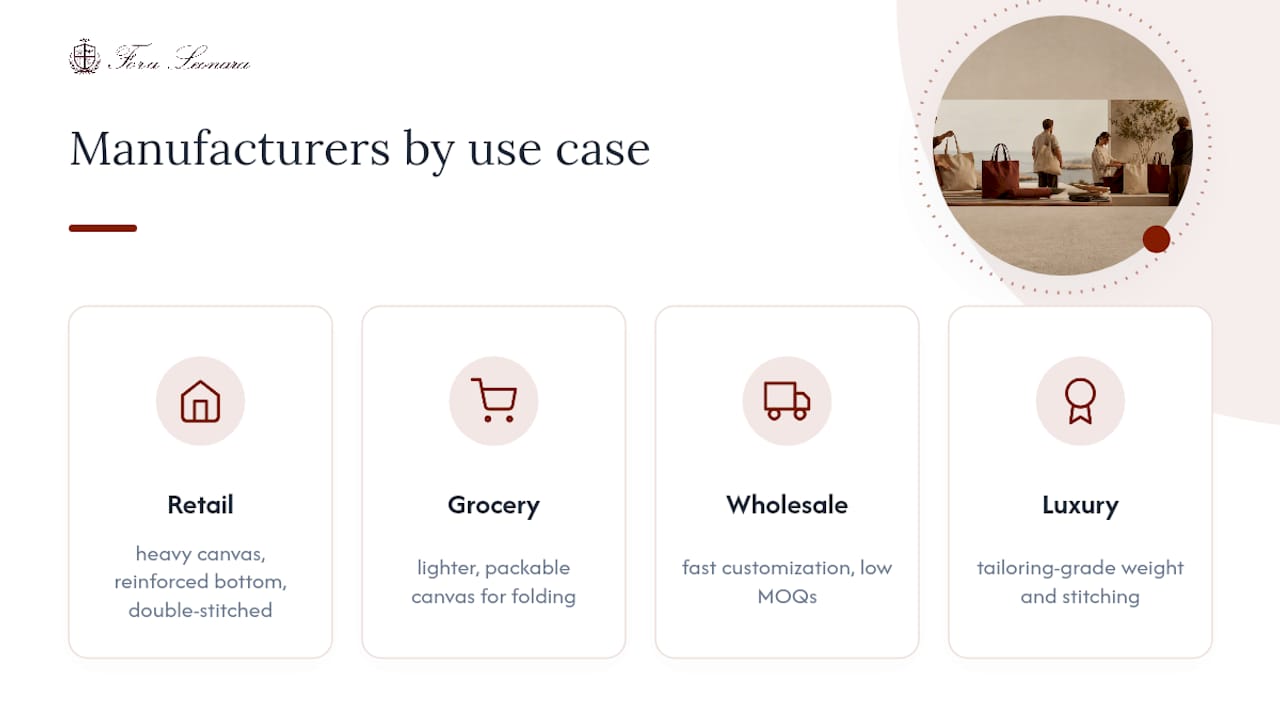
Retail and outdoor brands with decades of bag-making history tend to set the construction bar the rest of the market follows. L.L.Bean’s Boat and Tote line is the benchmark most reviewers point to, built on heavy-duty canvas, a reinforced flat bottom, and double-stitched seams tested for years of daily loading. That combination of heavy fabric and reinforced anchoring is what separates a bag meant to last from one meant to be replaced next season.
Grocery-focused suppliers such as organic cotton canvas manufacturers take a different approach, prioritizing lighter, more packable canvas suited to folding into a purse or glovebox rather than years of heavy hauling. Wholesale specialists like Tote Bag Factory build their reputation on customization speed and MOQ flexibility rather than premium fabric, which makes sense for organizations ordering hundreds of branded bags on a deadline.
At the luxury end, the calculus shifts. A canvas tote made in the same discipline as tailored menswear and womenswear that treats the bag as a wardrobe piece rather than a disposable giveaway, choosing canvas weight and stitching to match years of daily use rather than a single event. That’s a different buying decision than a promotional order, and it’s worth recognizing which category you’re actually shopping in before you compare price per unit across suppliers.
No single manufacturer wins across every use case. The right pick depends on whether you’re outfitting a household, a retail counter display, or a thousand-unit conference giveaway.
Environmental Impact and Sustainability Certifications to Check
Canvas totes are marketed as the eco-friendly alternative to plastic bags, but that claim depends heavily on the fiber source and how long the bag actually stays in use. Organic cotton canvas reduces pesticide use during growing compared to conventional cotton, which is why organic certification appears on more grocery-focused tote listings than on promotional ones.
For bulk and custom orders, ask suppliers directly whether their canvas carries a recognized certification such as GOTS (Global Organic Textile Standard) or OEKO-TEX, since neither term is regulated loosely enough to take at face value from marketing copy alone. A tote with no certification listed isn’t necessarily untreated conventional cotton, but you should ask rather than assume.
The bigger sustainability lever is durability, not certification. A reusable tote bag only offsets its own production impact after enough uses to replace dozens of single-use plastic bags, so a tote that falls apart after ten grocery trips undermines the entire pitch. This is where construction quality circles back to environmental impact directly: a gusseted, reinforced tote that lasts five years does more for sustainability than a certified-organic tote that rips after a season.
For organizations choosing between decoration methods, screen printing with water-based inks tends to have a lighter environmental footprint than plastisol-based prints, and it’s worth asking your supplier which ink system they use before finalizing a bulk order.
Delivery Times and Shipping for Bulk and Custom Tote Orders
Standard retail totes ship within a few business days like any other e-commerce order. Custom and wholesale orders run on a longer and less predictable timeline, and shipping delays are one of the most common sources of frustration for procurement teams working against an event date.
Expect the process to break into three phases: sample approval, production, and shipping. Sample approval alone can take one to two weeks depending on how many revision rounds your design needs. Production for a standard screen-printed order typically takes several weeks once the proof is approved, with embroidery runs often taking longer due to setup time on each design. Shipping adds more time on top of that, especially for suppliers producing overseas, where ocean freight can add weeks compared to domestic production.
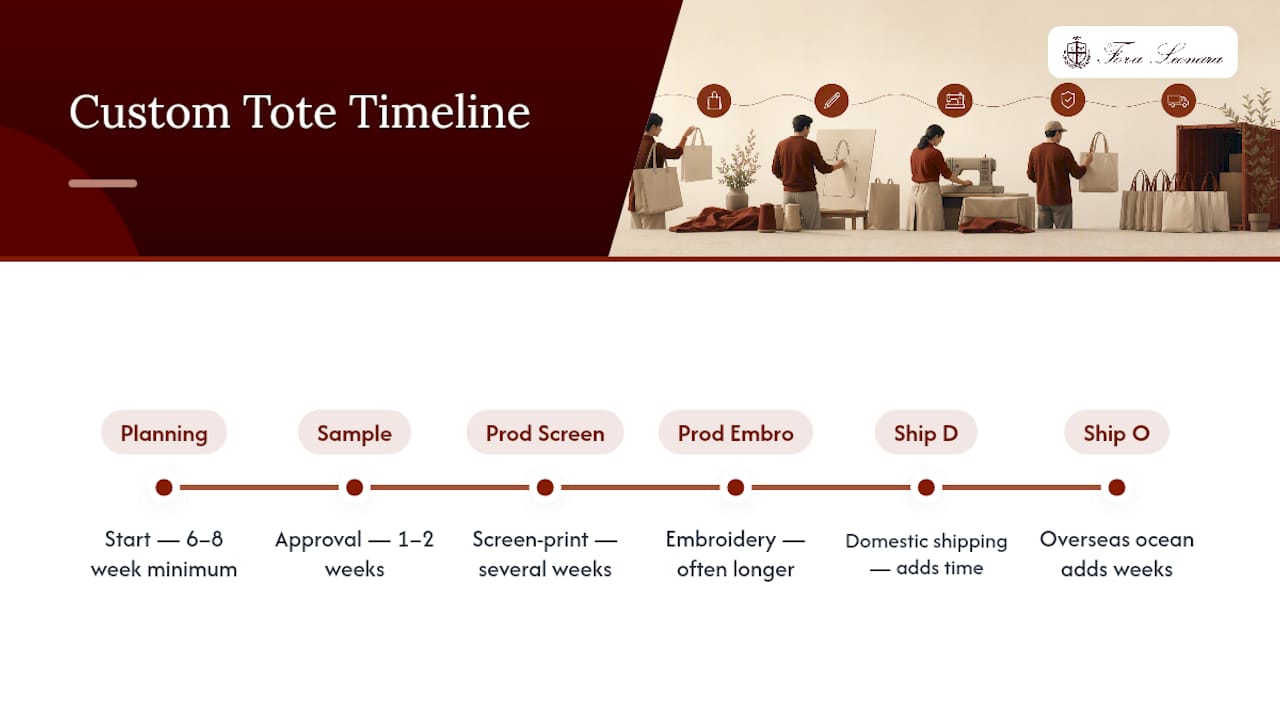
The practical takeaway for anyone planning a branded giveaway around a conference, launch event, or holiday campaign: start the sample and approval process at minimum six to eight weeks before you need bags in hand, and treat that as a floor, not a comfortable margin. Rush production exists with most suppliers, but it usually comes with a real cost premium and doesn’t always guarantee the same quality control on stitching and color matching that a standard timeline allows.
Cost Breakdown: Customization Fees, Shipping, and Taxes
The price on a wholesale quote rarely reflects the total landed cost. Four separate line items typically stack on top of the blank bag price: setup fees, per-unit decoration cost, shipping, and applicable sales tax.
Setup fees cover the cost of creating a screen or embroidery digitization file and are usually charged once per design, not per unit. Per-unit decoration cost scales with complexity: a single-color logo printed via screen print costs less per bag than a multi-color design or an embroidered logo, and that gap widens as order size grows.
Shipping cost depends heavily on order volume and destination. A small order might ship via standard parcel carriers, while a large bulk order often ships via freight, which changes the cost structure entirely and is usually quoted separately from the per-unit bag price.
Sales tax applies based on your business’s registered location and the supplier’s nexus, and many wholesale suppliers require a resale certificate to waive sales tax on orders intended for resale rather than internal use. If your organization plans to resell branded totes rather than give them away, confirm this documentation requirement before finalizing an order, since retroactively applying for tax exemption after an order ships is far more difficult than handling it upfront.
Return Policies and Warranties on Canvas Totes
Return and warranty terms vary sharply between retail totes and custom bulk orders, and the difference matters most when something goes wrong.
Standard retail totes purchased individually typically follow the seller’s normal return window, often 30 to 90 days, provided the bag is unused or shows only normal inspection wear. Some heritage retailers extend informal satisfaction guarantees on flagship canvas products, reflecting confidence in their own construction standards.
Custom and bulk orders operate under different rules almost universally. Once a design is approved and production begins, most wholesale suppliers do not accept returns for buyer’s remorse, since the bags are made to a specific spec that has no resale value to anyone else. What suppliers typically do guarantee is defect correction: if a batch arrives with printing errors, color mismatches from the approved proof, or construction defects like failed stitching, most reputable suppliers will reprint or refund the affected units.
The practical lesson for procurement teams: read the defect policy before you approve a proof, not after bags arrive. Ask specifically what percentage of a batch has to show a defect before the supplier will act, since some contracts set a threshold rather than covering any single flawed unit.
A Refined Canvas Tote From Fora Leonara
Most canvas totes on the market are built for one season of use, not ten. Fora Leonara’s canvas tote takes the opposite approach: dense, mid to heavy canvas cut and finished in the same European atelier that produces the house’s tailored clothing, with discreet detailing instead of a loud logo across the front.

It suits a professional who wants one dependable bag for the commute, the weekend market run, and the overnight trip, rather than a rotating drawer of promotional totes that thin out after a year. The construction philosophy matches everything else Fora Leonara makes under The Wall Street Reserve: understated, built to outlast the trend cycle, and free of visible branding.
You can browse the black canvas tote or the navy canvas tote directly, or pair one with a piece from the accessories collection to complete a capsule wardrobe. If you’re deciding between colors or want to see how the tote fits alongside ready-to-wear pieces, the ready-to-wear category is the next place to look.
Sources
Serious Eats’ hands-on comparison of reusable grocery bags remains the clearest independent look at how construction affects real-world durability. IKEA’s shopping and tote bag guidance covers washability trade-offs worth knowing before you buy for grocery use. Procurement teams evaluating wholesale suppliers can review MOQ and lead-time examples on Tote Bag Factory’s bulk product pages or browse curated accessory pairings through Couch & Dumbbells. Readers comparing construction quality on a finished product can also review L.L.Bean’s Boat and Tote specifications as a benchmark.
- The 5 Best Reusable Grocery Bags, Tested & Reviewed
- Shopping bags & tote bags | IKEA USA
- Boat and Tote®, Open-Top | Tote Bags | L.L.Bean International
FAQ
Who Makes the Best Canvas Tote Bags?
There’s no single best manufacturer across every use case: L.L.Bean’s Boat and Tote sets the benchmark for heavy-duty daily carry with its reinforced flat bottom and double-stitched seams, while wholesale specialists win on custom bulk pricing and lead time.
Does Trader Joe’s Still Sell Canvas Tote Bags?
Retailer-branded canvas totes, including Trader Joe’s, remain a common item at checkout counters, though availability and design rotate by season and location, so it’s worth checking with your local store.
What Is the Difference Between a Canvas Bag and a Tote Bag?
Canvas describes the fabric, a heavy, tightly woven cotton material, while tote describes the shape: an open-top bag with two parallel handles. A canvas tote bag is simply a tote made from canvas rather than nylon, leather, or another material.
Why Are Some Retailer Canvas Totes So Popular?
Limited-run branded totes often gain popularity through scarcity, repeat exposure, and simple attractive design rather than any material advantage over other canvas bags, according to reporting on the reusable bag category.
