

The most expensive garment in your collection is the one that remains unworn. It's a quiet irony of modern consumption that a suit featuring full-canvas construction and hand-finished horn buttons often represents a more prudent allocation of capital than a mass-market alternative. You likely understand the frustration of seeing a garment fail to retain its drape after a few outings or the guilt of an impulsive purchase that lacks true provenance. Mastering the cost per wear formula for clothing is the first step in rectifying this imbalance.
By applying this editorial logic, you will shift your perspective from impulsive consumption to strategic investment. We'll provide the mathematical proof behind the value of Super 150s worsted wool and a disciplined framework for auditing your wardrobe with the eye of a seasoned curator. This ensures that every acquisition, from the dark navy wool of the Wall Street Reserve to the refined lines of a Dune Veil Dress, serves as a permanent asset rather than a fleeting expense. We're moving beyond the noise of the retail floor and returning to the foundational principles of the atelier.
Key Takeaways
• Learn to calculate the true economic footprint of your wardrobe using the precise cost per wear formula for clothing, which accounts for maintenance costs and potential resale value.
• Understand the structural superiority of full-canvas construction and how it ensures a garment's drape remains intact through years of professional use.
• Discover why technical details like horn buttons and hand-sewn buttonholes are essential factors in reducing long-term repair needs and preserving a garment's provenance.
• Master the art of the wardrobe audit to distinguish between fleeting consumption and high-ROI assets such as the Super 150s worsted wool found in the Wall Street Reserve collection.
• Gain the mathematical confidence to prioritize atelier-level craftsmanship, viewing each purchase as a disciplined allocation of capital rather than a simple expense.
The Philosophy of Investment Dressing: Beyond the Price Tag
The professional wardrobe is not merely a collection of seasonal expenses. It represents a series of deliberate capital allocations. True discernment begins when we stop looking at the price tag in isolation and start evaluating the true economic footprint of the garment. This is where the cost per wear formula for clothing becomes an essential tool for the modern purist. It's a rejection of the frantic energy often found in contemporary retail. Instead, it favors a grounded, methodical approach to building a personal archive that reflects an old money aesthetic grounded in substance rather than spectacle. It invites the reader to linger on the details of construction rather than the speed of the transaction.
The Psychology of the Discerning Collector
The modern professional understands that a prominent logo is a poor substitute for genuine provenance. They look for the structural integrity of full-canvas construction and the subtle, matte sheen of Super 150s worsted wool. They appreciate the tactile weight of genuine horn buttons and the precision of a perfectly executed shoulder. A mastered uniform provides an emotional ease that trend-driven pieces cannot replicate. It's a silent communicator of precision and discipline. A piece from the Wall Street Reserve, for instance, speaks of authority through its impeccable drape rather than a flashy presentation. This persona values substance over spectacle.
The Ethical Imperative of Longevity
The philosophy of sustainable fashion is grounded in the total rejection of seasonal disposability. When a garment is built to develop a rich patina rather than to fall apart, the environmental impact is drastically reduced. At Fora Leonara, the commitment to slow fashion is a return to foundational principles. We favor hand-finishing, hand-sewn buttonholes, and selvedge edges because they represent a permanence that mass production lacks. This isn't just about aesthetics; it's about a commitment to craftsmanship. Cost per wear is the precise intersection where the initial purchase price meets the permanence of the garment's construction.
Explore the foundations of a disciplined wardrobe at foraleonara.com.
The Mathematics of Quality: The Cost Per Wear Formula
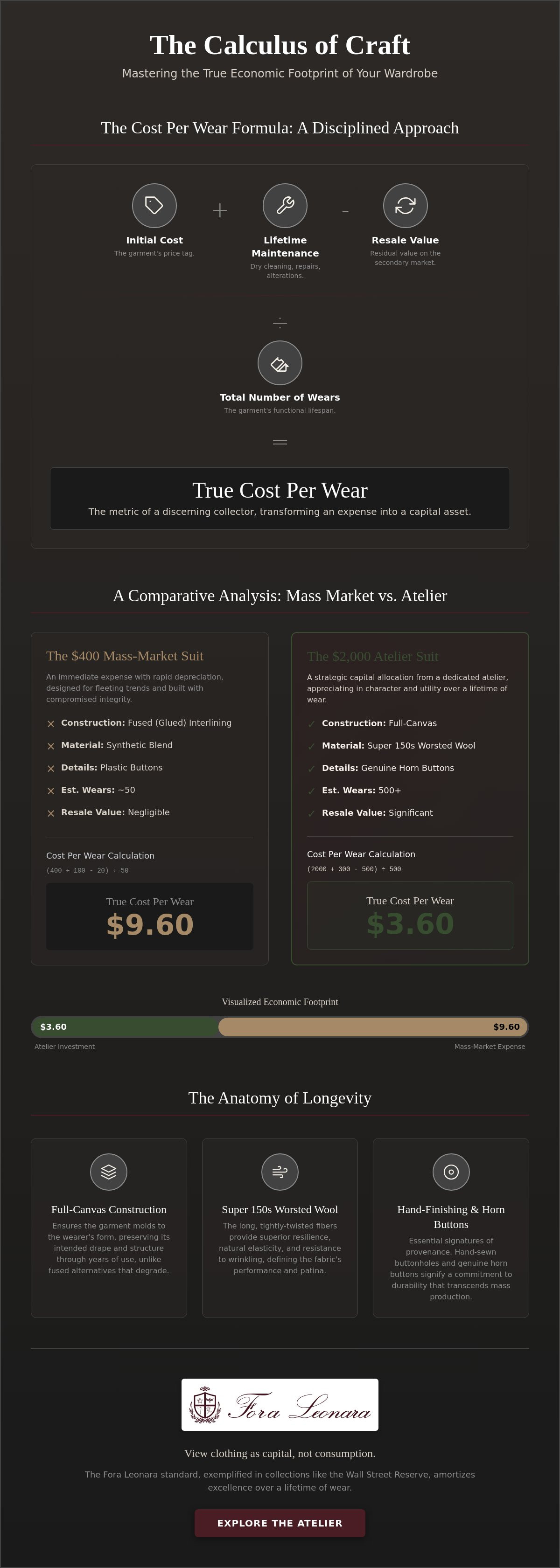
True discernment requires a departure from surface level arithmetic. While many look at Cost Per Wear: The Simple Equation, the veteran collector employs a more rigorous editorial calculation. The cost per wear formula for clothing should be viewed as: (Purchase Price + Maintenance - Resale Value) divided by the total Number of Wears. This calculation transforms a garment from a simple purchase into a high yield asset. It's a disciplined approach that accounts for the total lifecycle of the piece.
Consider the economic disparity between a $400 suit and a $2,000 alternative. The former often relies on fused construction, where synthetic glues eventually degrade and cause the fabric to bubble. The silhouette loses its drape after a handful of dry cleaning cycles. Conversely, a suit from a dedicated atelier using full-canvas construction adapts to the wearer's form. It gains a personal patina over time. Because the high end garment survives ten times as many outings and retains a significant residual value, its true cost is lower. Quality is the most effective hedge against depreciation.
Material science plays a pivotal role in this equation. Worsted wool, particularly in the Super 150s range, offers a resilience that lower grades lack. The long, tightly twisted fibers provide a natural elasticity that resists wrinkling and structural fatigue. When you view the technical specifications of our tailoring, you're seeing the foundation of this mathematical proof. It's about the intrinsic value of the materials used.
Calculating the Denominator: The Life of a Garment
The denominator of our formula is dictated by structural integrity. Fused jackets suffer from irreversible damage once the adhesive fails. Hand-finishing and reinforced seams prevent the fatigue that ends a garment’s life prematurely. Classic silhouettes, such as those found in the Wall Street Reserve, ensure the frequency of wear remains high across decades. A garment that remains aesthetically relevant for twenty years provides a vastly different ROI than a seasonal trend.
The Resale Variable: Luxury as Liquid Capital
Provenance acts as a protector of investment value. Garments crafted from premium worsted wool or featuring genuine horn buttons maintain a desirability that mass produced items lack. This is the difference between depreciating fashion and appreciating style. High quality materials retain their sensory quality, allowing them to be viewed as liquid capital on the secondary market. A well maintained piece with a clear heritage often commands a significant percentage of its original price, further lowering the final cost per wear.
Beyond the Sticker Price: Factoring Maintenance and Provenance
The sticker price of a garment is a deceptive metric. It represents only the entry fee into a relationship with a piece of clothing. To accurately apply the cost per wear formula for clothing, one must account for the silent variables of maintenance and structural decay. Cheaply constructed garments often carry a high hidden tax. They fail to age with grace. Fused interlinings eventually bubble and delaminate under the heat of a press. Plastic buttons shatter. These are not merely aesthetic failures; they are economic ones that necessitate frequent, costly replacements.
High quality fabrics also dictate the frequency of intervention. The science of drape is fundamentally linked to the quality of the fiber. Worsted wool, particularly in higher registers, possesses a natural elasticity and oil content that allows it to shed wrinkles and resist odor. This means the garment requires less aggressive chemical cleaning. Every visit to the dry cleaner is a stress test for a suit. A piece that maintains its integrity with simple steam and rest will inevitably outlast its more temperamental peers. It's a disciplined approach to garment care.
The True Cost of Synthetic Blends
Synthetic fibers like polyester and nylon are the primary detractors of a healthy CPW. They are prone to pilling and notorious for odor retention. This creates a cycle of excessive washing that rapidly degrades the fabric. Natural fibers offer a breathability that serves as a primary maintenance reduction strategy. Super 150s wool is a calculated investment in both immediate comfort and long term durability.
The Atelier Advantage
Provenance is the final guarantor of physical integrity. Knowing that a garment originated in a dedicated European atelier ensures a level of precision that globalized mass production cannot match. Proprietary manufacturing, such as the standards maintained by Rafael Zard, allows for uncompromising control over every stitch and seam. You can learn more about our commitment to these standards in Our Story. This direct oversight ensures that the garment you acquire today remains a pillar of your wardrobe for decades. It's a return to foundational principles.
Auditing the Atelier: How Construction Dictates Longevity
The internal architecture of a garment is the silent arbiter of its longevity. While the exterior fabric captures the eye, the construction beneath the surface determines how many years a piece remains in your rotation. In the context of the cost per wear formula for clothing, structural integrity is the primary driver of the denominator. A suit utilizing full-canvas construction features a natural hair cloth interlining stitched to the fabric. This allows the material to breathe and move independently. It avoids the rigid, adhesive-heavy nature of fused or half-canvas garments that inevitably fail after repeated exposure to the elements. This internal foundation ensures the garment retains its intended drape for decades.
Hand-finishing is another non-negotiable standard of the Fora Leonara atelier. Machine-made seams are often too tight, lacking the necessary "give" that allows a garment to move with the body. Conversely, hand-sewn elements provide a subtle flexibility. This precision ensures a silhouette survives the rigors of professional life and the occasional necessity of the dry cleaner. The "Wall Street Reserve" collection, featuring dark navy wool flannel, is designed with this multi-decade perspective in mind. The density of the flannel and the strength of the construction create a piece that remains a pillar of the wardrobe. Similarly, our small leather goods are crafted to develop a rich patina. Instead of wearing out, they wear in, improving their value as they age.
The Anatomy of a Suit Investment
Identifying the hallmarks of quality requires a trained eye. Look for pick stitching along the lapel and genuine working cuffs, often referred to as surgeon's cuffs. These details are markers of a process that prioritizes substance over speed. A well-constructed suit actually molds to the wearer over time. The canvas interlining gradually takes the shape of your body, resulting in a fit that becomes increasingly comfortable. You can explore these technical nuances further in our guide to Luxury Suits for Men. This bespoke-level attention to detail naturally increases the frequency of wear.
Materiality and the Environment
Longevity is also a product of specific finishing techniques. Selvedge edges and reinforced seams provide a structural defense against fraying and stress. In our women's collection, the Dune Veil Dress utilizes a silhouette that ignores seasonal trends in favor of permanent elegance. This timelessness is a critical variable in the cost per wear equation. By selecting garments with appropriate weights and versatile textures, the professional ensures year-round utility. A disciplined wardrobe is built on these foundational choices. To begin your own collection of high-ROI assets, view our full range of atelier-crafted garments.
The Fora Leonara Standard: Amortizing Excellence
Amortization is the financial language of the discerning professional. When we view garments as capital assets, the selection process becomes a rigorous filtering of the unnecessary. Fora Leonara stands as the logical conclusion of this discipline. By controlling the entire lifecycle through our proprietary EU factory, we ensure that the cost per wear formula for clothing yields a figure that justifies the initial allocation of capital. It's a return to foundational principles where the quality of the subject matter is allowed to speak for itself. We prioritize substance over the frantic spectacle of modern retail.
The quiet professional understands that a wardrobe is a portfolio. Every piece should be selected based on its ability to provide a long-term yield. This isn't about the "waste" of fast fashion, but rather the "yield" of luxury. By investing in garments that feature full-canvas construction and hand-finishing, you're opting for a lifecycle that spans decades rather than seasons. This is the essence of investment dressing. It requires a level of restraint and a commitment to uncompromising standards that few ateliers can provide.
Curating the Wall Street Reserve
The Wall Street Reserve Collection serves as a masterclass in this philosophy. Consider the dark navy wool flannel or the meticulously crafted cashmere shirts. These aren't merely items of apparel; they're the bedrock of a quiet luxury aesthetic. The flannel, in particular, possesses a weight and density that suggests permanence. It resists the thinning and pilling common in lesser materials. These pieces are designed to be worn with a frequency that rapidly lowers their CPW, proving that a higher initial price is often the most economical path forward. They represent the quiet confidence of a mastered, disciplined uniform.
The Final Audit: Quality over Quantity
We invite you to audit your current archive for what we call "dead capital." These are the garments that sit unworn because they lack the structural integrity to inspire confidence or the versatility to transcend seasons. To refine your future acquisitions, apply a disciplined checklist. Ask if the garment features full-canvas construction. Verify the presence of genuine horn buttons. Ensure the provenance leads back to a dedicated atelier rather than a faceless factory. This is how the modern purist reacts against the noise of the world. It's a return to the foundational principles of craft.
True luxury is ultimately found in the absence of the need for replacement. It's the emotional ease of knowing your wardrobe is composed of assets that age with a refined patina. When a garment is crafted with hand-finishing and Super 150s worsted wool, it doesn't just occupy space; it earns its place. We invite you to explore the collection at Fora Leonara and begin the transition from impulsive consumption to strategic investment. This is the art of discernment, mastered.
The Architecture of a Permanent Archive
The pursuit of a refined wardrobe requires a rejection of the superficial. You've seen how internal architecture, specifically full-canvas construction, dictates the lifespan of a suit. You understand that the cost per wear formula for clothing isn't just a savings tactic; it's a rigorous ROI calculation for your personal capital. By prioritizing extraordinary fabrics like Super 150s worsted wool and the technical mastery of our proprietary EU atelier, you transform your closet into an archive of enduring value.
True luxury is found in the quiet confidence of a garment crafted with Red Dot-level design discipline. It's a return to foundational principles where every horn button and hand-finished seam serves a purpose. This is the path to a collection that gains a rich patina rather than facing obsolescence. We invite you to move beyond the noise and embrace the precision of the atelier.
Invest in permanence with the Fora Leonara Collections.
Your journey toward a disciplined, high-ROI wardrobe begins with a single, intentional choice.
Frequently Asked Questions
What is a "good" cost per wear for a luxury suit?
A "good" cost per wear is one that eventually falls below the cost of a mass-market alternative through sheer longevity. If a suit from our atelier is worn twice monthly for a decade, the cost per wear formula for clothing reveals a figure that represents exceptional value. True discernment recognizes that the initial capital outlay is amortized over hundreds of successful outings, making the garment a high-yield asset.
Does a higher initial price always mean a lower cost per wear?
A higher price tag only results in a lower cost per wear if it's backed by superior construction and materials. A suit with fused interlining is a poor investment compared to one featuring full-canvas construction, regardless of the brand name. The focus must remain on technical mastery and the intrinsic quality of the worsted wool rather than the marketing budget of a global fashion house.
How does full-canvas construction affect the cost per wear formula?
Full-canvas construction is the primary driver of a low CPW because it prevents the structural failure common in fused garments. By allowing the fabric to move independently and mold to the wearer's frame, it ensures the suit retains its drape for years. This resilience significantly increases the total number of wears, which is the most critical variable in the cost per wear formula for clothing.
Can I include dry cleaning costs in my cost per wear calculation?
Maintenance costs are essential to any rigorous ROI calculation for your wardrobe. While high-quality natural fibers like Super 150s wool require less frequent professional intervention, the cost of occasional pressing should be added to the purchase price. A garment that resists odor and sheds wrinkles naturally will always prove more economical than a high-maintenance synthetic alternative that requires constant chemical cleaning.
Is the cost per wear formula different for leather goods vs. knitwear?
The fundamental mathematics remain constant, though the physical aging process differs between materials. Leather goods develop a rich patina that often increases their desirability and resale value over time, effectively lowering the long-term cost. Knitwear requires more diligent care to manage fiber fatigue, yet high-quality natural yarns provide a lifespan that far exceeds the seasonal lifespan of mass-market alternatives.
How do I estimate the resale value of a luxury garment for the formula?
Resale value is determined by the garment's provenance and the enduring relevance of its silhouette. Pieces with clear heritage and atelier-level finishing, such as those featuring genuine horn buttons and hand-sewn buttonholes, maintain higher liquid capital value on the secondary market. This residual value is subtracted from the total cost in your calculation, significantly reducing the final economic footprint of the purchase.
Why do synthetic fabrics often lead to a higher cost per wear?
Synthetic fibers like polyester suffer from pilling and permanent odor retention, which shortens their functional lifespan. They lack the natural elasticity of worsted wool, meaning they lose their shape and drape after only a few outings. This rapid degradation forces frequent replacements, resulting in a significantly higher cost per wear despite a deceptively lower initial price at the point of sale.
What is the "Wall Street Reserve" and how does it fit into investment dressing?
The Wall Street Reserve is a curated collection of foundational tailoring, including dark navy wool flannel and cashmere shirts. It represents the pinnacle of investment dressing by focusing on pieces with maximum versatility and structural longevity. These items are designed to be the bedrock of a professional archive, providing a high yield of wear across decades of professional life through uncompromising standards of construction.
