

The most profound statement a garment can make is often the one it refuses to speak aloud. For the discerning professional, high end minimalist knitwear represents a silent pact between the wearer and the atelier, where the absence of a logo signals a total reliance on technical perfection. It's a discipline of subtraction. You've likely experienced the quiet betrayal of a four-figure sweater that pills prematurely or a neckline that surrenders its shape; these are not merely aesthetic failures but symptoms of compromised provenance. As the global benchmark for wool reached 1,538.70 U.S. cents per kilogram in March 2026, the distinction between genuine material investment and marketing markup has never been more critical.
We agree that clothing should be treated as capital rather than consumption. This article promises to equip you with a rigorous framework for evaluating knit quality, from the thermal regulation of high-register fibers to the structural integrity of hand-finished seams. We'll preview the material science that defines the Fora Leonara philosophy and examine how upcoming EU transparency regulations are finally codifying the standards of slow fashion. You'll gain the insight necessary to build a wardrobe of grounded, quiet confidence that transcends the seasonal cycle.
Key Takeaways
• Identify the technical distinction between standard luxury and the architectural rigor of Super 150s worsted wool.
• Master the physical markers of high end minimalist knitwear, focusing on how hand-finished details and horn buttons signify a garment's structural permanence.
• Discover why the proprietary European atelier remains the essential standard for maintaining uncompromising quality control and provenance.
• Learn to curate a wardrobe of capital by identifying pieces that offer a high return on aesthetic investment rather than following transient trends.
The Anatomy of Restraint: Defining High End Minimalist Knitwear
True luxury is often found in what remains unsaid. In a market saturated with loud logos and transient trends, high end minimalist knitwear serves as a sanctuary of technical precision and quiet confidence. This isn't merely a category of apparel; it's a rigorous architectural exercise. Every stitch must justify its existence. When a garment lacks the distraction of overt branding, its quality becomes the primary narrative. The modern professional understands that a sweater is more than a seasonal layer. It's a structural foundation for a disciplined wardrobe. By rejecting the "disposable luxury" cycle, we embrace a philosophy where form follows function with uncompromising clarity.
The Philosophy of Investment Dressing
The concept of "Buy less, buy better" has transitioned from a niche sentiment to a global necessity. We've reached a point where discerning collectors view their wardrobe as a portfolio of capital rather than a series of consumable goods. This shift toward long-term garment custodianship is reinforced by recent regulatory movements, such as the EU ban on destroying unsold textiles effective July 2026. At Fora Leonara, we believe a garment's value is measured by its permanence. A well-constructed knit should develop a subtle patina of age without surrendering its structural integrity. It's an asset that demands a high return on aesthetic investment, serving as the quiet engine of a sophisticated uniform.
The Technical Threshold of Luxury
Distinguishing between marketing "premium" and technical "high quality" requires an editor's eye for detail. Most mass-market offerings rely on surface-level softness that quickly dissolves into pilling and distortion. In contrast, high-register knitwear is defined by the technical mastery of the atelier. The integrity of the garment begins with the process of interlooping yarn, where the tension and density of the stitch determine the final drape. It's about the provenance of the fiber and the precision of the finishing. Whether it's the use of worsted wool for a crisp finish or the integration of hand-sewn details, the technical specification is what ensures a piece outlasts the whims of the season. This level of restraint requires a proprietary factory where standards are never compromised for the sake of third-party wholesale margins.
Building a wardrobe of quiet excellence starts with understanding these foundational principles. It's about recognizing that the most powerful garments are those that allow the wearer's character to take center stage. Discipline is the ultimate form of sophistication. To explore the full breadth of our commitment to slow fashion and technical mastery, we invite you to view our latest collections at foraleonara.com.
The Materiality of Excellence: From Super 150s to Worsted Wool
The foundation of any high end minimalist knitwear piece is the raw fiber. It's the silent architect of the silhouette. While many brands prioritize immediate softness, true investment pieces rely on the technical specifications of the yarn. The history of minimalist fashion demonstrates that the most successful garments are those where the material is allowed to dictate the form. This requires a deep understanding of fiber length. Long-staple fibers are essential for longevity. They resist the friction that causes pilling. They ensure the garment retains its intended shape after years of wear.
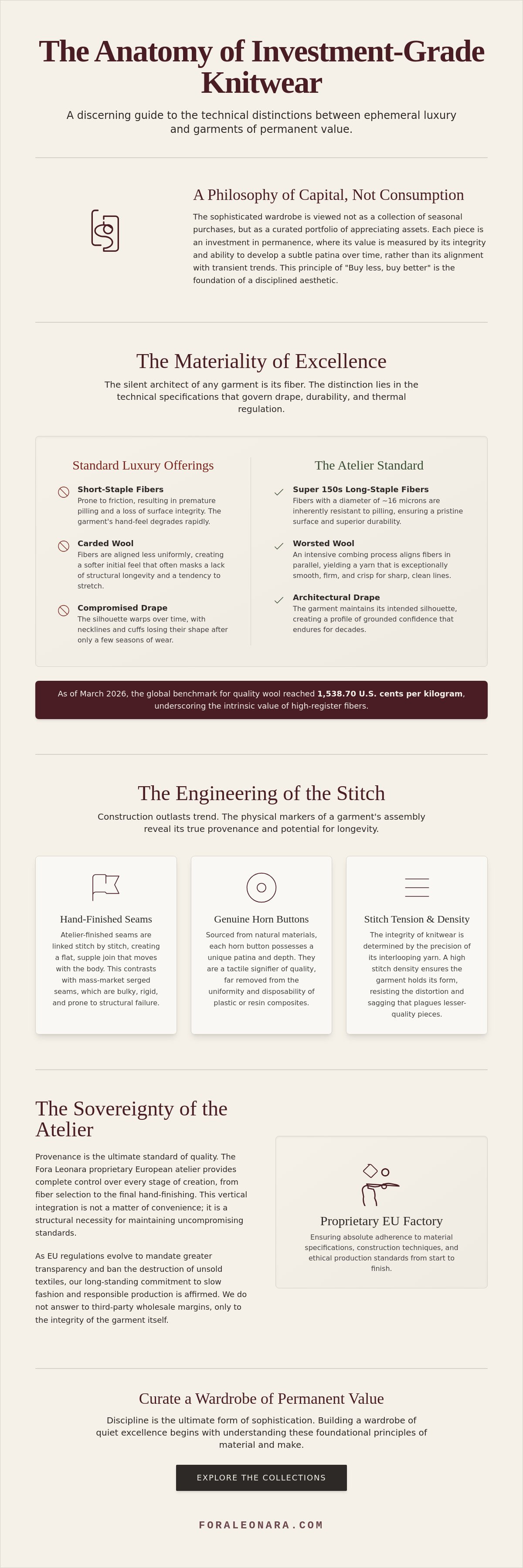
In the world of high-register textiles, the Super system remains a critical benchmark. A Super 150s designation indicates a fiber diameter of approximately 16 microns. This level of refinement provides a unique combination of silk-like hand-feel and surprising durability. It's a peak of textile engineering. When these fibers are processed as worsted wool, the result is a yarn that is smooth, firm, and exceptionally crisp. This precision is what allows for the sharp drape and clean lines characteristic of the Fora Leonara atelier. As of March 2026, the global wool price averaged 1,538.70 U.S. cents per kilogram. This reflects a market where quality is increasingly scarce and valuable.
The Science of High-Register Fibers
Thermal regulation is a biological advantage of superior natural fibers. High-grade cashmere and silk don't just provide warmth. They breathe. They adapt to the body's microclimate. This performance is enhanced by the hand-finishing process. In our proprietary factory, each piece is treated with a level of care that machines cannot replicate. Long-staple cotton is selected for its ability to resist the loss of form that plagues lesser garments. It's about maintaining a permanent standard of excellence. You can explore these textures within our curated collection of foundational layers.
Knitwear and the Discipline of Fiber
Weight is often a deceptive marker of quality. A heavy sweater is not necessarily a better sweater. True quality is found in yarn tension and the consistency of the spin. High-tension knits maintain a permanent silhouette. They resist the sagging that compromises a minimalist aesthetic. Sourcing ethics also play a vital role. Material provenance ensures that the artisans involved are treated with the respect their craft deserves. At Fora Leonara, we maintain a direct relationship with our sources. This transparency is the only way to guarantee that the material science matches the visual narrative. It's a commitment to a standard that transcends the seasonal cycle.
The Engineering of the Stitch: Why Construction Outlasts Trend
If materiality is the soul of a garment, construction is its skeleton. The structural integrity of high end minimalist knitwear relies on a level of mechanical engineering that few brands are willing to execute. While the mass market favors speed, the Fora Leonara atelier operates on the principle of architectural permanence. This requires a transition from simple assembly to disciplined creation. We apply the same rigorous standards found in full-canvas construction to our structured knits. This ensures that a blazer or foundational layer doesn't merely hang on the body but actively supports the wearer's silhouette. It's a commitment to a garment that adapts rather than deforms.
The Interior Life of a Garment
Quality begins where the eye cannot see. Most commercial knitwear utilizes "cut-and-sew" methods, where fabric is treated like a flat sheet and edges are surged. This creates bulk and weak points. In contrast, our collections prioritize fully-fashioned construction. This means each panel is knitted to the exact shape required, resulting in seamless transitions and superior strength. For our tailored trousers and heavier knits, we integrate reinforced seams and selvedge edges. These technical markers prevent the stretching and loss of form that define "disposable luxury." Precision tailoring ensures the silhouette remains permanent. It rejects the frantic cycle of seasonal trends in favor of lasting value.
Details That Signal Mastery
The distinction of a high-register piece often resides in its hardware and finishing. Genuine horn buttons are a non-negotiable standard for Rafael Zard. Unlike synthetic alternatives, horn possesses a natural depth and will develop a unique patina over decades of use. Each buttonhole is hand-sewn, a process that requires a level of patience and dexterity that machines cannot replicate. This hand-finishing extends to the setting of the sleeves. Hand-set sleeves provide a range of motion and a specific drape that mass production simply cannot achieve.
Consider the shoulder expression in a knit blazer from the Wall Street Reserve collection. It requires a subtle conviction. The transition from the neck to the shoulder must be seamless yet defined. This is achieved through varying the stitch gauge and tension across the garment. It's a silent signal of quality. These are the markers that the discerning professional recognizes instantly. They represent a mastery of craft that transcends branding. Every stitch is a deliberate choice. Every seam is a promise of longevity. To witness this technical mastery firsthand, we invite you to explore the craftsmanship at foraleonara.com.
The Sovereignty of the Atelier: Provenance as a Quality Standard
The integrity of a garment is inextricably linked to the site of its creation. In an era where many luxury labels have surrendered to outsourced manufacturing and the compromises of third-party wholesale, the proprietary factory remains a rare bastion of excellence. For high end minimalist knitwear, this control is not merely a logistical preference. It's a technical necessity. When the design vision and the production floor exist within the same architectural ecosystem, the results are uncompromising. Every stitch is monitored. Every tension setting is calibrated to the millimeter. This is the sovereignty of the atelier, where the heritage of European textile mastery meets the precision of modern standards. Rafael Zard founded this house on the principle that quality cannot be managed from a distance. It must be lived on the factory floor.
From Yarn to Garment: A Controlled Narrative
Vertical manufacturing allows for a level of transparency that the fragmented mass market cannot replicate. By maintaining our own facility in Europe, Fora Leonara ensures that the narrative of a garment remains unbroken from the raw fiber to the final hand-finishing. Small-batch production is the antidote to the defects inherent in volume-driven luxury. It allows our artisans to linger over the details that define a silhouette, such as the perfect drape of a cashmere shirt or the structural integrity of a knit blazer from the Wall Street Reserve. This methodical pace ensures that each piece meets a singular standard of excellence. We invite you to discover the story behind our proprietary European atelier and the craftsmen who bring our vision to life.
This level of control over the production narrative is also a hallmark of specialized European manufacturers like Athleisurebasics, who focus on technical excellence and high-quality construction for the premium foundational pieces that define a disciplined wardrobe.
The Ethics of Slow Fashion
Control over the manufacturing process facilitates a disciplined approach to resources. Traditional mass production often results in significant textile waste. However, an atelier-led model prioritizes precision over excess. This commitment to slow fashion is further supported by artisan welfare. The relationship between the maker's environment and the final quality of the garment is direct. A craftsman who is respected and unhurried produces work that carries a palpable sense of ease and permanence. Provenance is a verifiable record of excellence that transcends the aesthetic. In a homogenized fashion market, knowing exactly where and how your clothing is made is the ultimate luxury. To experience the results of this dedicated process, explore our full collection of investment-grade knitwear.
Investment as Discipline: Curating a Wardrobe of Permanent Value
The transition from the fleeting "capsule wardrobe" trend to a philosophy of permanent essentials marks the maturity of a collector's eye. It's a move away from the frantic search for versatility toward the acquisition of technical excellence. High end minimalist knitwear serves as the silent anchor of this collection. Every piece must offer a high return on aesthetic investment, where value is measured by the garment's ability to maintain its structural integrity over decades. We view clothing as capital. It's an asset that should appreciate in personal significance even as it develops a gentle patina of use.
The Professional Uniform
A disciplined uniform is built upon specific anchors that transcend the seasonal cycle. We prioritize the dark navy suit and the crisp white button-down shirt as the primary instruments of professional life. The nuance of color is vital. Dark navy and charcoal are not merely safe choices; they are the most sophisticated foundations for a wardrobe that must transition across global time zones and varying climates. Within the Wall Street Reserve collection, we've refined these foundational layers. By utilizing cashmere shirts and dark navy wool flannel, we create a narrative of quiet authority. These garments don't demand attention. They command respect through their precision and the sensory quality of Super 150s worsted wool.
The Longevity of the Silhouette
The most common pitfall in modern dressing is the surrender to hyper-skinny or overly-oversized trends. These silhouettes are designed for the moment, not the decade. A tailored silhouette, however, remains the most disciplined expression of style. It respects the natural drape of the fabric and the physical proportions of the wearer. Whether it's the selvedge finishing on a pair of trousers or the hand-set sleeves of a knit blazer, these technical markers ensure the garment remains relevant. It's about a permanent standard of excellence that rejects the noise of the modern world.
Owning less, but owning the extraordinary, is the ultimate form of confidence. It's an act of intentionality. A Fora Leonara garment is more than an item of apparel; it's a testament to the wearer's discipline and a commitment to the sovereignty of the atelier. By investing in pieces that prioritize material provenance and technical mastery, you're not just consuming fashion. You're building a legacy of refined taste. We invite you to explore the full breadth of our permanent collection at foraleonara.com.
Refining the Standard of Permanent Excellence
The pursuit of high end minimalist knitwear is ultimately a commitment to substance over spectacle. We've examined how the technical markers of quality, from the micron count of Super 150s fibers to the architectural rigor of atelier-led production, distinguish an investment from a mere purchase. True luxury doesn't announce itself; it's felt in the drape of worsted wool and seen in the precision of hand-finished seams. By prioritizing material provenance and the sovereignty of our proprietary European facility, Fora Leonara ensures that every garment serves as a lasting testament to the wearer's intentionality.
Building a wardrobe of quiet authority requires a rejection of the disposable. It demands a return to foundational principles where every stitch is a deliberate choice. When you choose to own less, you create space for the extraordinary. This discipline is the hallmark of the modern professional who views clothing as capital. By investing in pieces that prioritize craftsmanship, you're building a legacy of refined taste. We invite you to explore the foundational collection at foraleonara.com and begin your journey toward a more purposeful aesthetic. Your wardrobe should be as grounded and permanent as your ambitions.
Frequently Asked Questions
What technical markers should I look for in high end minimalist knitwear?
Look for fully-fashioned construction where the garment panels are knitted to shape rather than cut. This ensures the seams are robust and the silhouette remains permanent. High-tension stitches and hand-finishing at the neck and cuffs signal a commitment to longevity that mass production cannot replicate. These details ensure the garment resists the distortion often found in lesser luxury items.
Why is European atelier construction superior to outsourced manufacturing?
An EU atelier provides a controlled narrative where the heritage of craft meets rigorous quality control. Proprietary factories allow for small-batch production that avoids the inconsistencies of volume-driven luxury. This vertical model ensures that provenance is verifiable and that every garment reflects a singular vision of excellence. It prioritizes the artisan's welfare and the precision of the final stitch.
What does the "Super" number in wool actually mean for garment durability?
The "Super" number refers to the fineness of the wool fiber measured in microns. A Super 150s designation indicates a fiber diameter of approximately 16 microns, offering a silk-like hand-feel. While finer fibers are softer, they require precise spinning and tension to ensure the garment maintains structural integrity over time. It's a balance of refined elegance and technical resilience.
How can I tell if a knit is made from high-quality long-staple cotton?
High-quality long-staple cotton is identified by its exceptional surface smoothness and resistance to pilling. Shorter fibers often fray and create a fuzzy texture that compromises the minimalist aesthetic. A superior cotton knit will feel cool to the touch and possess a subtle, natural sheen that reflects its material purity. It's a fabric that retains its form after repeated wear.
Is full-canvas construction relevant to high-end knitwear?
Full-canvas construction principles are applied to structured knitwear, such as blazers, to provide a permanent shape that adapts to the wearer. While standard sweaters are unconstructed, high-register tailored knits utilize internal structural elements to ensure the shoulder and chest retain their definition. This prevents the sagging often seen in lesser garments. It represents a crossover between tailoring and traditional knitting.
How do I care for luxury knitwear to ensure it lasts for decades?
Longevity is achieved through disciplined maintenance and allowing fibers adequate rest between wears. Store garments folded rather than on hangers to prevent stretching the drape. Utilize cedar blocks to deter moths and only engage in professional cleaning when absolutely necessary to preserve the natural oils and patina of the wool. Proper storage is the most essential act of garment custodianship; you can learn more about Himalayan Wool and their expert advice on caring for high-quality handmade wool garments to ensure your investment lasts.
Why do high-end minimalist brands avoid overt logos on their garments?
The absence of a logo is the ultimate marker of quality confidence. For the discerning professional, the value of a garment lies in its construction, materiality, and the sovereignty of the atelier. When a piece is perfectly executed, the silhouette and the sensory quality of the fabric serve as the only necessary identifiers. It's an aesthetic of restraint that favors substance over spectacle.
What is the difference between worsted wool and standard wool knits?
Worsted wool is characterized by a process that aligns fibers and removes shorter staples, resulting in a smooth and crisp yarn. Standard wool knits often retain a loftier, fuzzier texture. Worsted construction is preferred for high end minimalist knitwear because it offers superior pilling resistance and a sharp, architectural drape. It's the technical choice for garments that require precision and durability.
