

Whether you need a tie depends on your industry, the occasion, and who is in the room: finance, law, and government settings still lean toward one, while tech and creative workplaces often skip it entirely. When you genuinely cannot tell, wear one or carry one. Removing a tie takes ten seconds; producing one from nowhere does not.
TL;DR:
- Conservative industries like finance, law, and government still expect a tie for interviews and client meetings, especially if the occasion is formal or high-stakes.
- Tech companies and startups generally treat ties as unusual, but wearing one for interviews rarely harms your chances, so research company culture beforehand.
- A simple, structured shirt with a well-fitting jacket can transition between formal and casual looks without changing clothes; adding or removing a tie instantly shifts attire level.
- When in doubt, dress one step more formal based on cues from the company’s website, recent photos, or your contact’s advice, and carry a spare tie just in case.
- Proper collar construction and matching tie width to lapel size matter more than the tie pattern or fabric, and fit, grooming, and comfort influence credibility as much as clothing choices.
Table of Contents
- Where a tie is still expected: industries and occasions that favor a tie
- Business professional vs business casual: a quick reference
- How to decide in five minutes: a day-of checklist
- Styling rules for a sharp tie look or a polished tieless outfit
- Fora Leonara’s approach: investment pieces that adapt across formality levels
- How business dress codes got here
- Regional and cultural variations in tie-wearing norms
- What a tie signals about competence and credibility
- Where to find adaptable suiting and private styling
- Sources
- FAQ
Where a tie is still expected: industries and occasions that favor a tie
Some industries never fully let go of the tie, and for good reason. Guidance on interview dressing notes that conservative sectors such as finance, law, and government typically expect a tie for interviews and high-stakes client interactions, where formality signals seriousness before a word is spoken.
Certain occasions call for a tie regardless of your everyday office culture:
- Job interviews, especially first rounds or entry-level roles where dressing up rarely counts against you.
- Client-facing meetings where the client’s own dress code sits above your company’s baseline.
- Formal presentations, board meetings, and any event billed as business professional.
- Ceremonies, award events, or first meetings with senior leadership outside your usual team.
Tech companies, agencies, and many startups have moved the opposite direction, treating a tie as unusual rather than expected. Brandeis University’s career center puts it plainly: wearing a tie for interviews rarely hurts, though some tech companies are the exception, and the same career guidance urges candidates to research a company’s actual culture before assuming either way.
Video calls complicate the calculus further. A camera crops you at the chest, so a tie reads as more deliberate on screen than in person, while an open collar can look casual or simply relaxed depending on the lighting and the room behind you.
Business professional vs business casual: a quick reference
The two dress codes get confused constantly, though the difference is straightforward once you see it laid out.
- Business professional usually means a suit, dress shirt, and, in most conservative settings, a tie: think interviews, courtrooms, and client pitches.
- Business casual typically drops the jacket-and-tie requirement but still expects a neat, collared shirt and polished shoes, keeping the look tidy without full formality.
- Adding or removing a tie is the fastest way to shift an outfit’s register: a navy suit with an open collar reads business casual, and the same suit with a tie reads business professional.
A few quick swaps make the difference concrete. Swap a tie for a crewneck sweater under a sport jacket to soften a formal look for a client lunch. Add a tie and a crisp shirt to the same trousers and jacket for a same-day pivot into a board meeting. Keep one tie in a desk drawer and one blazer in the office closet, since that single combination covers most last-minute formality shifts without a wardrobe change.
How to decide in five minutes: a day-of checklist
When you are staring at your closet with no clear answer, run through this in order.
- Step 1: Identify the event type and who will be there. A client pitch and a team stand-up call for different registers even in the same week.
- Step 2: Check the company’s website, LinkedIn photos, or recent event pictures for cues, or simply ask your contact what the dress code looks like.
- Step 3: For interviews or a first meeting with someone senior, dress one level more formal than you expect the room to be. Career-center guidance backs this instinct: research the specific company’s culture rather than assuming a blanket rule applies.
- Step 4: Build in a fallback. Carry a tie in your bag or car, and choose a jacket and shirt combination that looks complete either way.
Pro Tip: Keep a plain navy or burgundy tie rolled in your bag at all times: it works with nearly any suit color and removes the guesswork on short notice.
Etiquette guidance from the Emily Post Institute reinforces the same logic from a different angle: match your dress to the company culture rather than following a rigid personal rule, and treat clothing as a relationship tool rather than a test you pass or fail.
Styling rules for a sharp tie look or a polished tieless outfit
A tie only looks intentional when the details underneath it cooperate. A spread collar suits a wider knot such as a half-Windsor, while a narrow point collar wants a smaller four-in-hand knot so the proportions do not fight each other. Keep tie width in the same family as your lapel width, and let pattern do the work: a textured solid or small geometric print reads more current than a busy, high-contrast tie.
Going tieless has its own rules. A few points make the difference between polished and simply undone:
- Choose a shirt collar with enough structure to stand on its own, since a soft, floppy collar looks unfinished without a tie holding it in place.
- Keep the top button open but not the second, and let the jacket lapel do the framing instead of an exposed chest.
- Favor a slightly wider lapel on a tieless jacket, since a narrow lapel can look thin without a tie anchoring the eye.
- Groom deliberately. An open collar draws more attention to your neckline than a covered one does.
None of this substitutes for fit. A tie cannot rescue a jacket that pulls across the back, and an open collar cannot fix a shirt with sleeves two inches too long. Fabric quality and proportion carry more weight than the tie decision itself, which is why a well-cut jacket in good shoulder fit looks credible with or without one.
Fora Leonara’s approach: investment pieces that adapt across formality levels
Fora Leonara builds toward exactly this problem: garments that hold their shape and read as intentional whether or not a tie is involved. A structured sport jacket in a neutral palette, paired with a shirt cut for a clean collar roll, moves from a client meeting to a casual dinner without a second look.
A few principles guide that approach:
- Collar construction matters as much as color: a shirt built to sit cleanly open is as useful as one built for a tie.
- Neutral tones such as navy, gray, and olive transition between formal and relaxed settings more easily than bold patterns.
- The Atelier offers private styling for readers who want a wardrobe built around fewer, more versatile pieces rather than constant guesswork.
The goal is a small set of pieces that remove the daily decision rather than a closet full of single-purpose options.
How business dress codes got here
Business dress codes trace back to a much stricter era, when a suit, tie, and hat were the baseline for any office job regardless of industry. Through most of the twentieth century, formality was assumed rather than chosen: the tie signaled that you took the job, and the room, seriously.
Casual Fridays began chipping away at that uniform in the 1990s, giving employees one day a week to dress down before the norm crept into the rest of the week. The dot-com era accelerated the shift further, as tech founders and early employees rejected the suit-and-tie image entirely in favor of a look built around comfort and speed rather than hierarchy.
Recent industry reporting frames the current moment as a continuation of that trend rather than a break from it: overviews of workplace dressing describe business casual as the increasingly common default even in interview settings, with formal dress reserved for specific occasions rather than every workday. The tie has not disappeared. It has simply become situational instead of automatic, a signal you choose to send rather than a requirement you satisfy.
Regional and cultural variations in tie-wearing norms
Tie norms are not uniform even within a single country, let alone across borders. Financial and legal hubs tend to hold onto formal dress longer than other regions, since client expectations in those sectors change slowly and a tie remains a shorthand for seriousness. Creative and tech-heavy regions have moved further from that baseline, often treating a tie as a signal of unfamiliarity with the local culture rather than respect.
Industry trend reporting backs this unevenness: workplace dressing has normalized toward business casual broadly, but expectations still vary meaningfully by sector and region rather than moving at the same pace everywhere. A tie that reads as standard in one industry hub can read as overdressed a short flight away.
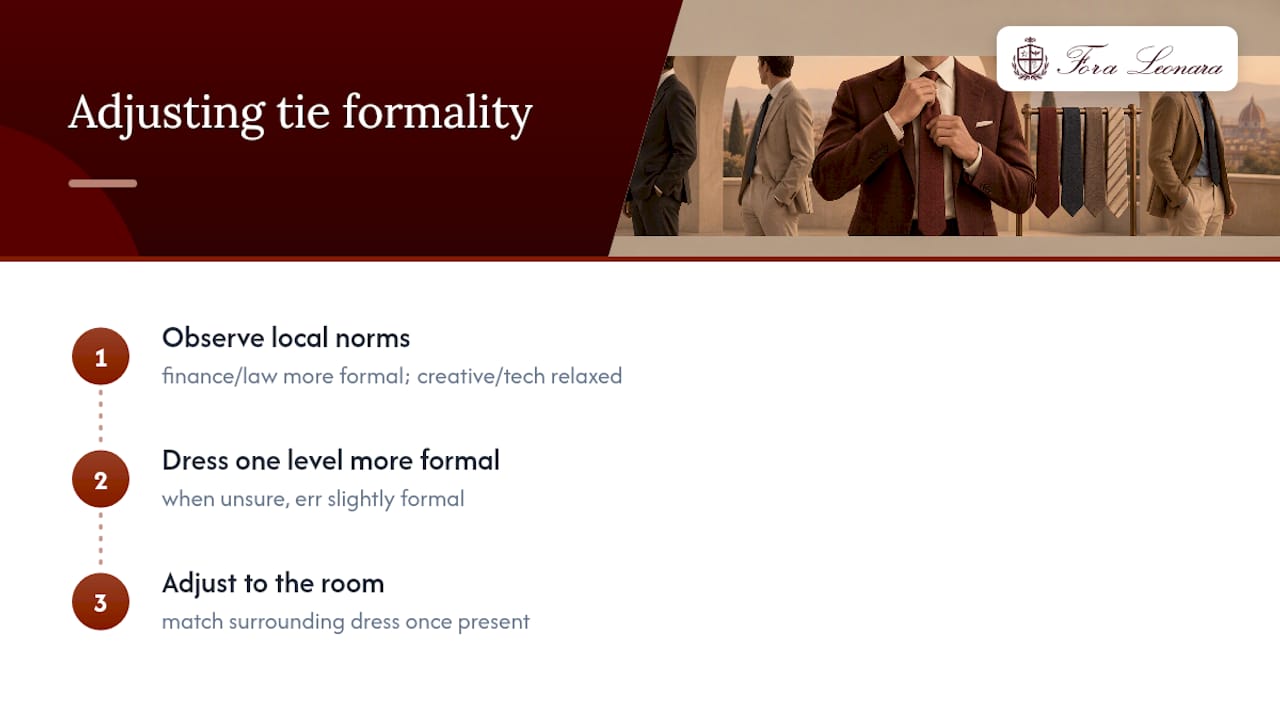
The practical takeaway is the same one that applies across occasions: observe before you assume. A tie that signals respect in one context can signal a lack of familiarity with the room in another, so the safest move when you are unsure of local or industry norms is the same one-level-up rule that works for interviews. Dress slightly more formal than you expect, then adjust once you see the room.
What a tie signals about competence and credibility
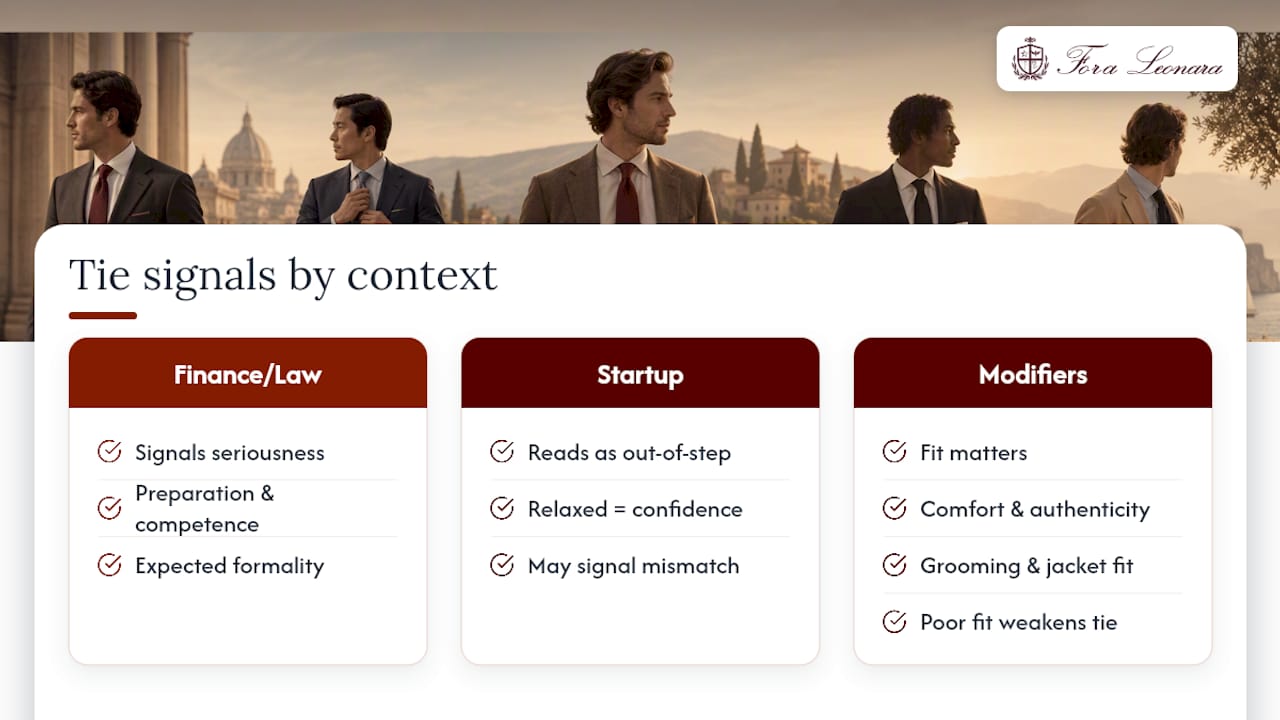
Attire genuinely shapes first impressions, though not in a single, absolute direction. Research on workplace dress links formal clothing to perceptions of authority and competence, while also noting that comfort and authenticity affect outcomes too, meaning a stiff, ill-fitting tie can undercut the very impression it is meant to create.
Context changes what a tie communicates. In finance or law, a tie still signals seriousness and preparation. In a startup pitch meeting, the same tie can read as slightly out of step with the room, since founders and investors in that world often equate a more relaxed look with confidence rather than a lack of effort. Neither reading is universally correct: both depend on what the room expects.
The same research on workplace perception notes that a manager’s clothing choices shift how a team reads warmth alongside competence, meaning the tie is one signal among several rather than the deciding factor. Fit, grooming, and how comfortable you look in what you are wearing all register alongside the tie itself. A perfectly knotted tie on an ill-fitting jacket sends a weaker signal than a clean, tieless look built on a jacket that actually fits through the shoulders.
Where to find adaptable suiting and private styling
Fora Leonara designs around this exact decision so you do not have to relitigate it every morning. A Signature Navy Sport Jacket paired with a tailored shirt reads complete with a tie for a client pitch and equally composed without one at dinner afterward, and the Classic Gray 3 Piece Suit carries the same versatility for more formal days.

A few things worth checking before you buy:
- Shoulder fit first: a jacket that pulls or gaps at the shoulder will look unfinished no matter what you add underneath.
- Collar construction: a shirt built to sit clean when open is worth as much as one built for a tie.
- Fabric weight: a mid-weight wool or a good linen moves between seasons and formality levels better than anything too heavy or too casual.
Browse the full collection or book a session with The Atelier for guidance built around your own wardrobe rather than a generic checklist. The Wall Street Reserve line is designed for exactly this kind of adaptability.
Sources
- To Tie or (K)not to Tie - CSE Connect - Brandeis University
- Business Casual vs. Business Professional: What to Wear to a Job Interview | The Link
- Business attire guide — BlackTieAttire
- Emily Post Institute: Etiquette today — business attire
FAQ
Is it okay to not wear a tie for a business professional interview?
It depends on the company and industry: conservative fields like finance, law, and government generally still expect a tie for interviews, while some tech companies do not. When you cannot confirm the company’s specific culture, wearing one is the safer default since it rarely counts against you.
What does business professional attire typically include?
Business professional generally means a full suit and dress shirt, with a tie expected in most conservative settings such as interviews and client meetings. The exact requirements shift by sector, so checking the specific workplace or event matters more than assuming one fixed standard.
Why has tie-wearing declined in many workplaces?
Workplace dress has shifted toward comfort and authenticity over strict formality, with many companies now treating business casual as the default rather than the exception. Etiquette guidance frames this as workplaces prioritizing genuine self-presentation over rigid rules, which has made the tie optional rather than standard in many sectors.
Does business casual require a tie or not?
Business casual typically makes a tie optional, but it still expects a neat, collared shirt and polished shoes rather than anything too relaxed. Whether shoes matter as much as the tie itself comes down to overall polish, and a proper shoe fit plays a real part in that impression.
How do I decide between a tie and no tie for a client meeting?
Check the client’s own dress code cues first, since their formality level usually outranks your own office norm for that meeting. When in doubt, apply the one-level-up rule and lean toward wearing a tie, since it is easy to remove but impossible to produce on short notice.
