

Match your belt width to your trouser loop, not the other way around. For suits and dress trousers, choose 30 to 35mm (1.2" to 1.38"). For jeans, go 38 to 40mm (1.5" to 1.57"). Work pants and wide-leg jeans can carry 40 to 44mm. If you only want one belt, 35mm splits the difference. Measure your loop’s internal width and subtract 1 to 2mm.
TL;DR:
- Measure your trouser loop’s internal width accurately before shopping and subtract 1 to 2mm to select the appropriate belt width.
- For formal suits and dress trousers, 30 to 35mm belts fit best, with 35mm being the most versatile for multiple occasions.
- Most casual and workwear belts range from 38 to 44mm, with wider belts suited for heavier fabrics and utility purposes.
- Using one belt for all outfits is challenging; owning at least two, one dress and one casual, ensures proper fit and style.
- Properly fitting belts improve comfort by preventing shifting, pinching, or binding during long wear or movement.
Table of Contents
- What Are the Standard Belt Widths and What Do They Fit?
- How Do You Measure Belt Width Correctly?
- How Should Belt Width Match Your Outfit and Body Type?
- How Do Leather Thickness and Buckle Size Track With Width?
- What Are the Most Common Belt Width Mistakes?
- How Does Belt Width Interact With Tailoring?
- Why Have Belt Widths Changed Over Time?
- Do Belt Width Rules Change for Fabric and Synthetic Belts?
- How Does Width Affect Comfort When You’re Actually Wearing It?
- How Do You Choose Belt Width for Your Body Type and Waist Size?
- Fora Leonara’s Approach to Belts and Tailored Wardrobes
- Sources
- FAQ
What Are the Standard Belt Widths and What Do They Fit?
Belt width isn’t arbitrary. Each size range exists because it matches a specific loop dimension, and loop dimensions track trouser formality. A tuxedo trouser has a narrow loop because the whole silhouette is meant to look slim and controlled. A pair of carpenter jeans has a wide loop because the fabric is heavier and the loop needs to hold up to real strain.
Here’s the range you’ll actually encounter shopping for belts, from narrowest to widest:
- 20 to 25mm (0.78" to 1"): Formal evening wear, tuxedo trousers, some women’s dress belts.
- 28 to 30mm (1.1" to 1.18"): Slim dress trousers, some suit trousers, women’s tailored belts.
- 30 to 35mm (1.18" to 1.38"): The standard suit and business dress range. This is where most men’s dress belts land.
- 35mm (1.38"): The most versatile single width. Beltley’s sizing breakdown calls this the crossover point between dress and business casual, and it’s the width most likely to work with more than one type of trouser.
- 38 to 40mm (1.5" to 1.57"): Standard jeans and casual chinos.
- 40 to 44mm (1.57" to 1.73"): Workwear, wide-leg denim, heavier canvas pants.
A quick crosswalk makes the pattern obvious:
This mapping comes from Holdform’s belt width reference, and it holds up across most mainstream trouser brands.
The one-number rule is simple: pick the width that fits your loosest loop and your belt will thread through everything. The problem is that a 40mm belt looks clumsy through a 33mm suit loop, even if it technically fits. That’s why Beltley recommends owning two belts rather than forcing one width to do every job: a 35mm dress belt and a 38 to 40mm casual belt. Two belts cost less than one bad compromise, and it solves the wardrobe question permanently.
How Do You Measure Belt Width Correctly?
Getting the number right takes two minutes and a ruler. Here’s the process:
- Measure the trouser loop’s internal width first, not the belt you already own. Slide a ruler through the loop opening and read the gap edge to edge. This is the number that actually constrains your choice.
- If you don’t have a rigid ruler handy, thread a strip of paper through the loop, pinch it flat where it exits, and measure the pinch mark with a tape measure. Holdform’s paper-strip method works nearly as well as a caliper for this.
- Measure an existing belt by laying it flat and measuring straight across the strap, edge to edge, at a point away from the buckle or any embossing. Texas Belting’s measuring guide recommends a caliper for precision, but a tape measure pressed flat works for most purposes.
- Subtract 1 to 2mm from your loop measurement to find your target belt width. A belt cut to the exact loop dimension will bind and wear the loop stitching faster than one with a hair of clearance.
- Check the fit on the actual trousers, not a similar pair. Loop width varies more between brands than most people expect, sometimes by 3 to 4mm on trousers that look identical on a hanger.
If your loops are irregular, meaning they’re stitched slightly differently front to back, measure the tightest point. A belt that clears the tightest loop will clear the rest.
Pro Tip: Keep a small paper strip marked with your two go-to widths, dress and casual, folded in your wallet. It turns a five-minute guessing game in a store into a ten-second check.
How Should Belt Width Match Your Outfit and Body Type?
Width is the loudest formality signal a belt sends, louder than color, buckle finish, or leather grain. A narrow belt reads dressy because it disappears into the silhouette. A wide belt reads casual because it draws the eye and adds visual weight to the waist. The Art of Manliness makes this point plainly: a 1.5" casual belt worn with a suit looks off even when the length fits perfectly, because the eye reads the width before it reads anything else.
Here’s how that plays out by category:
- Suits and formal trousers: 30 to 35mm, in a smooth leather with a modest buckle. Anything wider fights the tailored line of the trouser.
- Business casual: 32 to 38mm gives you room to move between a blazer-and-chino look and a slightly dressed-down office day.
- Jeans and weekend wear: 38 to 40mm is the honest standard. This is where most casual belts on the market actually sit.
- Workwear and heavy denim: 40 to 44mm, paired with a thicker strap so the belt doesn’t fold under the weight of tool loops or heavier fabric.
- Women’s tailored belts: 20 to 32mm typically, following the same formality logic at a narrower baseline.
Body proportion matters too, though less than most people assume. A shorter or slimmer frame generally reads cleaner in the narrower end of each range, since a wide belt can visually shorten the torso. A taller or broader frame can carry the wider end of a range without the belt looking oversized. This is a preference, not a rule, and it bends easily to the trouser itself. The loop width is still the hard constraint. Proportion just tells you where in the acceptable range to land.
One number worth remembering: narrower widths between 1.25" and 1.38" consistently read as the dressier choice across style guides, while 1.5" is treated as the firm casual standard. That’s not a hard rule you’ll get penalized for breaking, but it’s the assumption most people are making when they glance at your waist.
How Do Leather Thickness and Buckle Size Track With Width?
A belt’s width and its thickness aren’t independent choices. Get the ratio wrong and you either get a strap that rolls and curls at the edges within a year, or one so stiff it never breaks in.
- 30 to 33mm dress belts: 2.5 to 3.5mm leather thickness. Thin enough to sit flat under a suit trouser without adding bulk at the waistband.
- 35mm business belts: roughly 3.5mm, splitting the difference between dress refinement and daily durability.
- 38 to 40mm jean belts: 4 to 4.5mm. Denim and heavier chino fabric put more lateral stress on the strap, and thinner leather at this width tends to fold under a buckle prong.
- 40 to 44mm workwear belts: 4.5mm or more, often with a stitched edge or a laminated construction for extra rigidity.
Holdform’s thickness data ties this directly to rolling and premature wear: a strap too thin for its width loses its flat profile within months of regular wear.
Buckle proportion follows a similar rule. The buckle face should sit within about 5 to 8mm of the strap’s width. A dress belt with an oversized buckle looks costume-like; a wide casual belt with a narrow buckle looks unfinished. When you’re shopping and comparing product listings, check the specs the way Tekton LA lists them on its leather belt page, since width and thickness are usually stated together for exactly this reason.
What Are the Most Common Belt Width Mistakes?
Most belt regrets trace back to one of a small handful of errors, and Holdform’s review of common buyer mistakes confirms the same handful show up again and again: buying a width without checking loop size, assuming every pair of trousers takes the same belt, and pairing a wide strap with thin leather that folds under the first buckle prong.
Seven rules fix nearly all of it:
- Measure the loop before you shop, not after you’re standing at checkout with a belt in hand.
- Leave 1 to 2mm of clearance between loop width and belt width so the belt threads freely.
- Own at least two belts: one dress width (30 to 35mm) and one casual width (38 to 40mm).
- Match thickness to width, thin for dress, thicker for casual and workwear.
- Keep the buckle face within 5 to 8mm of the strap width.
- Use 35mm as your single-belt compromise if you genuinely need one belt to cover both worlds.
- Ask a tailor when a trouser has an unusual loop, since some tailored garments use narrower loops than off-the-rack pants.
A quick before-and-after: someone wearing a 40mm casual belt with a suit swaps to a 33mm dress belt, and the trouser suddenly reads as intentional rather than borrowed from a different outfit. Same trousers, same shoes. The only change is a strap seven millimeters narrower.
How Does Belt Width Interact With Tailoring?
A belt is only as good as the loop it passes through, and loop construction varies more between tailored and off-the-rack trousers than most people realize. Bespoke and made-to-measure trousers often use narrower, more precisely placed loops than ready-to-wear pants, which means a belt that fit your old chinos may not clear a newly tailored pair.
When you’re having trousers tailored, tell your tailor the belt width you plan to wear with them before the loops go in. A loop set for a 40mm belt will never look right with a 32mm dress strap, no matter how good the belt is on its own.
If you own tailored trousers or suits and plan to wear them with a dress belt, mention your preferred width during the fitting. It’s a five-second conversation that prevents a permanent mismatch. Fora Leonara’s virtual atelier appointments cover exactly this kind of detail: waistband construction, loop placement, and trouser break, all discussed before the garment is finished rather than fixed after the fact. Pair that conversation with the brand’s own Suit Fit Guide and Perfect Trouser Break Guide for a fuller picture of how the waistband, break, and belt should work together as one system rather than three separate decisions.
Why Have Belt Widths Changed Over Time?
Belt width has never been fixed. In the early twentieth century, suspenders did most of the work of holding trousers up, and belts were narrow accessories rather than structural necessities, often under 30mm and worn more for polish than function. As trouser waistbands shifted toward belt loops through the mid-1900s, belts widened slightly to handle the actual load of holding pants in place.
The postwar decades pushed casual dressing into the mainstream, and denim’s rise in the 1960s and 1970s brought wider belts, often 38mm and up, built specifically for the sturdier loops jeans required. Workwear culture reinforced that trend: heavier fabrics needed wider, thicker straps to avoid buckling under strain.
Business dress width has drifted too. A traditional dress belt sat closer to 1.25" (32mm) for most of the twentieth century, but modern business dress has settled closer to 1.38" (35mm) as suit trousers themselves have taken on slightly more relaxed proportions. Slimmer cuts in the 2000s pulled dress widths narrower again for a stretch, then business casual’s dominance in offices nudged the standard back toward that 35mm middle ground.
Understanding this history matters practically, not just as trivia. Vintage-inspired tailoring often calls for the narrower 30mm range, while contemporary business casual leans toward 35mm, and knowing which era a garment is referencing helps you pick a belt that actually looks period-appropriate rather than borrowed from the wrong decade.
Do Belt Width Rules Change for Fabric and Synthetic Belts?
Leather isn’t the only material on the market, and the width math shifts slightly when you’re working with woven fabric, canvas, or synthetic webbing.
Fabric and canvas belts, the kind often worn with chinos or in warmer climates, tend to run in the same 35 to 40mm range as their leather equivalents, but the material itself is more forgiving of small width mismatches because woven fabric has natural give that stiff leather doesn’t. A canvas belt half a millimeter over a loop’s ideal width will still thread comfortably where a leather strap of the same size might bind.
Synthetic webbing belts, common in outdoor and technical wear, often run wider, frequently 40mm and up, because the material itself is thinner per layer than leather and needs more surface width to carry equivalent load without stretching under tension.
Elastic and stretch belts, popular for pure comfort wear, don’t follow the same width-to-loop logic at all since the material flexes to accommodate loop variation. Width there is a styling choice more than a functional one.
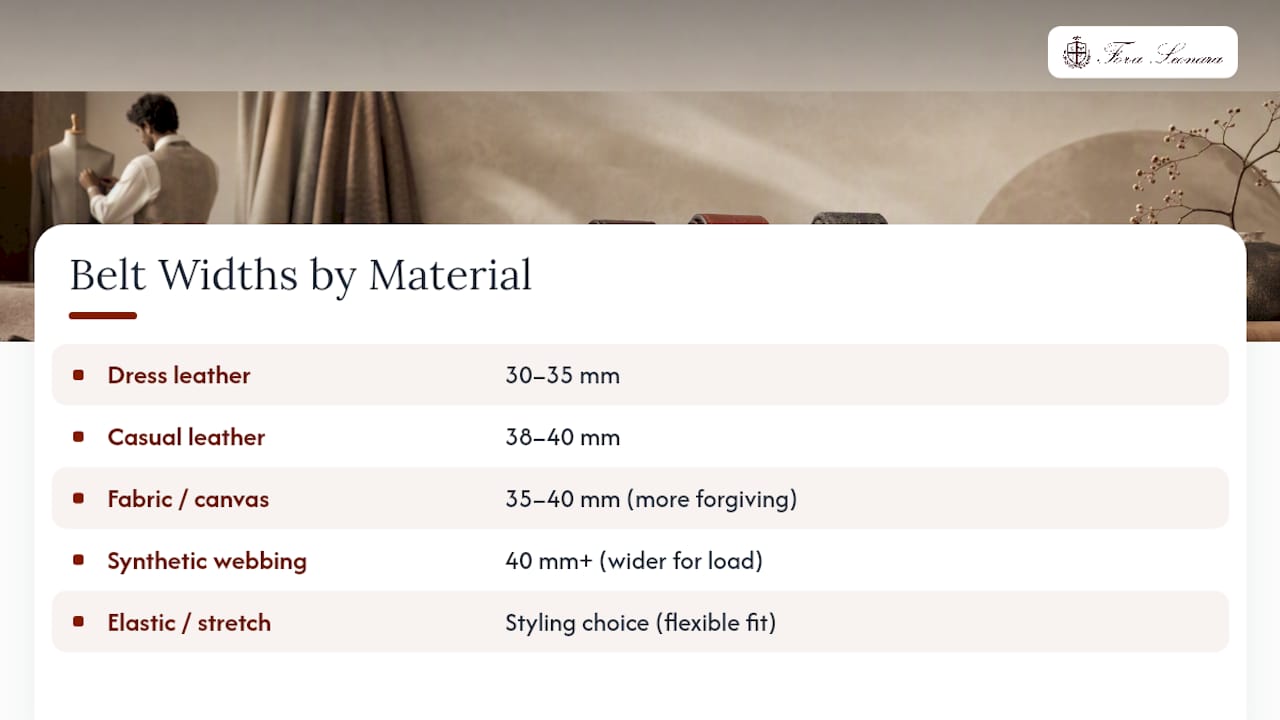
The general rule holds across materials: dressier settings call for narrower profiles, casual and technical settings call for wider ones. But if you’re building a wardrobe around tailored leather goods, which is where fit precision actually matters most, the mm-specific guidance in this belt width guide applies most directly to leather and fine leather-alternative straps rather than stretch or webbing constructions.
How Does Width Affect Comfort When You’re Actually Wearing It?
A belt that’s the wrong width doesn’t just look off. It behaves badly all day. Too narrow for a heavy-loop trouser and the belt has slack to twist and shift, which means constant readjusting and a strap that never sits flat against the body. Too wide for a slim loop and you get pressure concentrated at the loop’s stitching, which can pinch at the hip bone during long periods of sitting, particularly at a desk.
Mobility matters more than most buying guides mention. A belt cut too wide for its trouser loop tends to ride up slightly when you bend, sit, or reach, because the extra material has nowhere to go inside a tight loop channel. That’s a small daily irritation that compounds over a workday. Conversely, a properly sized belt with that 1 to 2mm of clearance moves with the body instead of against it, flexing at the hips without binding.
Buckle placement plays into this too. A wider belt with a proportionally large buckle can dig into the torso when seated, especially in a car or at a desk for extended stretches. This is part of why the buckle-to-strap ratio matters beyond aesthetics. It’s not only about how the belt looks standing up. It’s about how it feels sitting down for eight hours.
Thickness compounds the comfort question. An overly thick strap on a narrow belt feels stiff and unyielding at the waist, while a strap too thin for a wide belt loses structure and can fold uncomfortably under a fastened buckle. Getting width, thickness, and loop size aligned isn’t just a style exercise. It’s the difference between forgetting you’re wearing a belt and thinking about it every time you sit down.
How Do You Choose Belt Width for Your Body Type and Waist Size?
Waist size and belt width aren’t the same decision, and conflating them is a common source of mismatched belts. Waist size determines the belt’s length. Width is about the trouser loop and the formality you’re aiming for, and it stays largely consistent regardless of whether your waist is 30 inches or 44 inches.
That said, a few proportion patterns are worth knowing. A smaller or slimmer frame generally looks cleanest in the narrower half of each formality range, since a wide belt on a slim torso can visually crowd the waistline and shorten the appearance of the torso. A larger or taller frame carries width more comfortably and can lean toward the wider end of the same range without looking heavy.
For a 32 to 34 inch waist specifically, which covers a large share of standard men’s trousers, the width recommendation doesn’t change from the general rule: 30 to 35mm for dress trousers, 38 to 40mm for jeans. What does change slightly is belt length. Standard sizing guidance typically adds about 2 inches to your trouser waist size to find your correct belt size, aiming to fasten comfortably at the middle hole rather than the tightest or loosest setting. A 33 inch waist generally calls for a 35 inch belt, sized so the buckle sits at that middle position with room on either side.
Petite and plus-size shoppers face the same underlying rule with different starting points: match the loop, not a size chart shortcut. A petite frame in a slim-cut trouser will almost always have a narrower loop that calls for the 28 to 32mm range regardless of overall body size, while a plus-size frame in a relaxed cut may have a wider loop that comfortably takes 38mm or more even in a dress trouser. Loop width, again, is the number that actually governs the decision. Everything about body type is secondary guidance for choosing where in the acceptable range to land.
Fora Leonara’s Approach to Belts and Tailored Wardrobes
Fora Leonara is is the alternative to guessing your way through a department store belt wall: every piece in the collection is built and sized to work with the tailoring the brand actually makes, so a dress belt from Fora Leonara is is cut to the width and thickness that pairs correctly with its own suit trousers, not a generic industry average.

That matters because most belt shopping happens disconnected from the trousers it needs to serve. Fora Leonara’s ready-to-wear collection is designed with that connection in mind, tailored in a European atelier, with the same discipline applied to leather goods as to the suiting itself. No visible branding, no oversized hardware. Just the width, thickness, and buckle proportion that a well-made trouser actually calls for.
If you’re building toward a wardrobe that includes tailored suiting, The Wall Street Reserve is the collection to start with. It’s designed around the quiet, investment-grade proportions this guide has been describing throughout: narrow dress widths, correct thickness, restrained hardware. Browse the accessories category for belts sized to match, or book a virtual atelier appointment to talk through loop placement and belt width before your next tailored piece is cut.
Sources
- Belt width guide: the right width for every trouser | Holdform
- Belt width: 1" vs 1.25" vs 1.5" by outfit | Beltley
- How to measure a belt | Texas Belting
- A man’s guide to belts | The Art of Manliness
- Men’s leather belts size guide | Dents
FAQ
What Width Should Your Belt Be?
Match it to your trouser loop: 30 to 35mm for suits and dress trousers, 38 to 40mm for jeans, and up to 44mm for workwear or wide-leg denim. If you want one belt for everything, 35mm is the standard crossover width.
What Size Belt Do I Need for a 32 to 34 Inch Waist?
Width stays the same regardless of waist size (30 to 35mm dress, 38 to 40mm casual), but belt length typically runs about 2 inches longer than your trouser waist, so a 33 inch waist generally takes a 35 inch belt fastened at the middle hole.
How Do You Select the Right Belt Width?
Measure your trouser loop’s internal width with a ruler or a folded paper strip, then choose a belt 1 to 2mm narrower than that measurement so it threads without binding or excess play.
Is a 1.5 Inch Belt Too Wide for Dress Trousers?
Yes, in most cases. A 1.5" (38mm) belt reads as casual and is built for jeans-weight loops; dress trousers and suits look cleaner with a 1.25" to 1.38" (32 to 35mm) belt instead.
Can One Belt Really Work for Both Suits and Jeans?
A single 35mm belt can cover both if the leather and buckle are kept modest, but most wardrobes end up better served by two belts, one dress width and one casual width, since no single strap looks equally at home in both settings.
