

Grade letters like A, B, and C are mostly vendor shorthand, not a regulated standard, so the letter on a tag tells you less than you think. The specs that actually predict how a sweater feels and wears are micron count, staple length, and yarn construction. A general rule holds: “Grade A” usually implies finer, longer fiber, but you should always ask for the numbers behind the label before you trust it.
TL;DR:
- The perceived quality of cashmere based on letter grades is unreliable because there is no standard, and different vendors have different thresholds and criteria.
- Micron count and staple length provide more accurate indicators of fiber fineness and durability than grade letters, with ideal levels being under 16 microns and 30mm or longer.
- Proper dehairing, yarn construction, and finishing processes significantly impact the feel, age resistance, and pilling of a cashmere garment, beyond just fiber fineness.
- Buyers should ask for detailed spec sheets, fiber measurements, and perform tactile tests in person, rather than relying on vague grade claims or marketing language.
- Sourcing from reputable suppliers like Fora Leonara involves documentation of fiber metrics and consistent construction standards, which ultimately ensure lasting value over generic grade labels.
Table of Contents
- Cashmere Grades Explained: What Do A, B, and C Actually Claim?
- The Technical Metrics That Actually Determine Cashmere Quality
- How Do You Evaluate Cashmere When Shopping?
- Common Misconceptions and Marketing Traps in Cashmere Grading
- How Fora Leonara Applies These Standards When Sourcing Cashmere
- Quick Cashmere Buying Checklist
- How Geography Shapes Cashmere Grade and Quality
- Raw Cashmere Grades Versus Processed Material Grades
- How Goat Breed and Harvesting Season Affect Fiber Quality
- How Do Cashmere Grades Compare to Other Luxury Fibers?
- Fora Leonara’s Approach to Cashmere Sourcing and Construction
- Sources
- FAQ
Cashmere Grades Explained: What Do A, B, and C Actually Claim?
No government agency or industry board enforces a single A/B/C cashmere grading system. Different mills, brands, and wholesalers assign these letters to their own inventory based on internal thresholds, and there is no universally enforced standard behind the labels, which is exactly why two “Grade A” sweaters from different retailers can perform very differently.
That said, a rough pattern shows up across enough vendors to be worth knowing:
- Grade A: Typically the finest and longest fiber a supplier stocks, often marketed as suitable for next-to-skin wear.
- Grade B: Mid-range fiber, sometimes slightly coarser or shorter, commonly used in mid-priced sweaters and blends.
- Grade C: Coarser, shorter fiber, often blended with wool or synthetic fibers to bulk out cost-driven products.
Some vendors attach approximate numbers to these tiers, for instance pairing “Grade A” with fiber in the 14 to 16 micron range and longer staple lengths, while “Grade C” might sit closer to 19 microns with shorter fiber. Treat any such pairing as one supplier’s convention, not a fixed rule. A mill in Inner Mongolia and a mill in Italy can both call their best lot “Grade A” while using different cutoff points for fineness, color, and length. The letter is a summary of a private classification system, and the summary can be honest, inflated, or simply inconsistent from one label to the next.
This is why the grading conversation among serious buyers has shifted almost entirely toward numbers. A spec sheet that states 15.5 microns and a 34mm staple length tells you something concrete. “Grade A” by itself tells you what the seller wants you to conclude.
The Technical Metrics That Actually Determine Cashmere Quality
Four measurements do the real work of predicting how a cashmere garment will feel, drape, and age: fiber diameter, staple length, dehairing quality, and yarn construction.
Micron count measures fiber diameter in millionths of a meter, and it is the most commonly cited number in cashmere marketing. The finest cashmere runs roughly 14 to 16 microns, producing the buttery hand that makes cashmere famous. In the US, the FTC’s Wool Products Labeling Act sets the ceiling: a fiber can only be marketed as cashmere if its average diameter is 19 microns or less. Anything coarser legally cannot be called cashmere at all, regardless of what letter grade a tag claims.
Staple length matters just as much, and it gets far less attention. Longer fibers, generally in the range considered suitable for premium lots, spin into yarn with fewer loose fiber ends poking out. Fewer loose ends means less friction against fabric and skin, which means less pilling over time. A very fine micron count without adequate staple length can still pill quickly, since short fibers work loose from the yarn structure no matter how soft they feel on day one.
A legal 19-micron ceiling applies in some markets. The FTC’s legal definition of cashmere in the US caps average fiber diameter at 19 microns. Anything coarser is wool or a cashmere blend, no matter what the hangtag says.
Dehairing removes the coarse guard hairs that grow alongside the fine undercoat on a cashmere goat. Incomplete dehairing leaves prickly guard hairs in the yarn, which shows up as an itchy or uneven hand even when the base fiber tests fine on paper.
Yarn construction decides how those fibers behave once knitted. Single-ply yarn feels plush initially but has less structural integrity, while 2-ply construction generally offers better stitch definition, shape retention, and pilling resistance. Worsted spinning, which combs and aligns longer fibers before spinning, produces a smoother, stronger yarn with fewer stray ends than woolen spinning, which accepts shorter fiber and creates a loftier, fuzzier yarn that can pill faster. You can read more on how these methods diverge in our breakdown of worsted versus woolen spinning.
Gauge (stitches per inch) and finishing steps like steaming, brushing, and washing also shape the final hand, sometimes disguising mediocre fiber and sometimes wasting excellent fiber through sloppy processing.
Pro Tip: If a listing gives you a micron number but no staple length, ask for it directly. The two figures together tell you far more than either one alone, and a seller who can’t produce a staple length probably never measured it.
How Do You Evaluate Cashmere When Shopping?
Judging cashmere on sight or touch alone is unreliable, so build a short checklist you can run through in a store or before checkout online.
- Ask for the micron count. Expect a number between 14 and 19 microns; anything vague like “ultra-fine” without a figure is a dodge.
- Ask for staple length. A serious supplier can quote this in millimeters; 30mm and up is a reasonable durability threshold.
- Ask about ply and yarn count. “2-ply” or “12-gauge” style answers signal a vendor who actually tracks construction.
- Request a spec sheet or lab report if you’re buying in volume or from an unfamiliar brand. Reputable B2B cashmere sourcing follows exactly this pattern, requesting fiber fineness, staple length, and yarn count rather than trusting a grade letter.
- Do the wrist test in person. Rub the fabric against the inside of your wrist for a few seconds; genuine high-quality cashmere feels smooth, not scratchy, and doesn’t shed visibly.
- Check weight and drape. A garment that feels weightless but collapses limply may be under-spun; one that holds shape when draped over your hand is doing something right.
- Look for stitch definition in close-up photos when buying online. Crisp, even stitches suggest a tighter gauge and more consistent yarn.
- Read the return policy. A seller confident in their fiber quality rarely hides behind a restrictive or vague return window.
Early pilling deserves a specific note. Some pilling in the first few wears is normal even in good cashmere, and high-quality cashmere tends to pill less overall and stabilize after initial wear once loose fiber ends work themselves out. Persistent, heavy pilling that keeps returning after several wears is the signal of short staple length or poor yarn construction, not a normal break-in period.
Pro Tip: If you can, ask for a small knitdown sample before committing to a bulk or custom order. A swatch reveals hand, stitch density, and early pilling behavior far better than a spec sheet alone.
Common Misconceptions and Marketing Traps in Cashmere Grading
The biggest myth is that “Grade A” functions like a certification. It doesn’t. Since no enforced standard exists, a seller can call mediocre fiber “Grade A” with zero legal consequence, as long as the finished product still clears the 19-micron cashmere threshold.
A second trap: assuming a fine micron count alone means quality. A supplier touting “15-micron Grade A cashmere” with no staple length disclosed could be selling short-staple fiber that pills within weeks. Micron and length work together; one number without the other is half an answer.
- Two “Grade A” sweaters from different brands can differ by several microns and several millimeters of staple length.
- “Grade B” at one mill can outperform “Grade A” at another if the B lot has longer staple fiber.
- A vague grade claim with no numbers attached is a red flag, not a reassurance.
The quick test: ask for micron count and staple length before you ask what grade something is. If a seller can’t answer, the letter grade is decoration.
How Fora Leonara Applies These Standards When Sourcing Cashmere
Fora Leonara sources cashmere against the same fiber metrics this article walks through, not against a marketing letter. The priority is a fineness band that stays comfortably under the FTC’s 19-micron ceiling, paired with staple lengths long enough to resist pilling through years of wear rather than a single season.
Construction choices follow the same logic. Fora Leonara favors 2-ply yarns and gauges that hold their shape after repeated wear, the kind of stitch discipline detailed in our study of luxury knitwear construction. Finishing steps are chosen to preserve hand without sacrificing structure.
- Suppliers are evaluated against documented spec sheets, not verbal grade claims.
- Sample knitdowns are approved before production runs, matching the same test we recommend shoppers request.
- Fineness and staple length figures are checked together, never in isolation.
The larger point holds whether you’re buying from Fora Leonara or anywhere else: informed sourcing decisions built on real numbers deliver lasting value, letter grades don’t. Our own approach to cashmere sourcing reflects that discipline throughout the atelier process.
Quick Cashmere Buying Checklist
Keep this list handy the next time you’re comparing sweaters, whether in a fitting room or a browser tab.
- Micron count disclosed (target: under 19, ideally 14 to 16 for next-to-skin pieces)
- Staple length disclosed (target: 30mm or longer for durability)
- Ply and gauge stated, not just “soft” or “premium” language
- Garment weight and drape checked by hand
- Stitch density visible in photos or in person
- Documented spec sheet available on request
- Clear, reasonable return policy
Fine versus durable, in two lines: for the softest possible hand, prioritize the lowest micron count you can find. For a piece you’ll wear for years, prioritize staple length and 2-ply construction over shaving off a micron or two.
How Geography Shapes Cashmere Grade and Quality
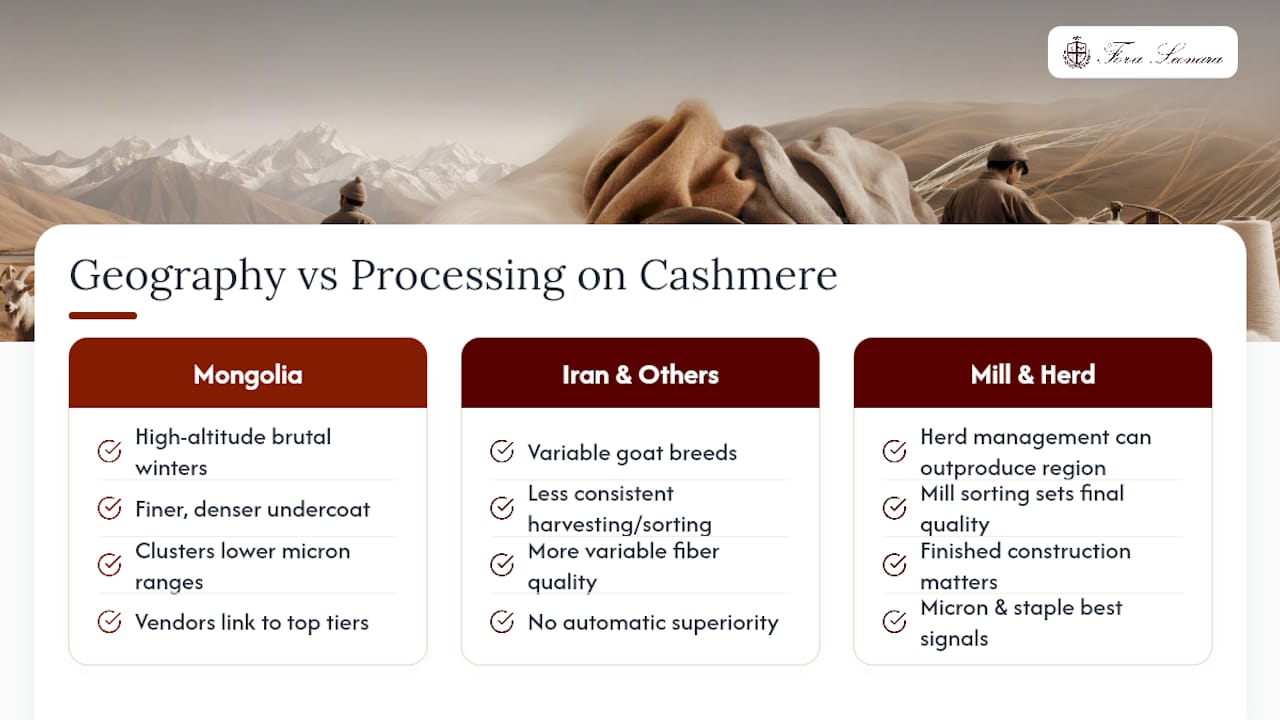
Cashmere goats live across a narrow band of high-altitude, cold-climate terrain, and where they graze affects fiber quality before any grading label gets applied. Mongolia and Inner Mongolia produce the majority of the world’s cashmere, and the region’s brutal winters push goats to grow especially fine, dense undercoats as insulation. Fiber from these herds often clusters in the lower micron ranges that vendors associate with their top tiers.
Fiber from Iran, Afghanistan, and parts of China’s other cashmere-producing provinces varies more, partly due to differences in goat breed and partly due to less consistent harvesting and sorting infrastructure. None of this means one country’s fiber is automatically superior. A well-managed herd in one region can outproduce a poorly managed herd in a “prestige” region. Geography sets the raw material’s baseline potential, but the mill’s sorting standards and the finished garment’s construction still determine what actually reaches a shopper. That’s another reason a grade letter tied only to a country of origin claim is a weaker signal than a micron and staple length figure tied to an actual lot.
Raw Cashmere Grades Versus Processed Material Grades
Raw cashmere grading happens at the herder and cooperative level, sorting fleece by color, coarseness, and the presence of guard hair before any dehairing takes place. This raw sorting is coarse by design, meant to separate obviously usable fiber from waste quickly during the collection season.
Processed material grading happens after dehairing, when the fine undercoat has been separated from guard hair and cleaned. This is where mills assign the commercial grade labels, and those internal thresholds for fineness, length, and color become the numbers (or the letters) that eventually reach a garment tag. A raw lot that looked mediocre before dehairing can yield surprisingly fine processed fiber, and the reverse happens too. This gap between raw and processed grading is part of why a letter grade printed on a finished sweater’s tag reflects a mill’s judgment about the processed material, not a guarantee about the original fleece. Serious buyers ask which stage a quoted grade refers to, since the two are not interchangeable.
How Goat Breed and Harvesting Season Affect Fiber Quality
Not all cashmere goats produce the same fiber. Breeds like the Mongolian cashmere goat and the Hircus goat found across Central Asia have been selected over generations for undercoat fineness and density, and breed differences alone can shift average micron count by a meaningful margin before any grading happens.
Harvesting season matters just as much. Cashmere goats shed their winter undercoat naturally in spring, and herders traditionally comb it out rather than shear it, which helps preserve staple length compared to shearing methods that can cut fibers short. Fiber combed at the right point in the molt tends to come out longer and cleaner, while fiber collected too early or too late in the season mixes more coarse guard hair into the harvest, complicating the dehairing process. A goat’s age plays a role too, with younger goats often producing finer fiber that coarsens somewhat as the animal ages. All of this happens well before a mill ever assigns a commercial grade, which is one more reason the letter on a finished garment’s tag is several steps removed from the animal that grew the fiber.
How Do Cashmere Grades Compare to Other Luxury Fibers?
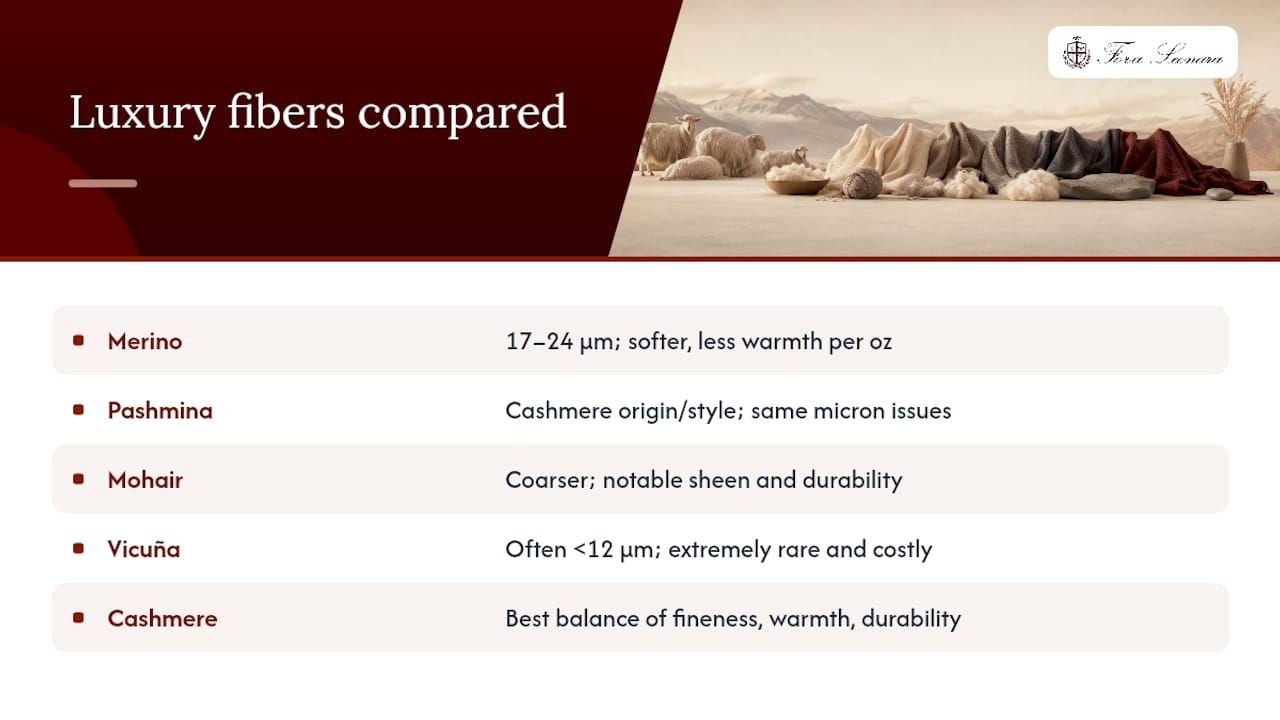
Cashmere sits in a specific niche among luxury fibers, valued for warmth-to-weight ratio more than any other single property. Merino wool, by comparison, commonly runs coarser at 17 to 24 microns depending on the grade, which explains why fine merino can feel soft but rarely matches cashmere’s warmth per ounce.
Pashmina causes more confusion than any other comparison point, mostly because the term gets used loosely in retail. Technically, pashmina refers to cashmere fiber from a specific high-altitude goat population, primarily in the Himalayan region, often woven into shawls using traditional hand methods. In practice, pashmina is a style and origin descriptor layered on top of cashmere, not a separate fiber competing against it. A garment labeled “pashmina” is generally cashmere or a cashmere-silk blend, and the same micron and staple length questions apply.
Mohair, from Angora goats, tends to run coarser than cashmere and delivers a distinctive sheen and durability rather than cashmere’s soft hand. Vicuña, one of the rarest and most expensive fibers in the world, can beat cashmere on fineness alone, sometimes measuring under 12 microns, but its scarcity and cost put it in a different purchasing category entirely. Against all of these, cashmere’s advantage isn’t that it’s automatically the softest or the strongest fiber. It’s that, at its best, it balances fineness, warmth, and reasonable durability better than almost anything else available at a comparable price point.
Fora Leonara’s Approach to Cashmere Sourcing and Construction
Fora Leonara sources cashmere to documented specifications rather than marketing labels, prioritizing measurable fineness and staple length figures over any letter claim a supplier might offer. Construction choices follow the same standard: gauge, ply, and finishing selected to hold shape and resist pilling well past a first season of wear.

The Wall Street Reserve line applies this thinking to pieces meant to anchor a professional wardrobe for years, not seasons. If you want to see these standards in a finished garment, the Cashmere Camel Crewneck shows the construction choices discussed throughout this piece: a considered gauge, clean stitch definition, and finishing meant to age well rather than impress on day one. The Timeless Elegance set reflects the same sourcing discipline in a different silhouette, and the broader ready-to-wear collection gives a fuller sense of how these fiber and construction priorities carry across the line. If you’re comparing a piece against the checklist in this article, start there and ask the same questions of any garment you’re considering, cashmere or otherwise.
Sources
For deeper technical detail beyond this guide, see SELVANE’s grading breakdown, That Yarn’s micron explainer, and general background on yarn and fiber terminology for readers new to textile sourcing language.
- Cashmere micron: what the numbers really mean — That Yarn
- Cashmere sweater grading: fiber specs for B2B buyers — FashionHDL
- How to evaluate high-quality cashmere — Onward Cashmere
FAQ
What is the best grade of cashmere?
There’s no universal “best grade” since letter grades vary by supplier. The better question is whether a garment offers a documented micron count under 19 (ideally 14 to 16) and a staple length of 30mm or more.
Is 2-ply or 3-ply cashmere better?
For most everyday garments, 2-ply construction offers a strong balance of softness, shape retention, and pilling resistance. Heavier 3-ply or multi-ply yarns can add warmth and structure but aren’t automatically superior, since ply is only one factor alongside micron and staple length.
Which is better, pashmina or cashmere?
Pashmina is a style and origin term for cashmere fiber, typically from goats in the Himalayan region, so the two aren’t competing categories. A garment labeled pashmina should be judged by the same micron and staple length standards as any other cashmere piece.
What grade cashmere does J-Crew use?
Retailers don’t typically publish the letter grade or exact micron specifications for mass-market cashmere lines. Rather than relying on a brand’s internal label, ask any retailer directly for the micron count and staple length behind a specific garment.
