

Linen fabric weight refers to how much a square meter of fabric weighs, measured in grams per square meter (GSM) or U.S. ounces per square yard, and it is the single best predictor of how a linen will look and behave. As a rule of thumb, lightweight linen suits airy shirts and dresses, medium weight fits structured dresses and trousers, and heavy linen belongs in jackets and upholstery. Below you will find the conversions, a swatch-testing method, and a full selection checklist.
TL;DR:
- Linens at 120 GSM or lighter are suitable for airy garments but tend to wrinkle and require linings for opacity.
- Fabrics in the 160 to 260 GSM range balance drape, durability, and structure best for most clothing projects.
- Heavier linens above 260 GSM offer greater shape retention and resistance to wear but need careful pressing to maintain texture.
- A swatch test measuring 10 by 10 centimeters weighing around 2 grams can estimate fabric GSM before purchase.
- Finish treatments like sanforization impact shrinkage and handle, influencing how a linen drapes and ages over time.
Table of Contents
- What fabric weight means: GSM, oz/yd² and how mills measure it
- Common linen weight bands and what they’re for
- How weight shapes drape, opacity, and durability
- How to choose the right linen weight for your project
- Measuring and converting weight with a simple swatch test
- Care, finishing, and shrinkage across weight bands
- Expert note: choosing linen weight for pieces built to last
- How Fora Leonara can help with linen and fit
- Sources
- FAQ
What fabric weight means: GSM, oz/yd² and how mills measure it
GSM stands for grams per square meter, and it is the number mills use to describe how dense a fabric is. A higher GSM generally means a thicker, more substantial cloth, while a lower GSM means something sheer and light enough to move with a breeze. Mills arrive at this figure by weighing a cut sample of known area and scaling the result up to one square meter, a method de Linum describes as the standard way to compare linens across suppliers.
GSM is a useful starting point, but it does not tell the whole story. Two linens listed at the same GSM can feel and drape completely differently depending on:
- The weave: a tight plain weave reads denser than a loose, open weave at the same weight.
- The yarn size: thicker, unevenly spun yarns add visual heft without necessarily adding mass.
- The finish: sanforization and softening treatments change how a fabric falls and handles.
- The fabric width: wider bolts sometimes carry slightly different weight-per-yard math than narrower ones.
Common linen weight bands and what they’re for
Linen suppliers generally group fabrics into four practical bands, and knowing where a bolt falls tells you almost everything about what it can become. The bands below, along with their typical uses, follow the matrix used by Canvas ETC.
To convert any GSM figure to oz/yd², divide by about 33.9, a conversion Canvas ETC confirms works for standard linen. A 200 GSM linen, for example, comes out to roughly 5.9 oz/yd². Before cutting into any of these bands, hold a swatch up to light and press it once to see how it truly behaves, since listed GSM and lived experience do not always match.
How weight shapes drape, opacity, and durability
Weight is the main variable behind how a linen garment moves, sits, and ages. Lighter linens fall close to the body and wrinkle readily, which is part of their appeal for warm-weather wear, while heavier linens hold their own shape and resist crushing.
- Drape: linens under 160 GSM float and gather; linens above 260 GSM stand away from the body and hold pleats.
- Opacity: anything under about 160 GSM often needs a lining or an underlayer for tops and dresses.
- Seams: heavier linens create more seam bulk and usually call for interfacing choices suited to thicker cloth.
- Durability: heavier weaves resist abrasion and pilling better, which matters for pieces worn often, like trousers or outerwear.
Pro Tip: Fold a swatch into a seam allowance and press it before cutting your garment. If the fold feels stiff or bulky at that weight, expect the same at every seam in the finished piece.
How to choose the right linen weight for your project
Matching weight to project is mostly a matter of asking the right questions before you buy, whether you are sewing a shirt at home or evaluating a ready-made piece.
- Define your silhouette first: a loose, unstructured shirt calls for a different weight than a tailored, close-fitting one.
- Consider your climate: very lightweight linens under 120 GSM suit hot, humid conditions but wrinkle and show translucency quickly.
- Decide on lining early: if your fabric falls under 160 GSM and you want opacity, plan a lining rather than fighting the fabric later.
- Ask suppliers for GSM, width, fiber content, and finish (sanforized or unsanforized) before ordering yardage.
- Use decision anchors as your defaults: around 140 to 160 GSM for a loose shirt, and roughly 200 to 260 GSM for trousers or a structured jacket.
For readers weighing linen shirt weights specifically, Fora Leonara’s own guide to judging linen shirt quality walks through what to look for beyond the weight label alone.
Measuring and converting weight with a simple swatch test
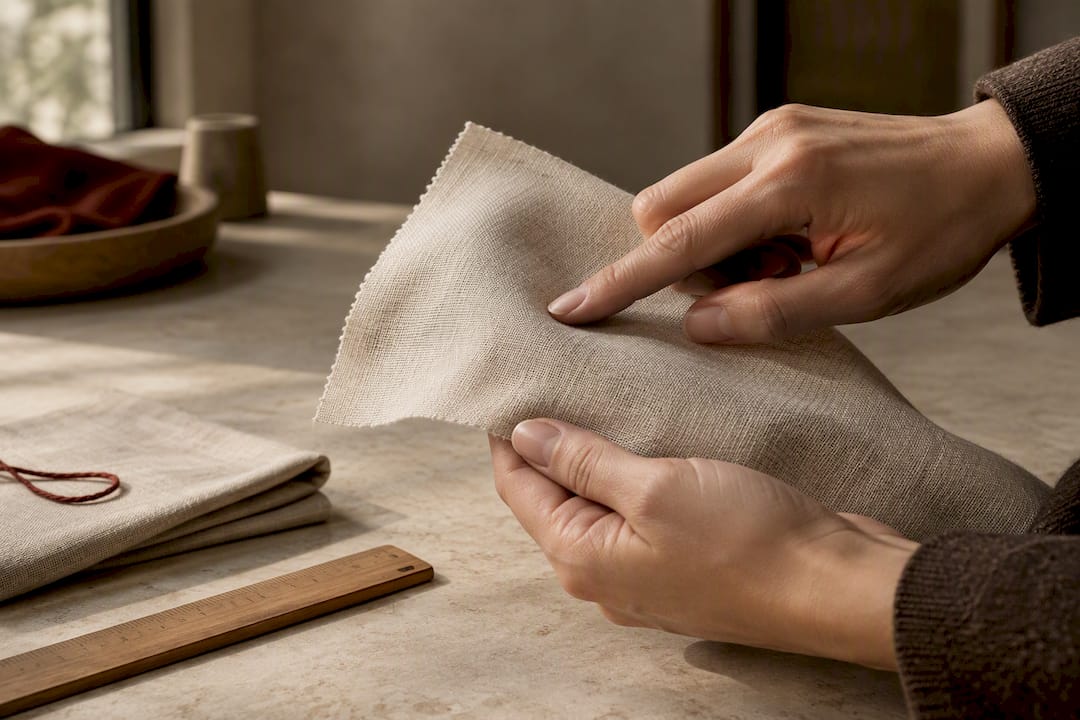
If a listing has no GSM figure, you can estimate one yourself. Cut a sample of known area, such as 10 by 10 centimeters, weigh it on a kitchen scale, and scale the result up to one square meter. A sample weighing 2 grams at that size scales to roughly 200 GSM.
Once you have a swatch in hand, run it through a short protocol before committing to yardage:
- Wash and dry it the way you plan to wash the finished piece, then note any shrinkage.
- Press it and check whether wrinkles fall out cleanly or set in.
- Sew a test seam to see how much bulk it creates.
- Hold it up to a light source to judge real opacity, not just the listed weight.
De Linum recommends this kind of swatch verification as the fastest way to catch a mismatch between a listed GSM and how a fabric actually performs.
Care, finishing, and shrinkage across weight bands
How a linen is finished changes its hand as much as its raw weight does. Sanforized and softened linen has already been treated to control shrinkage and relax the fibers, so it feels lighter and drapier than an unsoftened linen at the same GSM, a distinction Sartor Bohemia notes as one of the most common sources of confusion for buyers.
- Lightweight linens (under 160 GSM) tolerate machine washing but benefit from a cool iron while still slightly damp.
- Medium weights (160 to 260 GSM) hold their shape best when air-dried and pressed on the reverse side.
- Heavy linens (260 GSM and up) shrink less overall but need more careful pressing to avoid flattening their texture.
- Always ask a supplier whether a fabric is pre-washed or sanforized, since that single detail predicts most of its shrinkage behavior.
Expert note: choosing linen weight for pieces built to last
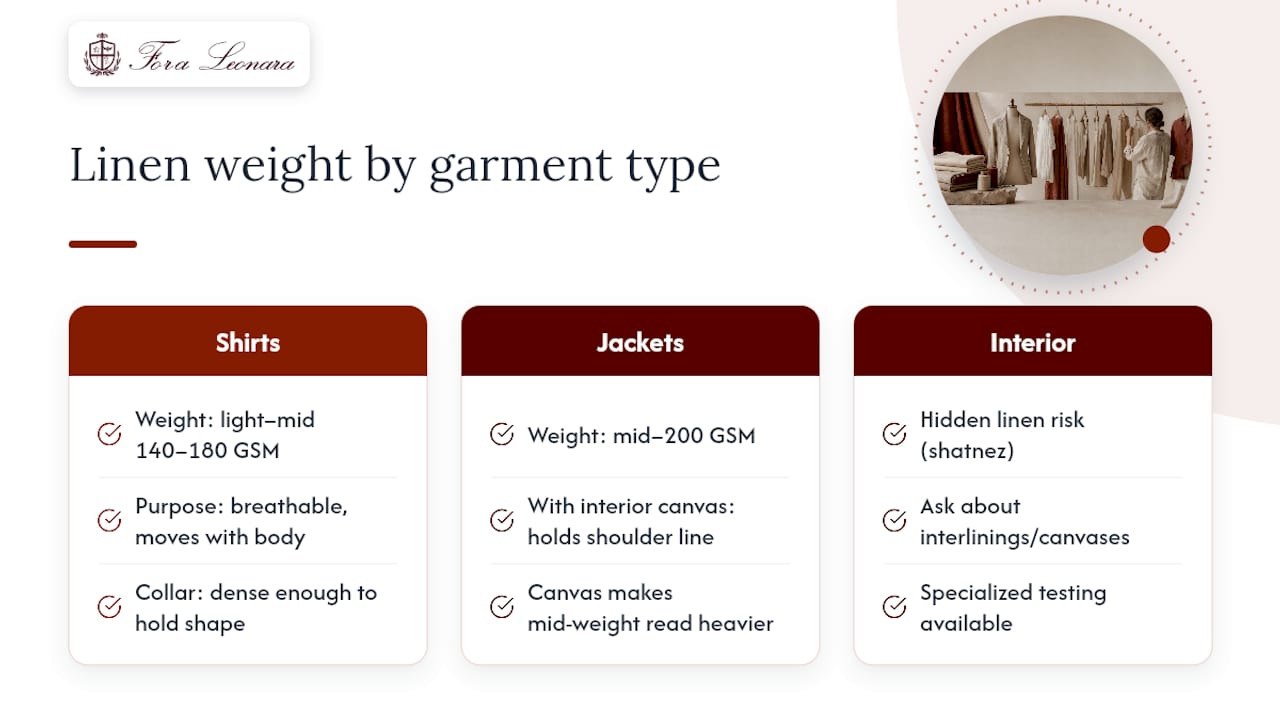
An approach to tailored linen starts with the same question every careful sewist asks: does this weight support the structure the garment needs, or fight it? For shirts meant to move with the body, lighter linens on the lighter end of the medium band work well, light enough to breathe but dense enough to hold a collar’s shape. For jackets and structured pieces, a heavier linen paired with the right internal canvas changes how the fabric reads entirely, often making a mid-weight cloth feel far more substantial once construction is complete.
Pro Tip: A well-chosen interior canvas can make a 200 GSM linen jacket hold its shoulder line as well as a much heavier fabric would on its own.
One detail worth knowing if you observe shatnez: linen is sometimes used inside wool garments, in collar canvases or interfacings, even when the visible fabric is entirely wool. Chabad explains that this hidden linen can create a prohibited wool-linen mixture under Jewish law, and specialized testing exists to identify it. Readers with this concern should ask about interior fabrics, not just the shell, before buying tailored wool pieces.
For readers weighing origin alongside weight, our guide to Irish versus Italian linen explains how flax source and weave tradition shift a fabric’s hand independent of its GSM number.
How Fora Leonara can help with linen and fit
Choosing the right weight is only half the job. The other half is construction: how a collar is canvassed, how a seam is finished, how a garment is cut to let the fabric do what it does best. Fora Leonara’s linen pieces, including the Linen Truffle Shirt and Linen Serene Shirt, are cut from fabric selected for exactly the drape and structure each style calls for.

If you are weighing a linen investment and want guidance beyond a GSM chart, The Atelier offers personal styling built around your build, climate, and wardrobe. You can browse the full collection or request an Atelier consultation to talk through fabric and cut before you commit.
Sources
- Linen fabric weights and GSM guide | Canvas ETC
- Understanding GSM in linen fabric — why fabric weight matters | de Linum
- The lowdown on linen weights | Sartor Bohemia
- Chabad
FAQ
Is linen just 100% cotton?
No, linen and cotton are different fibers entirely. Linen comes from the flax plant’s stalk, while cotton comes from the cotton plant’s seed boll, and the two have distinct weight, texture, and wrinkle behavior even at similar GSM.
Why did God say not to mix linen and wool?
This refers to shatnez, a biblical prohibition against combining linen and sheep’s wool in a single garment. According to Chabad.org, the rule applies even to small hidden linen elements like collar canvases inside wool garments, which is why specialized testing exists to detect them.
Which is heavier, cotton or linen?
Weight depends on the specific fabric rather than the fiber alone, since both linen and cotton are sold across a wide range of GSM bands. A lightweight cotton voile and a lightweight linen can weigh about the same, just as a heavy cotton canvas can outweigh a heavy linen.
What is the lightest weight linen?
The lightest linens fall in the very lightweight band, roughly 80 to 120 GSM according to the Canvas ETC weight matrix. These fabrics suit sheer panels and linings but are usually too translucent for standalone garments without an underlayer.
