

Vegetable tanned leather is hide cured with plant tannins, usually from oak bark, chestnut wood, quebracho, or mimosa, in a process that can take weeks rather than days. The result is a firm, dense leather that darkens into a rich patina with age and holds tooling and molded shapes better than almost any other tannage. Choose it for belts, wallets, saddlery, and anything meant to be carried for a decade, not a season. Skip it if you need something soft, stretchy, or fully water-resistant out of the box.
TL;DR:
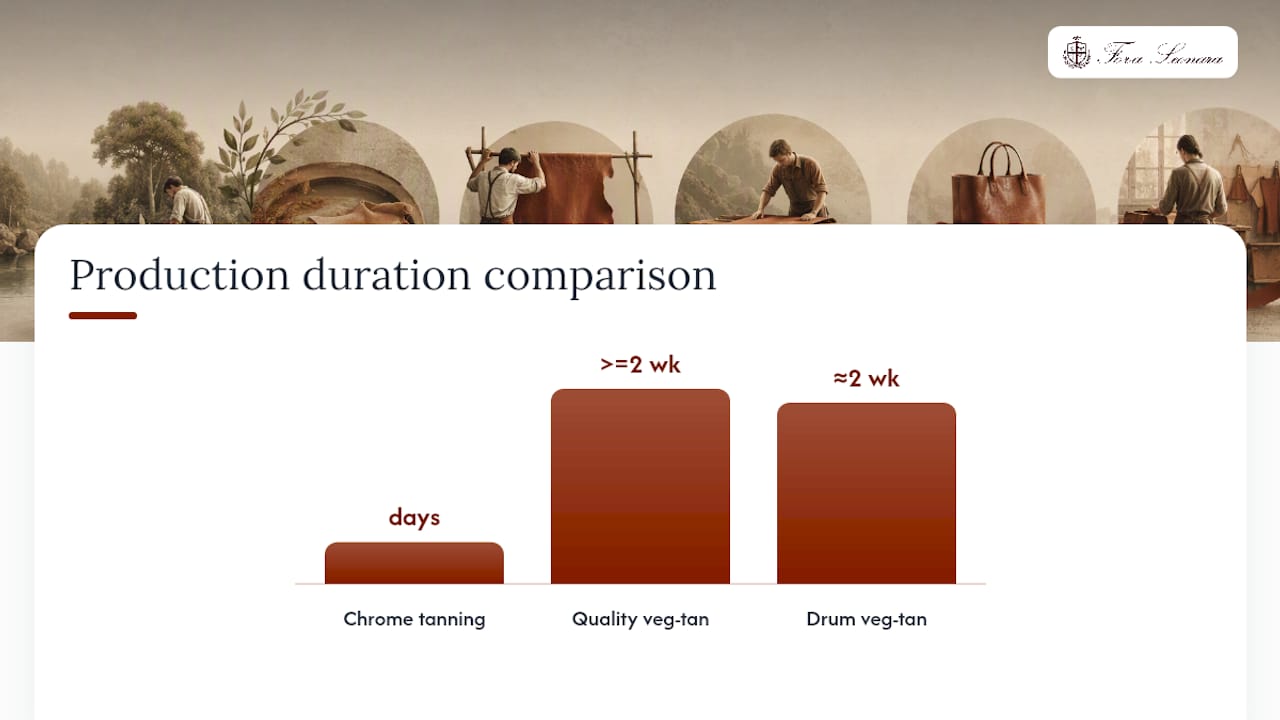
- Vegetable tanned leather takes several weeks or even months to produce, significantly longer than the one to three days for chrome-tanned leather, explaining its higher cost.
- Full veg-tan retains its firm structure, develops a rich patina over years, and is ideal for items like belts, wallets, and saddlery that benefit from aging gracefully.
- Water exposure causes spotting and darkening in veg-tan, and heavy soaking can permanently deform thinner pieces, making it unsuitable for rainproof or highly flexible applications.
- The type of tannin source influences the leather’s color and texture, with oak and chestnut producing lighter tones, while quebracho yields deeper reds.
- Veg-tan is primarily chosen for structured goods that require precise shaping, tooling, and long-term durability, rather than for soft or highly flexible products.
Table of Contents
- A Brief History of Vegetable Tanning
- How Vegetable Tanning Actually Works
- Why Crafters Choose Vegetable Tanned Leather
- The Real Drawbacks of Vegetable Tanned Leather
- Vegetable Tanned vs. Chrome Tanned Leather
- What to Actually Make With Vegetable Tanned Leather
- How to Care for Vegetable Tanned Leather
- Fora Leonara’s Approach to Material Selection
- Where to Find Investment-Grade Leather Pieces
- Sources
- FAQ
A Brief History of Vegetable Tanning
Tanners have used bark and plant matter to stabilize hide for thousands of years, but the version crafters prize today traces most directly to Italian workshops, particularly the pit tanneries around Tuscany, where the process has changed remarkably little since the early 20th century. Hides still rest in slow-moving pits of tannin liquor, sometimes for a month or more, before finishing.
That patience is the point. Small-batch tanneries treat time as an ingredient, and buyers who care about provenance look for tannage notes on a hide, the tannin source, the region, whether it was pit tanned or drum tanned, the same way a wine buyer reads a label.
- Heritage tanneries in Italy and parts of the United States still run pit and vat processes for premium hides
- Industrial chrome tanning dominates volume production because it finishes in a fraction of the time
- Some tanneries hold designations tied to regional consortiums that certify traditional methods
Modern veg-tan sits in a strange spot: a niche process by volume, but the default choice wherever a maker wants leather that ages rather than just wears out.
How Vegetable Tanning Actually Works
The process starts long before any tannin touches the hide. Raw hides go through curing to stop decomposition, then liming to loosen hair and fat, then deliming to neutralize the lime and prepare the collagen fibers to accept tannin. Only after that prep work does the actual tanning begin.
- Curing removes moisture and salts the hide to prevent bacterial breakdown before processing
- Liming softens the hide and strips hair, fat, and other unwanted tissue
- Deliming and bating neutralize the lime bath and open the fiber structure
- Tannin baths introduce plant tannins gradually, in pits or rotating drums, over days or weeks
- Drying and conditioning stabilize moisture content once the tannins have fully penetrated
- Oiling and finishing restore suppleness and set the final color and surface texture
The tannin source shapes the outcome as much as the process itself. Oak and chestnut tend to produce lighter, warmer tones and a firmer hand. Quebracho, a South American hardwood extract, gives deeper reddish color and is prized for saddlery leather. Mimosa runs paler and is often blended with other tannins for a rounder, more consistent result. Vegetable tannins can be used alone or in retanning, added after an initial tan to build fullness and tonal depth without starting the process over.
Vegetable tanned leather takes significantly longer to produce than chrome tanning, which often completes within days. That gap explains most of the price difference between the two, and it also explains why veg-tan fibers consolidate more tightly, giving the leather its characteristic firmness. Drum tanning has shortened the timeline somewhat by keeping hides in constant motion through the tannin liquor, but even accelerated drum processes rarely finish in under two weeks for a quality result, according to Leather Advice. When you’re buying material, ask whether a hide is full vegetable tanned or retanned. Full veg-tan means plant tannins did the entire job. Retanned usually means a chrome base got a vegetable finish for color and body, a legitimate technique, but a different material than pure veg-tan.
Why Crafters Choose Vegetable Tanned Leather
The patina is the headline feature, and it’s not marketing language. Vegetable tannins react to UV light, oils from your hands, and simple air exposure by darkening and deepening in tone over months and years. A natural veg-tan wallet carried daily for two years looks noticeably different, richer, warmer, more amber, than the same wallet fresh off the shelf. That transformation is part of why resale buyers in the vintage leather goods market often pay a premium for well-aged pieces rather than treating wear as damage.
Structurally, veg-tan behaves in ways softer leathers can’t match:
- It holds a burnished edge, meaning the raw edge of the hide can be sanded, slicked, and polished to a glassy finish without stitching or paint
- It wet-forms, so a soaked piece of veg-tan will hold a molded shape once it dries, which is exactly how holsters and structured cases are made
- It accepts tooling and stamping cleanly, since the dense fiber structure holds an impression instead of springing back
- It ages instead of degrading, so scuffs and scratches often blend into the patina rather than looking like damage
There’s also a sensory element buyers notice immediately: genuine veg-tan has a warm, almost sweet, earthy scent from the tannins themselves, distinct from the flatter chemical smell of freshly chrome-tanned hide.
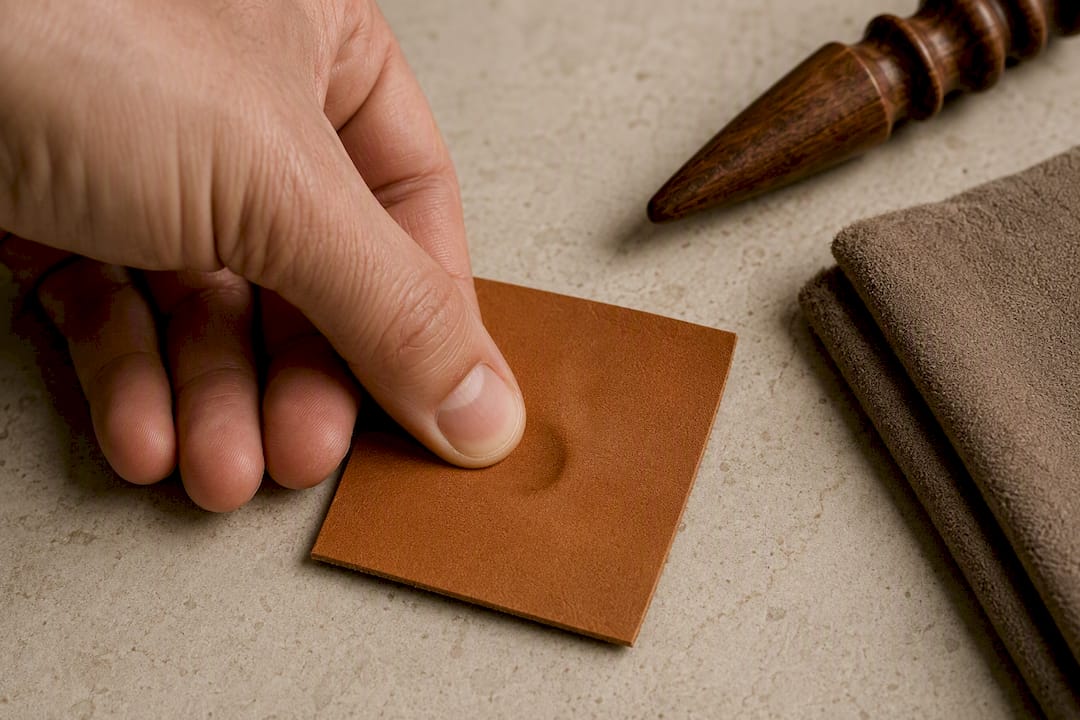
Pro Tip: Press a thumbnail gently into a veg-tan sample. If it holds a faint impression that fades over a minute or two, that’s a strong sign of a genuinely full vegetable tannage rather than a retanned or heavily finished hide.
The Real Drawbacks of Vegetable Tanned Leather
Veg-tan is not the right material for every project, and pretending otherwise does readers a disservice. Water is the biggest limitation. Untreated veg-tan spots and darkens when it gets wet, sometimes permanently, and heavy soaking can warp thinner pieces out of shape entirely.
- Water exposure causes visible spotting and color shift that conditioning only partially prevents
- Fresh veg-tan is noticeably stiff and needs a genuine break-in period before it softens to a comfortable hand
- It costs more per square foot than chrome-tanned leather, largely because of the longer production timeline
- Lead times run longer, which matters if you’re a maker working against a deadline or a buyer waiting on a custom order
- It’s a poor match for thin, stretchy components or soft garment leather, where drape and flexibility matter more than structure
If you need a leather jacket that moves with the body or a bag that needs to shrug off rain, veg-tan is the wrong starting point. Match the tannage to the job first, then worry about aesthetics.
Vegetable Tanned vs. Chrome Tanned Leather
The chemistry split explains almost everything else. Vegetable tanning bonds plant-based tannins to collagen fibers, a slow reaction that builds density and structure. Chrome tanning uses chromium(III) salts, which bond faster and produce a softer, more pliable hide with far more consistent color batch to batch. Chrome-tanned leather is also inherently more water resistant, which is why most everyday bags, shoes, and upholstery leather run through a chrome process.
The time and cost gap is stark: chrome tanning finishes in one to three days, while a proper vegetable tan runs weeks to months. That difference ripples into everything from wastewater treatment needs to how a tannery prices its hides. Neither process is universally “cleaner.” Chrome tanning uses less water and time but leaves chromium-laden effluent that requires careful treatment. Vegetable tanning uses more water and energy over its longer cycle but relies on renewable plant inputs and produces byproducts that are generally easier to manage responsibly.
| Factor | Vegetable Tanned | Chrome Tanned |
|---|---|---|
| Structure | Firm, holds shape | Soft, flexible |
| Patina | Develops over years | Minimal aesthetic change |
| Water resistance | Low without treatment | Higher, more consistent |
| Tooling and stamping | Excellent | Poor |
| Production time | Weeks to months | One to three days |
| Typical cost | Higher | Lower |
By some industry estimates, vegetable tanning accounts for a minority share of global leather production, yet it dominates the premium hard-goods and heritage segment, according to Carl Friedrik’s material research. Many tanneries split the difference with combination tanning, chrome tanning first for efficiency, then a vegetable retan for body and tonal depth. This approach is a pragmatic middle ground rather than a compromise, as Babylon Leather notes in its breakdown of the two methods.
What to Actually Make With Vegetable Tanned Leather
Veg-tan earns its reputation on structured goods, not soft ones. Belts, structured wallets, saddlery, and tooling projects are the classic applications, and for good reason: each one benefits from a material that holds a shape, takes an edge finish, and ages visibly with use.
- Belts: 8 to 10 oz veg-tan holds a clean edge and resists curling over years of daily wear
- Wallets and card cases: 4 to 6 oz gives enough structure without excessive bulk in a pocket
- Saddlery and tack: heavier weights, often 10 oz and up, handle sustained tension and friction
- Watch straps: 2.5 to 3.5 oz keeps flexibility for wrist movement while still holding a burnished edge
- Sheaths and holsters: 8 to 9 oz wet-forms cleanly around a blade or firearm and holds that shape permanently
Some products mix tannages deliberately. A bag might use veg-tan for a structured base and handles while lining the interior with a softer chrome-tanned panel, getting rigidity where it’s needed and flexibility where it isn’t. That’s not a compromise so much as good engineering, matching material properties to the demands of each component rather than forcing one leather to do every job.
How to Care for Vegetable Tanned Leather
Veg-tan rewards a little attention and punishes neglect visibly, which is part of what makes ownership feel deliberate rather than passive.
- Wipe away spills immediately with a dry or barely damp cloth, then let the piece air dry away from direct heat, which can cause cracking
- Condition sparingly, roughly every three to six months for regularly used items, with a cream or balm designed for vegetable tanned hides rather than heavy mineral oils that can darken leather permanently
- Buff in a light coat of wax if you want added water resistance, understanding that veg-tan will never become fully waterproof no matter how well it’s treated
- Watch for over-oiling, which softens fiber structure and can leave a permanently darkened, greasy appearance that’s difficult to reverse
- Send seriously worn edges or deep scuffs to a professional for restanding or edge refinishing rather than attempting a full repair at home
Café Leather’s research on tanning confirms what most experienced owners already know: conditioning extends a hide’s life and improves water resistance at the margins, but it has limits, and no topical treatment turns veg-tan into a rain-proof material. Fora Leonara’s own guide on how to condition leather walks through the safe frequency and product types in more detail for anyone maintaining a piece long term.
Fora Leonara’s Approach to Material Selection
Fora Leonara sources materials from its own European Union factory, where craftsmanship discipline extends to how leather is chosen, not just how it’s cut and stitched. Vegetable tanned leather fits naturally into that philosophy: it ages instead of aging out, and it rewards the kind of long ownership Fora Leonara designs for rather than seasonal replacement. Readers who want to see this thinking applied to finished goods can browse the small leather goods collection, or read more on the editorial case for investment leather and why provenance matters as much as construction.
Where to Find Investment-Grade Leather Pieces
Fora Leonara’s small leather goods are built around the same material logic covered here: structure that holds up, tannage chosen for longevity, and finishing that ages honestly rather than falling apart.

If a wallet or belt is next on your list, the small leather goods collection is a reasonable place to start, alongside the broader ready-to-wear range for anyone building out a full wardrobe around the same quiet-luxury standard. Pair a purchase with Fora Leonara’s conditioning guide so the piece ages the way it’s meant to, deepening in tone rather than showing wear as damage. For readers hunting the secondary market for older veg-tan pieces with an established patina already in place, sites like this pre-owned bag marketplace are worth a look before committing to new. Either way, the goal is the same: buy once, and let the leather do the aging for you.
Sources
- Chrome vs veg-tanned — Gentleman’s Gazette
- Tannins
- Vegetable-tanned vs chrome-tanned — Leather Advice
- What Is Vegetable Tanned Leather? — Galen Leather
If you’re sourcing hide directly for a project, ask the supplier for a tannage spec sheet. A reputable tannery will tell you the tannin source, whether the hide is full veg-tan or retanned, and roughly how long it spent in the tanning process. That single document tells you more than any visual inspection ever will.
FAQ
Is vegetable tanned leather better than chrome tanned leather?
Neither is universally better. Vegetable tanned leather wins for structure, tooling, and patina; chrome tanned leather wins for softness, color consistency, and water resistance. The right choice depends on what you’re making.
How long does it take to produce vegetable tanned leather?
Vegetable tanning typically takes weeks to months, compared with one to three days for chrome tanning, which is the main reason veg-tan costs more per square foot.
Can vegetable tanned leather get wet?
It can, but it will spot and darken, and heavy soaking can warp thinner pieces permanently. Light conditioning and wax treatments improve water resistance somewhat but never make it fully waterproof.
What is the best weight of vegetable tanned leather for a wallet?
Most crafters use a moderate weight of veg-tan leather for wallets that balances structure with comfort, while belts and sheaths require heavier weights to provide sturdiness.
Does Fora Leonara use vegetable tanned leather in its products?
The brand selects materials with an emphasis on longevity and quiet luxury, values that align closely with vegetable tanned leather’s aging characteristics, and its small leather goods reflect that same material discipline.
