

Virtual personal styling delivers curated outfits, a workable wardrobe plan, or both, without a single in-person fitting. Most services combine a style questionnaire with video consultations and photo review to build look boards and shopping lists within days. For investment wardrobes, pairing that styling advice with a virtual tailoring appointment, like the virtual tailoring appointments some brands offer through digital ateliers, closes the gap between “good outfit ideas” and clothes that actually fit.
TL;DR:
- Virtual styling is most effective for busy professionals, frequent travelers, and those preparing for specific events by offering tailored wardrobe plans and quick outfit ideas.
- The cost varies widely, from hourly rates to full packages that include shopping lists, revisions, and tailoring, with higher prices for senior stylists or integrated tailoring services.
- Successful booking requires clear preparation, including recent photos, measurements, defined goals, and reviewing stylist portfolios to ensure transparency and suitability.
- Integrating virtual styling with digital tailoring offers a better fit and longer-lasting wardrobe pieces, particularly valuable for investment wardrobes that prioritize quality and precise fit.
- Pricing and service scope should be carefully clarified beforehand, with attention to included revisions, sample work, and whether tailoring is part of the package.
Table of Contents
- What Does Virtual Personal Styling Include?
- How Does a Virtual Styling Session Work?
- Who Benefits Most From Remote Styling?
- What Does Virtual Personal Styling Cost?
- How Do You Choose the Right Virtual Stylist?
- How Do You Prepare for Your First Session?
- How Fora Leonara Pairs Styling and Virtual Tailoring
- The Atelier at Fora Leonara: How to Book
- Sources
- FAQ
What Does Virtual Personal Styling Include?
Services vary widely, but most fall into a handful of categories. A wardrobe audit reviews what you already own and flags gaps. Look and outfit boards give you specific combinations to wear immediately. Capsule planning builds a smaller, interchangeable set of pieces designed to reduce daily decision fatigue, an approach RealSimple’s archived capsule wardrobe guidance has long recommended for exactly this reason.
Other common offerings:
- Guided shopping lists with shoppable links matched to your budget and body type
- Event styling for a single occasion, like a wedding or a work conference
- Ongoing subscriptions that refresh recommendations seasonally
- Virtual tailoring, where a stylist or atelier collects measurements remotely to fit garments before they’re made or altered
A single session typically produces a PDF look book or a short shopping list. A full package adds capsule planning, follow-up revisions, and, in some cases, tailoring measurements tied to actual garment orders.
How Does a Virtual Styling Session Work?
Most services follow a similar arc from booking to delivery, though the tools behind them differ. AI-driven platforms like Lookastic generate outfit combinations from a virtual wardrobe you build yourself, while visual tools like Styl10 render you in outfits and remember your closet for daily suggestions. Human-led services rely more on live consultation and judgment.
- Onboarding: a style quiz, an intake form covering sizing and lifestyle, and uploaded photos or measurements.
- Session format: live video calls, asynchronous look boards sent for your review, or chat-based back and forth. Virtual tailoring appointments add a step here, collecting precise measurements through guided photos or video.
- Delivery: a single look often arrives within 48 hours. A full wardrobe program, including capsule planning and multiple revisions, usually takes one to four weeks.
Marketplace-style platforms such as Glamhive match you to a specific stylist based on your intake answers, so the format you get can depend heavily on who you’re paired with.
Who Benefits Most From Remote Styling?
Virtual styling suits some situations far better than others. Busy professionals who don’t have time to shop in person get the most obvious return, since boutique remote services like Social Garb are built specifically around saving time for people managing demanding schedules.
Beyond that, a few profiles stand out:
- People navigating a body size change benefit from wardrobe audits that reassess fit rather than repeating old sizing assumptions.
- Frequent travelers get the most value from capsule planning, since a smaller, coordinated set of pieces solves packing problems directly.
- Anyone prepping for a specific event does well with a short, focused session rather than a long-term program.
- Investment shoppers building a professional wardrobe benefit most from pairing capsule planning with tailoring, since fit determines whether expensive pieces actually get worn.
Bespoke fitting still matters more than a webcam for structural alterations, like adjusting a jacket’s shoulder line, where a tailor needs hands-on access to the garment.
What Does Virtual Personal Styling Cost?
Pricing splits into four common structures: flat one-off fees for a single session, hourly rates, multi-session packages, and monthly subscriptions. Boutique services like SilSett illustrate the split clearly, offering short “Style SOS” calls for quick advice alongside longer “Style Revamp” packages that include a full wardrobe audit and curated shopping list.
Pro Tip: Ask exactly what “package” includes before booking. A “revamp” at one service might mean a single audit; at another, it includes three follow-up rounds and a shopping list built and sent for you.
What raises the price:
- Senior or celebrity-adjacent stylists command higher hourly rates than newer stylists.
- Done-for-you shopping, where the stylist actually places orders, costs more than advice alone.
- Bespoke tailoring integrated into the package adds cost but removes the guesswork of ordering off-the-rack sizes remotely.
Editorial roundups covering the online styling market note that pricing spans from DIY app subscriptions to premium human-curated packages, so comparing scope matters more than comparing sticker price alone.
How Do You Choose the Right Virtual Stylist?
Vet a service the same way you’d vet any professional you’re paying for expertise, not just enthusiasm.
- Ask about process first. How many sessions, what’s delivered, and in what format?
- Ask about revisions. Is a second round of outfit suggestions included, or billed separately?
- Request sample work. A real stylist should have a portfolio or before-and-after examples to show.
- Ask about refunds and cancellations. Vague answers here are a warning sign.
- Ask whether tailoring is integrated or whether you’re left to handle fit adjustments on your own after the styling advice arrives.
Trust signals worth requiring: documented client testimonials, transparent pricing published before you commit, and a portfolio showing real client transformations rather than stock photography.
Pro Tip: If a stylist won’t show you a single before-and-after example, treat that as disqualifying, not just a minor gap. Portfolios are the one thing a legitimate styling business always has ready.
Red flags include scope that stays deliberately vague (“we’ll figure it out together”), refusal to share prior client work, and slow, evasive replies before you’ve even paid.
How Do You Prepare for Your First Session?
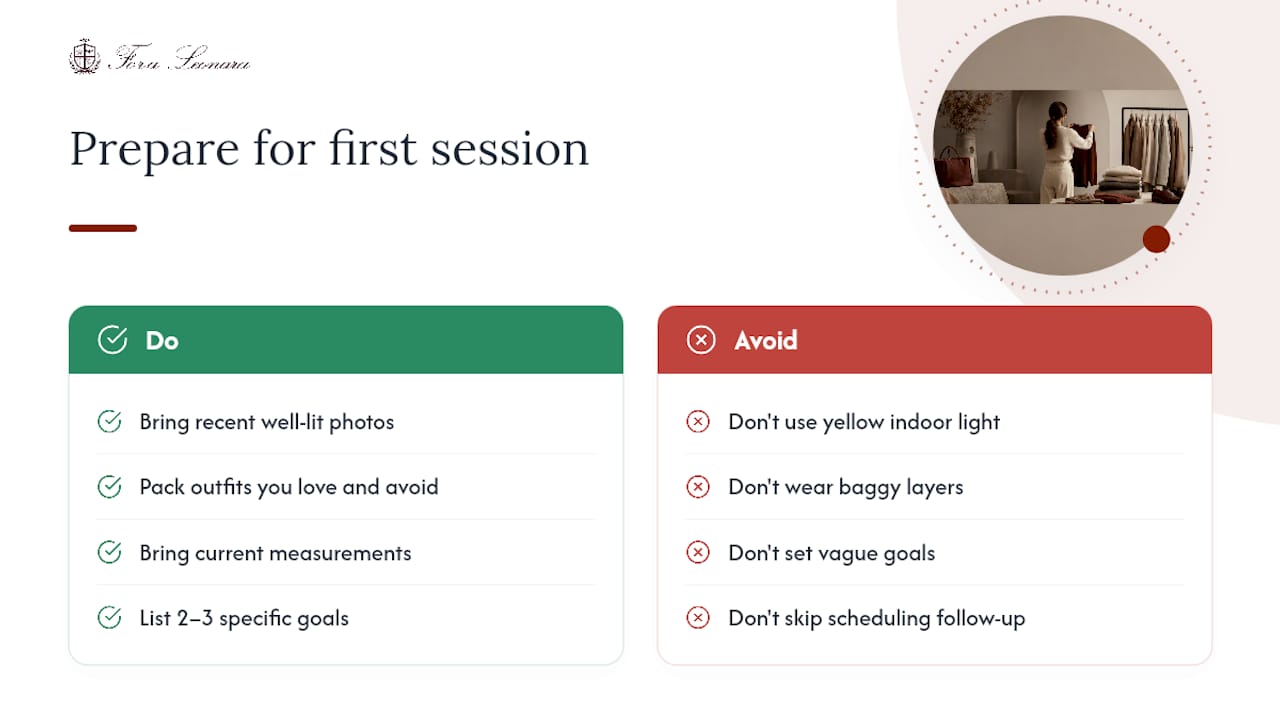
Show up with material, not just intentions. Gather recent photos in well-lit, natural light, plus a few outfits you already love and a few you actively avoid wearing. Include current measurements if the service requests them, along with a rough calendar of what you’re dressing for over the next few months, work travel, events, seasonal shifts.
For photos, stand in daylight rather than under yellow indoor bulbs, and take shots from the front, back, and side in fitted clothing so a stylist can actually assess proportion. When measuring, wear close-fitting clothes rather than baggy layers that distort the numbers.
Before the call, write down two or three specific goals, whether that’s “more versatile work outfits” or “finally solve what to wear to weddings.” Vague goals produce vague recommendations. Ask about scheduling a follow-up before the session ends, so revisions don’t stall in a scheduling back-and-forth afterward.
How Fora Leonara Pairs Styling and Virtual Tailoring
Some brands have built digital ateliers that combine styling advice with precise, measurement-driven fitting, so recommendations translate into garments cut for your actual body rather than a generic size chart.
The point of pairing styling with tailoring isn’t convenience alone. It’s reducing the gap between what a stylist suggests and what actually arrives at your door fitting the way it should.
For an investment wardrobe, that pairing matters more than it sounds. A well-styled outfit built around a poorly fitted jacket still reads as off. Garments fitted through measurement-driven tailoring tend to get worn longer and altered less, which lines up with the broader case for buying fewer, better-made pieces instead of replacing ill-fitting fast fashion every season. Fora Leonara’s approach to building a timeless professional wardrobe rests on that same logic: fewer pieces, chosen and fitted with intention, outlast a closet full of approximate sizes.
The Atelier at Fora Leonara: How to Book
Fora Leonara is the option for readers who want styling advice that ends in a garment actually built to fit, not just a shopping list you’re left to execute alone. The Atelier suits professionals assembling an investment wardrobe, particularly anyone drawn to the tailored restraint of The Wall Street Reserve, where quiet, logo-free tailoring is the entire point.

Booking starts with a request through Fora Leonara’s digital atelier, where you’ll be scheduled for a virtual appointment covering both style direction and measurement collection. Expect the first call to run through your wardrobe goals, then move into fit details, if tailoring is part of your request, so the garments you eventually order, whether a suit, a shirt, or a piece from the ready-to-wear collection, are cut with your actual proportions in mind rather than a standard size chart. If you already know the category you want to build around, browse Fora Leonara’s full product range before your appointment so the conversation starts with specifics instead of generalities.
Sources
- The 7 Best Online Styling Services of 2026 - InStyle
- Your Personal AI Stylist - Lookastic
- AI personal stylist · Styl10
- Best Way to Book a Personal Stylist Online | SilSett
FAQ
How Much Does a Virtual Stylist Cost?
Pricing depends heavily on format: single sessions can run from modest hourly rates up to premium fees for senior stylists, while packages that include shopping lists or tailoring cost more. Fora Leonara’s Atelier pricing is available directly through the booking page rather than published as a flat rate.
What Is the 3-3-3 Rule for Outfits?
It’s a capsule-wardrobe method where you build a rotation from roughly three tops, three bottoms, and three pairs of shoes (or a similar small set) worn in combination for a set period, reducing decision fatigue while stretching a limited wardrobe further.
How Do You Become a Virtual Personal Stylist?
Most virtual stylists build credibility through a portfolio of real client transformations, formal styling or fashion merchandising training, and platform experience on stylist marketplaces before working independently.
What Is the Best Online Personal Styling Service?
There’s no single best option: AI tools like Lookastic and Styl10 suit low-cost outfit generation, boutique services like SilSett suit quick advice or full revamps, and Fora Leonara’s Atelier suits readers who want styling paired directly with measurement-driven tailoring for investment pieces.
