

Ready-to-wear is off-the-rack sizing built for speed and immediate purchase. Made-to-measure adjusts a standard base pattern to your own measurements, and for most fashion-conscious buyers, it delivers meaningfully better fit and longevity per dollar. If you need something this week, buy ready-to-wear and budget for alterations. If you’re investing in a piece you’ll wear for years, made-to-measure is worth the wait, with some luxury brands built around that logic.
TL;DR:
- Ready-to-wear suits are based on standard sizes with a typical chest-to-waist ratio of six inches, often requiring significant alterations for perfect fit.
- Made-to-measure adjusts an existing pattern with 10 to 25 measurements, offering a better fit especially in chest, waist, and sleeve pitch, but may still struggle with shoulder and armhole precision.
- Fully bespoke suits, crafted from scratch with extensive handwork and multiple fittings, are best for severe postural deviations or for garments where craft is the main focus.
- Budget, fit deviation, wearing frequency, and longevity goals should guide your choice between RTW, MTM, and bespoke, with cost and timeline increasing accordingly.
- Construction quality, internal canvas type, and alteration policies significantly influence the garment’s durability and value over time.
Table of Contents
- Ready-To-Wear: What It Actually Solves (and Where It Fails)
- Made-To-Measure: How the Process Actually Works
- Where Bespoke Fits Into the Picture
- How to Choose: A Decision Framework for RTW, MTM, and Bespoke
- Cost and Timeline: What to Actually Budget
- What Fora Leonara Looks For in Fit and Construction
- Fora Leonara: A Direct Path to Better Fit
- Sources
- FAQ
Ready-To-Wear: What It Actually Solves (and Where It Fails)
Ready-to-wear, or RTW, means the garment already exists in a fixed size before you ever walk into a store. Manufacturers cut in standardized blocks, like 38R or 42L, and ship inventory that’s meant to fit a statistical average, not you specifically. That’s the entire trade: speed and predictability in exchange for a compromise on fit.
The compromise usually shows up in one place first: the drop. Most RTW suit jackets are built assuming a fixed chest-to-waist relationship, typically a 6-inch difference between chest and waist measurements. If your body doesn’t match that ratio, either the jacket or the trouser is going to need real alteration work, not just a quick hem.
Construction is the other variable that separates a $400 jacket from a $1,200 one, and it’s rarely obvious from the outside. Lower-tier RTW often uses fused interlining, a layer of canvas glued rather than stitched to the shell fabric. It looks fine on day one. Over time, fused construction is more prone to bubbling and loses its shape faster than half or full canvas construction, which is stitched by hand or machine and moves with your body instead of against it.
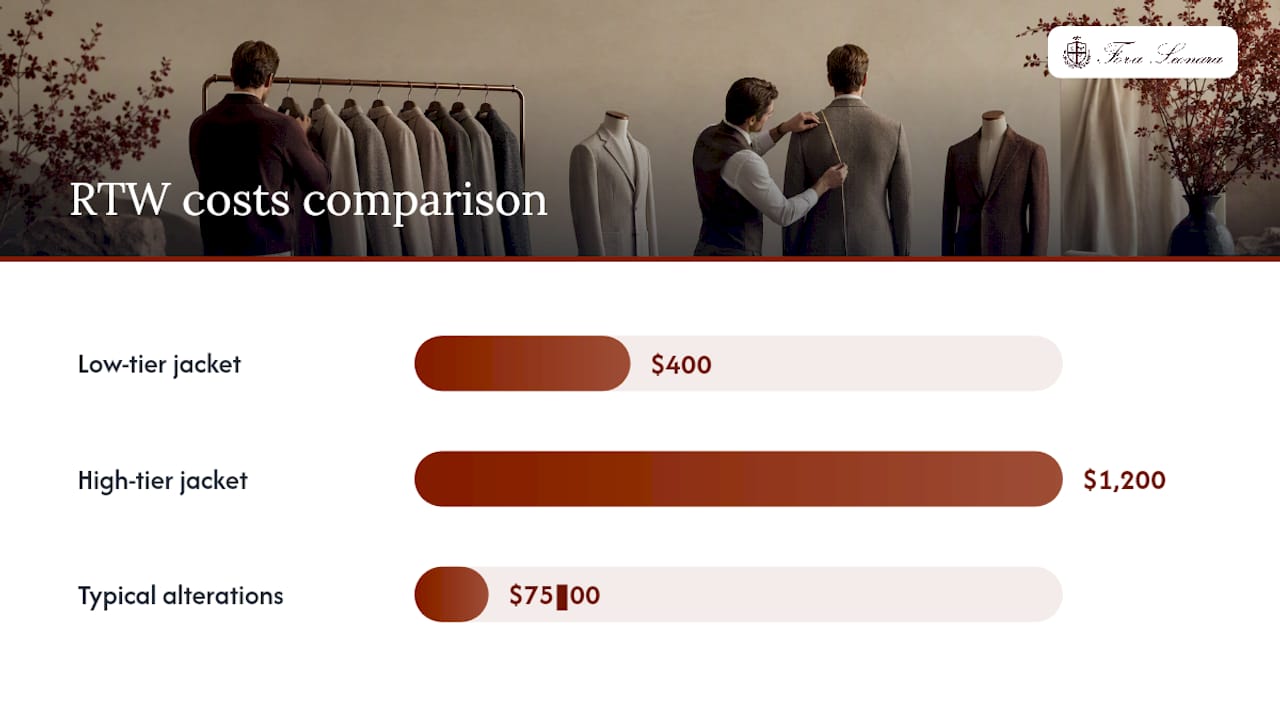
Alterations can only do so much. A tailor can shorten a sleeve, take in a waist, or adjust a trouser break in an afternoon. What a tailor generally cannot fix is a shoulder seam that sits wrong on your frame, because that requires re-cutting the entire shoulder and armhole, work that often costs more than the garment itself.
Before you buy anything off the rack, run this quick check:
- Shoulder seam: it should sit right at the edge of your shoulder bone, no divots, no pulling.
- Sleeve pitch: your arm should hang naturally without the sleeve twisting or bunching at the elbow.
- Canvas type: ask or feel for it. Pinch the front chest panel; if it springs back cleanly, it’s likely canvassed.
- Alteration budget: assume $75 to $200 or more depending on what needs work, and factor that into the real price.
Pro Tip: Try the jacket on and raise both arms straight up. If the whole jacket rides up past your hips instead of just the sleeve, the shoulder fit is off, and no tailor can correct that cheaply.
Made-To-Measure: How the Process Actually Works
Made-to-measure, or MTM, starts from an existing base pattern, then adjusts it using your individual measurements before cutting. It’s not a pattern built from nothing, and that distinction matters more than most shoppers realize.
The typical MTM process takes between 10 and 25 measurements, covering chest, waist, shoulder width, sleeve length, back length, and trouser rise, among others. Those numbers get fed into a modified block pattern rather than a hand-drafted one. The result: a jacket that balances properly across your chest and waist, a sleeve pitched to match how your arm actually hangs, and trousers with a rise that sits where your body needs it, not where an average customer’s does. Most MTM programs also open up a customization menu: lapel width and style, lining color, pocket configuration, button choice, and sometimes vent style or working buttonholes on the cuff.
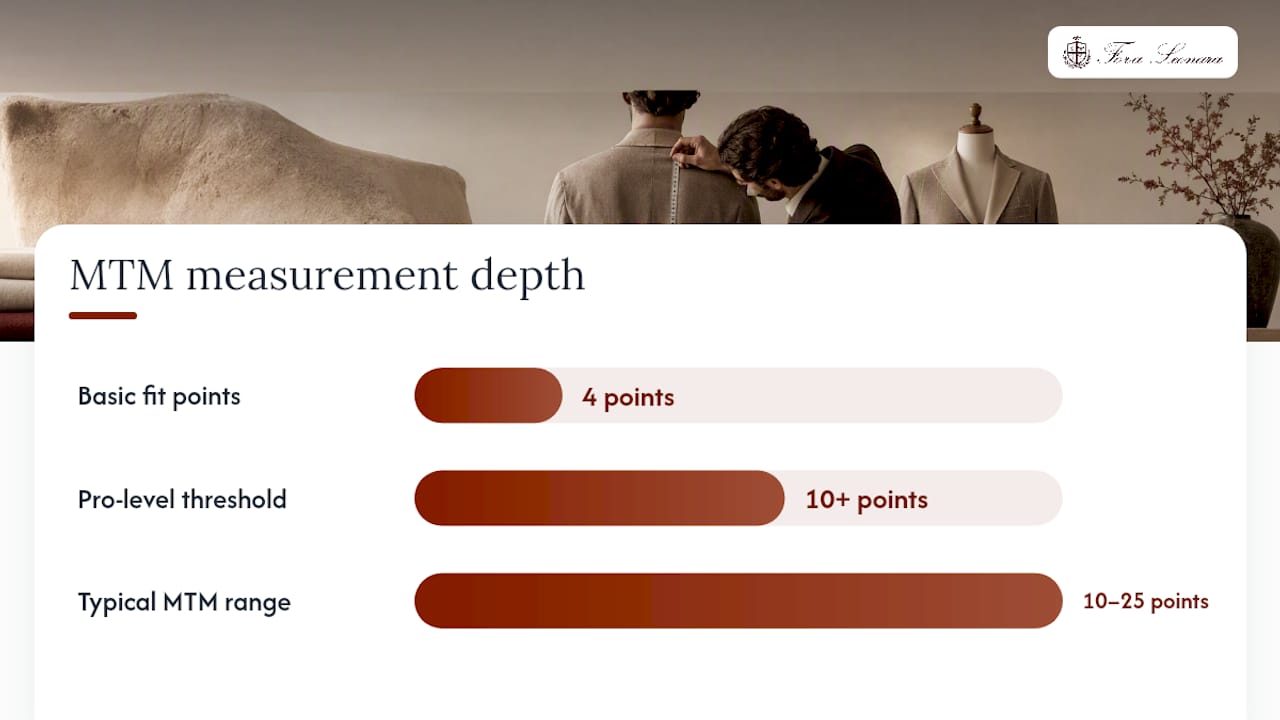
Where MTM still falls short of bespoke is precision at the shoulder and armhole. Because the starting point is a template, not your unique frame, MTM can get close on shoulder fit but rarely nails it with the same accuracy as a pattern drafted from scratch. That’s the real technical line between the two methods, not fabric quality or price alone.
Quality varies enormously between MTM providers, and this is the part most buyers skip past. Three things determine the outcome:
- Measurement technique: whether a trained fitter takes your measurements in person or you self-measure from a chart at home.
- Pattern-transfer system: how accurately the provider’s software or pattern-maker translates your numbers into the adjusted block.
- Factory skill level: the same measurements can produce very different garments depending on who’s actually cutting and sewing.
Before committing to an MTM provider, ask these questions directly: Where does the base pattern come from, and how many measurements do they take? Is there an in-person or guided virtual fitting, or are you measuring yourself blind? What’s the policy if the first garment doesn’t fit, and is there a window for a second fitting or free adjustment?
Pro Tip: Ask an MTM provider how many fit points they adjust beyond the basic four (chest, waist, shoulder, sleeve). A program that touches ten or more, including things like shoulder slope and back balance, will almost always outperform one that only tweaks the obvious three.
Industry commentary consistently points to MTM as the practical middle ground: it delivers most of the fit benefit of bespoke at a fraction of the cost, which is exactly why it’s become the default recommendation for buyers who wear tailored clothing regularly but don’t need a fully hand-drafted garment.
Where Bespoke Fits Into the Picture
Bespoke means a pattern drafted individually from scratch, not adjusted from an existing block, combined with substantial hand-work and several fittings along the way. Industry definitions tied to Savile Row and bodies like the Savile Row Bespoke Association put the hand-work involved at 50 or more hours per garment, which explains both the price and the timeline.
Bespoke earns its cost in specific situations: significant postural asymmetry that no template can accommodate, or when the craft process itself is the point, not just the result. For most people buying a work suit or a wardrobe staple, it’s overkill.
Here’s what to verify before paying bespoke prices for something that isn’t:
- Ask directly whether the pattern is drafted from your measurements alone or adjusted from a house block.
- Ask how many fittings are included and whether a paper pattern is kept on file for you specifically.
- Watch for the word “bespoke” used loosely in marketing when the real process is closer to MTM than to a true individually drafted garment.
How to Choose: A Decision Framework for RTW, MTM, and Bespoke
Pick your method by weighing five things, in this order of priority for most buyers: how soon you need the garment, how far your body sits from a standard block, how often you’ll wear the piece, your budget, and how long you want it to last.
- Urgency: need it in days, not weeks? RTW with alterations is your only real option.
- Body type: significant deviation from standard proportions (long arms, sloped shoulders, a shorter rise) pushes you toward MTM or bespoke.
- Frequency of wear: a suit you’ll wear weekly justifies MTM’s cost; a suit for one event probably doesn’t.
- Budget: know your ceiling before you shop, and factor in alteration costs for RTW, not just sticker price.
- Longevity goals: if you’re buying to keep for a decade, construction quality matters more than the label on the price tag.
When you’re evaluating any provider, RTW, MTM, or bespoke, ask these questions in this order:
- What measurements are actually taken, and by whom?
- What’s the canvas construction: fused, half, or full?
- What’s the alteration policy, and is a second fitting included?
- Can you see or feel the internal construction before buying?
A few practical red flags worth knowing:
- If a brand won’t show you the inside of a jacket (the canvas, the interlining, the seam finishing), that’s worth questioning.
- Always confirm there’s enough seam allowance left for future alterations, especially at the waist.
- Understand the return or refit window before you pay, particularly for MTM, where the first fitting isn’t always the final one.
Cost and Timeline: What to Actually Budget
Price ranges vary by brand and market, but the general bands hold up across most guides: RTW suits run from roughly $300 to $1,500 or more depending on construction quality, MTM typically runs higher for the customization and fitting work involved, and bespoke sits well above both once you account for the hours of hand-work.
Lead times follow a predictable pattern: RTW is available same day, MTM commonly takes 3 to 8 weeks, and bespoke runs 8 to 12 weeks or longer, depending on fabric availability and how many fittings are required.
Alterations are where RTW’s real cost hides. Sleeve shortening, trouser hemming, and waist suppression are common line items, and total alteration costs often land between $75 and $200 or more depending on how much work is needed. Run the math on cost-per-wear: a $600 RTW suit needing $150 in alterations that you wear 20 times a year for three years costs roughly $12.50 per wear. A $1,200 MTM suit that fits correctly out of the box and lasts twice as long, worn the same amount, can land at a similar or lower cost-per-wear once you factor in the alteration savings and extended lifespan.
What Fora Leonara Looks For in Fit and Construction
When Fora Leonara evaluates a jacket, whether it’s a fitting or a finished garment, four points get checked before anything else: shoulder seam placement, sleeve pitch, collar roll, and overall balance between front and back. Poor shoulder fit is treated as disqualifying, because it’s the one flaw alterations genuinely cannot correct after the fact.
Producing in an EU-based factory gives Fora Leonara direct control over canvas selection and finishing, which shapes both the drape of a jacket and its cost-per-wear over years of use, not just its price on day one.
A few habits extend the life of any investment garment:
- Rotate suits across at least two to three days between wears to let fibers recover.
- Use wooden hangers with a shaped shoulder, never wire.
- Have canvassed jackets re-pressed by a tailor annually rather than relying on home steaming alone.
Pro Tip: If a jacket has full or half canvas construction, it’s worth a professional press once a year. It resets the roll of the lapel and the drape across the chest far better than steaming at home ever will.
Fora Leonara: A Direct Path to Better Fit
Not every reader wants to build a full MTM order from scratch, and not every wardrobe gap needs one. Fora Leonara offers two clear paths depending on what you need right now.

If you want a curated, ready-to-buy piece with the construction quality that separates real tailoring from fast fashion, the ready-to-wear collection is built for exactly that: no guesswork on canvas or finishing, sized with the fit issues described above already accounted for. If you’re closer to the investment end of the decision, buying a suit you intend to keep for a decade rather than a season, Fora Leonara’s virtual private atelier appointments give you a guided path toward measurement-based fit without needing to walk into a physical store. The signature line, The Wall Street Reserve, was built specifically for that second reader: quiet, logo-free pieces meant to outlast trend cycles. Browse men’s tailoring or women’s collections to see where your size and priorities line up, and book a virtual atelier appointment if you’re ready to move past off-the-rack compromises for good.
Sources
- Ready-to-wear — Wikipedia
- Bespoke vs Made-to-Measure vs Off-the-Rack: What’s Actually Different (Nathan Tailors)
FAQ
What Does “Ready to Wear” Mean?
Ready-to-wear refers to clothing mass-produced in standard, fixed sizes and available for immediate purchase, without any measurements taken for the individual buyer.
What’s the Difference Between Made-to-Measure and Ready-to-Wear?
Ready-to-wear uses a fixed standard size, while made-to-measure adjusts an existing base pattern using your own measurements, typically 10 to 25 data points, for a notably closer fit without the full cost of bespoke.
How Much More Does Made-to-Measure Cost Than Ready-to-Wear?
Made-to-measure typically costs more than RTW upfront, but it often delivers most of the fit benefit of bespoke at a fraction of bespoke pricing, and can lower your effective cost-per-wear once alteration expenses on RTW are factored in.
What Is the 3-3-3 Rule for Clothing?
The 3-3-3 rule is a minimalist styling approach where you build outfits from 3 tops, 3 bottoms, and 3 pairs of shoes; it’s a wardrobe-planning concept rather than a tailoring standard, and it works best when the pieces in rotation are genuinely durable, which is where investment-grade construction matters most.
What’s the Real Difference Between a $500 Suit and a $5,000 Suit?
The gap usually comes down to construction and materials: a lower-tier RTW suit often uses fused interlining and lower-grade cloth, while a higher-end suit typically features full canvas construction, finer wool, and more hand-finishing, all of which affect drape, durability, and how the garment ages over years of wear.
