

In-house manufacturing means a garment is cut, sewn, and finished under a brand’s direct control, inside its own atelier, rather than farmed out to a subcontractor the label barely oversees. For a buyer, that distinction is the difference between a label’s word and a label’s fabric mill, stitch count, and quality checkpoint. Houses like Fora Leonara build cost-per-wear value on exactly this kind of control.
TL;DR:
- Verifiable signals of genuine in-house manufacturing include named ateliers, production run numbers, and disclosures of fabric suppliers.
- Quality markers such as precise fabric origin, dense stitching, and hand-finished seams indicate superior durability and craftsmanship.
- In-house control enables better consistency and integration between design and production, reducing hidden costs and improving material quality.
- Durable, well-made garments with features like canvassing and full lining justify higher upfront prices due to lower cost-per-wear over time.
- Brands like Fora Leonara maintain strict oversight of their own European ateliers, ensuring transparency and quality in every piece.
Table of Contents
- What In-House Manufacturing Fashion Actually Changes for Buyers
- A Buyer’s Checklist for Evaluating In-House-Made Garments
- Fabric and Tailoring Markers That Signal Investment-Grade Construction
- The Investment Case: Why Cost-Per-Wear Favors In-House Garments
- How to Verify a Brand’s In-House Manufacturing Claims
- How Fora Leonara Builds Quiet Luxury From the Atelier Up
- Sources
- FAQ
What In-House Manufacturing Fashion Actually Changes for Buyers
Ownership of the production line does not automatically make a garment better. It makes accountability possible, which is a different thing, and a more useful one.
When a brand controls its own factory, the people setting stitch density, canvas weight, and finishing standards answer to the design team, not to a third-party contractor juggling five other clients that month. That managerial proximity is what lets a house guarantee consistency season after season, a point Deloitte’s analysis of the luxury sector draws out when it discusses why vertically controlled houses can authenticate provenance in ways arm’s-length outsourcing rarely replicates. A subcontractor optimizes for throughput. An in-house atelier optimizes for the signature techniques that make a house recognizable without a logo.
There’s a cost angle too, and it is easy to miss. Outsourced production carries hidden expenses: inspection rounds, rework on failed batches, sorting for defects before a single garment ships. Insourcing lets a brand build quality into the first pass instead of catching problems after the fact, according to a BCG and Highsnobiety whitepaper on luxury craft economics. That saved cost tends to show up as better materials rather than a lower price.
None of this happens automatically, though. Owning a factory that lacks the specific skill to hand finish a buttonhole or drape a bias cut is just owning a building. What matters is whether the ownership secures a genuine capability, not merely production capacity, as research on vertical integration in luxury points out. A few things separate real capability from box checking:
- Named, traceable ateliers rather than a generic “own facilities” claim
- Retained artisans with documented tenure in a specific technique
- A visible link between design decisions and production choices, not a design team disconnected from the factory floor
- Consistency across seasons, not a one time flagship collection
Consumers have caught on to this distinction. Fabric quality and production process now rank among the top factors shoppers weigh when evaluating a luxury brand, per research on traceability and transparency in fashion. The brands rewarded for that scrutiny are the ones that can actually show their work.
A Buyer’s Checklist for Evaluating In-House-Made Garments
You don’t need a textile degree to spot the difference between a garment cut by someone who owns the outcome and one cut by whoever bid lowest. You need to know where to look.
- Check the fabric provenance. A tag or product page naming a specific mill, or at minimum a country and fiber origin, beats a vague “premium fabric” claim every time.
- Count the stitches per inch. Along a seam or hem, denser, even stitching signals a slower, more deliberate machine pass or hand finish rather than a rushed run.
- Examine the seam finishing. Turn the garment inside out. Bound or French seams that lie flat without fraying suggest a factory built for durability, not just speed.
- Look at the lining. A full lining in a jacket or trouser, cut from a fabric that matches the shell’s quality tier, is a reliable proxy for whether corners were cut elsewhere.
- Inspect the hardware. Buttons, zippers, and clasps that feel substantial and sit flush usually come from a supplier chain the brand vetted itself.
- Look for a production run number or atelier reference. Brands with nothing to hide tend to print or disclose one.
- Search for traceability documentation, such as a Digital Product Passport or an equivalent supply-chain statement, rather than a single unverifiable “Made in” line.
Fora Leonara’s own connoisseur’s checklist for identifying quality clothing brands walks through several of these markers in more depth, including how to read a garment’s construction under normal store lighting.
Watch for the inverse signals too: a “made in” claim with no city, atelier, or region attached; product photography that shows only flat lays and never construction detail; or descriptions that change fabric composition between the product page and the care label. Those inconsistencies are rarely accidents.
Pro Tip: Photograph the inside seams and lining before you decide, then compare that image against the brand’s own atelier photography on its site. If the construction style doesn’t match what the brand claims to produce, ask before you buy.
Fabric and Tailoring Markers That Signal Investment-Grade Construction
Two garments can look identical on a hanger and diverge completely in how they age. The difference usually comes down to markers that only show up once you handle the cloth or turn a seam inside out.
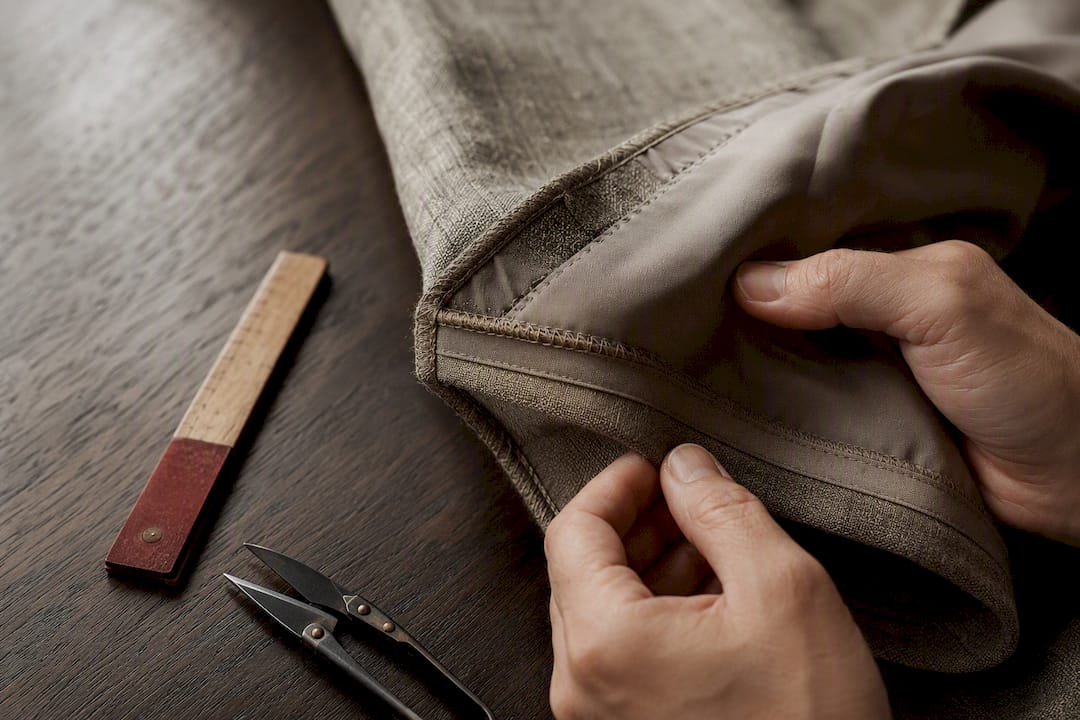
Start with the fabric itself. Mill origin matters because reputable European and British mills, names like those behind worsted wool or Italian linen, have reputations built over decades on weave consistency and finish. A tight, even weave resists pilling and holds a crease; a loose or irregular one won’t. Fiber composition should be stated precisely, not rounded to “wool blend,” and the finish, whether a cloth is brushed, milled, or given a particular sheen, tells you how it will behave after repeated wear.
Tailoring markers matter just as much:
- Canvassing. A full or half canvas construction in a jacket, versus a fused interlining, determines whether the garment molds to the body over time or simply goes limp.
- Hand stitching. Hand-finished lapels and armholes flex with movement in a way machine-only construction cannot match.
- Buttonhole finishing. A hand-worked buttonhole has a slightly irregular, raised edge; a machine buttonhole looks perfectly uniform and flat.
- Pattern matching. Stripes and checks that align across seams and pockets indicate a cutter who prioritized precision over yield.
- Seam allowance. Generous allowances mean a garment can be let out as fit changes, extending its usable life by years.
Fora Leonara’s guide to how a suit is actually made breaks down canvassing and hand finishing in more detail, and its editorial guide to spotting high-quality fabrics covers weave and mill markers buyer by buyer. Every one of these choices maps directly to durability. A fused jacket might look fine in month one; a canvassed one still holds its shape in year eight. That gap is exactly what cost-per-wear is built to measure.
The Investment Case: Why Cost-Per-Wear Favors In-House Garments
Cost-per-wear divides a garment’s price by the number of times you actually wear it, and it’s the cleanest way to compare a $180 fast-fashion shirt against a $340 in-house-made one. The math almost always favors the better-built piece, because durability and repeat wear compound.
A shirt that survives 200 washes without collar fray costs less per wear than one that needs replacing after 30, even at a fraction of the price. Fora Leonara’s Cost Per Wear Formula guidance walks through this calculation directly, and the underlying logic holds regardless of brand: garments built with canvassing, hand finishing, and traceable fabric tend to have a longer usable life, which lowers their real cost even when the sticker price is higher.
Different categories carry different thresholds:
- A tailored wool suit built to last a decade or more can reasonably justify a higher upfront price than one expected to hold up for two or three seasons.
- Premium knitwear made from finer, tightly spun fibers resists pilling and stretching, extending wear count well past a mass-market equivalent.
- A well-constructed dress shirt with reinforced seams and a quality collar interlining often outlasts three or four fast-fashion replacements.
The core figure to remember: cost-per-wear only drops when both durability and actual usage rise together. A beautiful garment left in the closet still has a high cost-per-wear.
How to Verify a Brand’s In-House Manufacturing Claims
Most brands say “crafted with care.” Fewer can answer specific questions about where and how.
- Ask which atelier produces the garment, and where it’s located. A credible answer names a city or region, not just a country.
- Ask which production stages happen in-house versus outsourced. Cutting, sewing, and finishing are the three to press on specifically.
- Ask who supplies the raw materials. A brand that names its mills or leather tanneries is disclosing something a brand hiding behind “premium materials” is not.
- Request a lot or run number, or ask whether one exists for the piece you’re considering.
- Ask whether atelier visits or virtual appointments are available. A brand confident in its process usually says yes.
Vague, deflecting answers are themselves useful data. Specific ones, backed by imagery or documentation as research on luxury’s craft economy notes, are what separate a real provenance story from marketing language.
How Fora Leonara Builds Quiet Luxury From the Atelier Up
Fora Leonara was founded on the belief that a garment’s quality should be verifiable, not asserted. Every piece, from linen shirting to wool suiting, moves through the brand’s proprietary European atelier under direct oversight, which is what allows the house to stand behind its construction rather than a supplier’s promise.

That control shows up most clearly in The Wall Street Reserve, the house’s signature line built for US professionals who want tailoring that reads as deliberate rather than loud. No visible branding, no logo doing the talking, just fabric sourcing and construction that hold up under the kind of scrutiny this article just walked through. If you want to see the difference in person rather than take a brand’s word for it, Fora Leonara’s virtual private atelier appointments let you ask the exact questions covered above and get specific answers.
Browse the current ready-to-wear collection to see the construction markers firsthand, or go directly to the men’s or women’s categories to find a piece built for how you actually wear clothes, not just how they photograph.
Sources
- Traceability and transparency: why they have become strategic imperatives in fashion luxury
- Global powers of luxury (Deloitte analysis)
- Vertical integration in luxury: control, risk and the ecosystem crossroads
FAQ
What Does “In-House Manufacturing” Mean in Fashion?
It means a brand cuts, sews, and finishes its garments inside a facility it owns and directly oversees, rather than contracting that work to an outside factory with limited brand supervision.
How Can I Tell If a Garment Was Really Made In-House?
Look for specific, verifiable signals: named atelier locations, production run numbers, mill or fabric supplier disclosures, and construction details visible in the seams and lining, not just a general “made in” label.
Does In-House Manufacturing Guarantee Better Quality?
It creates the conditions for better quality by removing outsourced inspection costs and giving a brand direct control over technique, but ownership only matters if the factory has genuine artisanal capability, not just production capacity.
Why Does Fora Leonara Manufacture In-House?
Fora Leonara produces its garments in its own European atelier under founder Rafael Zard’s oversight, which lets the house control material sourcing and construction quality directly rather than relying on a subcontractor’s standards.
What Is Cost-Per-Wear and Why Does It Matter for Luxury Purchases?
Cost-per-wear divides a garment’s price by how many times you wear it, and well-constructed, in-house-made pieces typically lower that figure over time because they last longer and hold their shape through repeated use.
