

Nappa is a finishing and tanning style, not an animal. Calfskin names the hide itself, taken from young cattle. Choose Nappa-finished goods when you want a buttery, soft hand-feel that drapes; choose calfskin when you want dress-grade structure, a high polish, and grain that resists creasing. The two aren’t rivals, either, since plenty of Nappa leather is made from calfskin hides in the first place.
TL;DR:
- Nappa leather is a finishing style often made from calfskin but can also derive from lamb or goat hides; calfskin is defined by the animal’s age, typically under six months old.
- Softness in Nappa comes from chrome tanning, aniline dyeing, and fatliquoring, with surface finish affecting durability and stain resistance.
- Calfskin’s fine grain and density make it ideal for structured, polished products like dress shoes and wallets, but it is generally more expensive per hide due to yield and quality control.
- Genuine Nappa and calfskin show natural grain variation and a distinct leather scent; synthetic alternatives and bonded leathers lack authenticity and breathability.
- Luxury goods favor uncorrected, full-grain Nappa or calfskin for longevity and patina, while corrected or pigmented leathers target affordability and durability for everyday use.
Table of Contents
- Nappa Leather vs Calfskin: The Core Difference Explained
- Tanning, Finishing, and What Actually Makes Nappa Soft
- Calfskin Anatomy: Why Younger Hides Behave Differently
- How Nappa and Calfskin Perform Under Real Wear
- Where Each Leather Actually Belongs
- Keeping Nappa and Calfskin Looking Their Best
- Spotting Real Nappa and Genuine Calfskin
- Fora Leonara’s Approach to Sourcing Fine Leather
- Environmental and Ethical Sourcing Considerations
- What Nappa and Calfskin Actually Cost
- Luxury Goods vs Everyday Products: Where the Line Falls
- Fora Leonara’s Leather Goods, Chosen for the Long Run
- Sources
- FAQ
Nappa Leather vs Calfskin: The Core Difference Explained
The confusion around “nappa leather vs calfskin” comes from mixing up two different categories. One describes how a hide is tanned and finished. The other describes which animal, and what age, the hide came from. You can have calfskin that isn’t Nappa, and Nappa that isn’t calfskin.
The name Nappa dates back to a specific American innovation. The tanning method was developed in Napa, California, in the late nineteenth century, reportedly by a tanner named Emanuel Manasse working for a company there, and the geographic name stuck to the process itself, according to Wikipedia’s history of Nappa leather. Today “Nappa” refers to a soft, full grain or top grain leather typically finished through chrome tanning, aniline dyeing, and fatliquoring, a combination that produces that signature pliable feel prized in handbags, driving gloves, and car seats.
Calfskin, on the other hand, is defined purely by the animal’s age. It comes from cattle typically under about six months old, before the hide develops the coarser fiber structure of adult cowhide. That younger hide has a tighter, finer grain and a denser fiber pack, which is why tanners describe calfskin as thinner but often stronger per square inch than cowhide.
Here’s where the overlap happens:
- Nappa can be produced from calf, lamb, or kid hides, not just adult cattle.
- A dictionary-level definition even limits Nappa to sheep or goat skin in some usage, per Oxford Learner’s Dictionary, which shows how loosely the term travels across the trade.
- Calfskin that hasn’t gone through Nappa finishing (say, a vegetable-tanned calf hide) is still calfskin. It just isn’t Nappa.
So when someone says “Nappa vs calfskin,” they’re often really asking “soft chrome-tanned finish vs firmer traditional finish,” while both pieces might have come from the exact same kind of hide.
Tanning, Finishing, and What Actually Makes Nappa Soft
Softness in Nappa leather isn’t an accident of the animal. It’s built, step by step, in the tannery. Here’s the general sequence tanneries follow to get that signature drape:
- Hide selection. Young, fine-grained hides go into the Nappa pipeline first, since they already start with fewer scars and tighter fiber structure.
- Chrome or combination tanning. Chromium salts penetrate the hide quickly and leave it flexible, which is why chrome tanning is the standard method behind most modern Nappa leather.
- Aniline dyeing. Soluble dyes soak through the hide rather than sitting on top of it, preserving the natural grain and letting the surface stay breathable.
- Fatliquoring. Oils and fats get worked into the fibers during this stage, which is the single biggest contributor to that soft, almost pillowy hand-feel.
- Finishing. A light surface treatment, or none at all for pure aniline Nappa, determines how much natural texture and vulnerability remains visible.
Each stage trades one property for another. Aniline-dyed, lightly finished Nappa feels incredible against the hand and shows the hide’s natural character, but it also scratches and stains more easily since there’s little protective coating standing between the surface and the world. Heavier pigmented or semi-aniline finishes sacrifice some of that softness for a leather that shrugs off water spots and light scuffs.
Pro Tip: If you’re comparing two Nappa items side by side, press your thumb into the surface. If it springs back with no visible mark, it likely has a protective top coat. If it holds a faint impression, you’re looking at pure aniline Nappa, softer but more delicate.
Calfskin Anatomy: Why Younger Hides Behave Differently
Calfskin’s properties trace directly back to the animal’s age at slaughter. Cattle raised past that young threshold develop thicker, coarser collagen fiber bundles as they mature, which is exactly what calfskin avoids.
A few anatomical facts explain most of what buyers notice in finished goods:
- Calfskin runs thinner than adult cowhide, generally in a range tanners consider suitable for lining and dress leather rather than structural or heavy-duty use.
- Despite being thinner, its fiber packing is denser, which is why calfskin can outperform adult cowhide on tensile strength measured per square inch.
- The grain surface is tighter and more uniform, with fewer visible pores, which is what gives calfskin shoes and wallets that glassy, refined look under polish.
- Fewer scars and growth marks show up on younger hides, since the animal has had less time to accumulate the scrapes and insect bites that mar mature cowhide.
That density and grain quality come at a cost, literally. Calves yield smaller hides than full grown cattle, so a maker gets less usable leather per animal. Combine that with the tighter quality control needed to keep such a fine grain consistent across a hide, and you get a material that tanneries and makers routinely price at a premium over standard cowhide. That’s the economic reason calfskin shows up disproportionately in formal shoes, wallets, and fine linings rather than work boots or heavy bags.
How Nappa and Calfskin Perform Under Real Wear
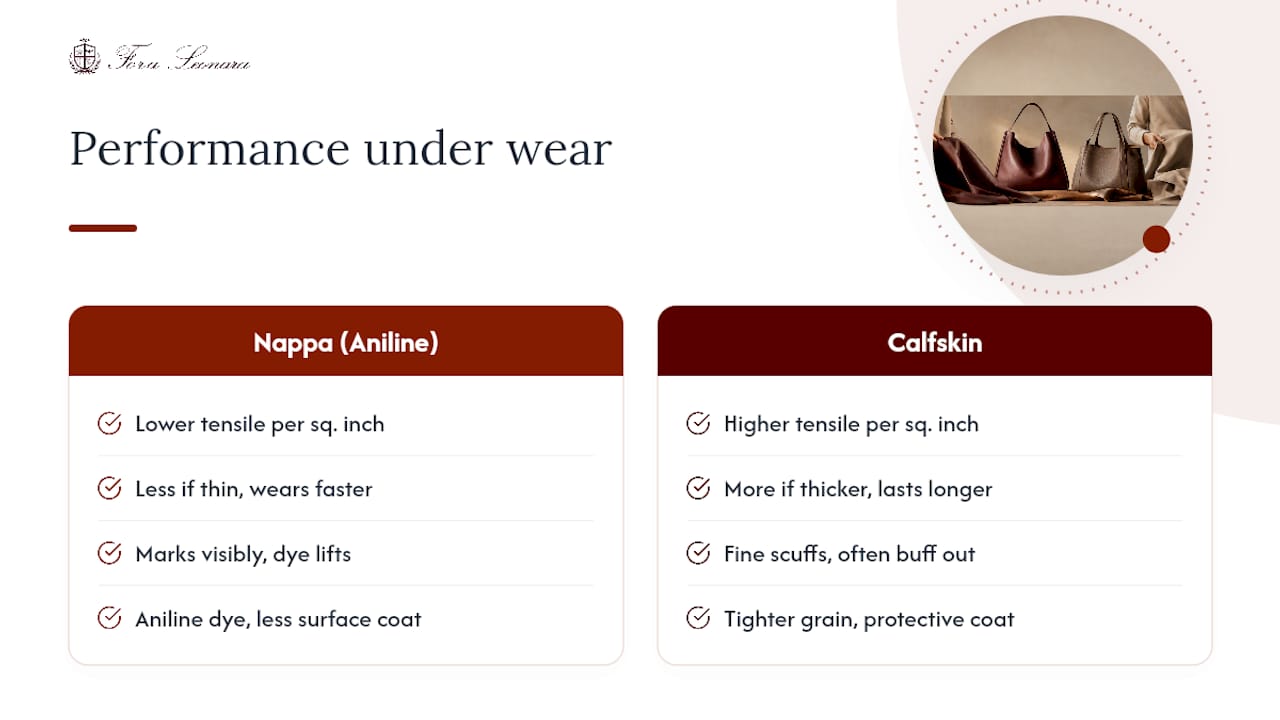
Strength numbers get misread constantly in this comparison. Calfskin’s advantage in tensile strength is measured per square inch of material, not as an absolute claim about toughness. A thicker adult cowhide can still outlast a thinner calfskin panel in raw abrasion resistance and impact durability, even if the calfskin technically resists tearing better relative to its own thickness, a distinction tanner analysis draws out clearly.
Where the numbers actually matter: Calfskin’s density gives it superior tensile strength per square inch, but a thicker hide, regardless of animal age, generally wins on absolute abrasion resistance and long-term surface toughness simply because there’s more material to wear through.
Scratches tell a different story depending on finish, not just origin. Calfskin’s tight grain shows fine scuffs as light surface marks that often buff out with a cloth and a little conditioner. Aniline Nappa, whether from calf, lamb, or kid, marks more visibly because the dye sits in the fiber rather than under a protective coat, so a scratch can lift color and show a lighter line underneath.
For lifespan, expect light-use dress goods in either material, a wallet, a pair of gloves, a handbag carried occasionally, to hold their look for years with basic care. Daily-carry pieces under heavier stress wear faster in soft aniline Nappa than in a firmer, thicker calfskin or a protected pigmented finish, simply because there’s less buffer between hand contact and the dye layer.
Where Each Leather Actually Belongs
Match the material to the job, and most of the “which is better” debate disappears. Nappa’s give and softness make it the natural choice for goods that need to flex or cushion:
- Soft structured or slouchy handbags, where drape matters more than rigidity.
- Driving gloves and interior automotive upholstery, where flexibility and a cushioned feel improve daily use, one of the most common commercial applications for Nappa.
- Outerwear linings and soft leather jackets that need to move with the body.
Calfskin’s tighter grain and ability to hold a high polish push it toward structure and formality:
- Dress shoes and formal boots, where a glassy shine and crisp edge define the category.
- Wallets, cardholders, and belts that benefit from a fine, low-pore surface, the kind of application you’ll see in Fora Leonara’s small leather goods.
- Refined linings inside structured bags and luggage, where thinness paired with strength matters.
Patina develops differently, too. Aniline Nappa darkens and softens further with handling. Calfskin tends to develop a tighter, more even sheen rather than dramatic color shift.
Keeping Nappa and Calfskin Looking Their Best
Care routines diverge based mostly on finish, so treat aniline Nappa and polished calfskin as two separate maintenance jobs even when they came from a similar hide.
- Wipe down after use. A soft, dry microfiber cloth removes surface dust before it grinds into the grain, especially important on unprotected aniline Nappa.
- Clean gently, sparingly. Use a leather-specific cleaner formulated for the finish type; aniline Nappa needs a milder, water-light approach than pigmented or heavily finished calfskin, which tolerates a bit more product.
- Condition on a schedule, not a whim. Roughly every three to six months for pieces in regular rotation, less often for items worn only occasionally, keeps oils in the fiber structure from drying out.
- Store with shape support. Stuff bags and shoes to hold form, and keep both materials away from direct heat and sunlight, which accelerates cracking and color fade.
- Triage stains fast. Blot, never rub, and address spills within minutes; a professional leather conservator should handle deep stains or color loss on high-value pieces rather than a home remedy.
Pro Tip: Test any new conditioner on an inconspicuous edge first, like the underside of a strap. Aniline Nappa in particular can darken more than expected from oil-based products, and that change is often permanent.
For a fuller walk-through of product choice and timing, Fora Leonara’s guide on how to condition leather without damaging it covers the sequencing in more depth.
Spotting Real Nappa and Genuine Calfskin
Authenticity checks don’t require lab equipment, just attention to a few reliable signals.
- Grain irregularity. Genuine full-grain Nappa and calfskin both show slight natural variation, pore patterns, faint marks, that never repeat in a perfect pattern the way an embossed synthetic does.
- Edge inspection. Look at a cut edge or seam. Real leather shows a fibrous, suede-like cross-section; a bonded or split imitation often reveals a flat, layered look.
- Scent. Genuine leather carries a distinct, slightly earthy smell. A strong chemical or plastic odor is a red flag.
- Label language. Terms like “full-grain,” “aniline,” and a named country or tannery of origin suggest a maker willing to be specific. Vague phrases like “leather-like” or “PU coated” usually mean it isn’t leather at all.
- Breathability test. Press your palm flat on the surface for a few seconds. Real leather warms and feels slightly porous. Synthetic “faux Nappa” often stays cool and feels sealed, a warning several leather retailers flag directly.
- Price sanity check. Genuine calfskin and true Nappa both carry real material and labor costs. A price far below what a comparable material typically commands is itself a signal worth investigating.
Fora Leonara’s Approach to Sourcing Fine Leather
Fora Leonara controls hide selection and finishing inside its own European Union factory rather than outsourcing to third-party tanneries. That kind of direct oversight matters more than it sounds. It means the same eye that chooses a hide also signs off on the finishing, so a calfskin cardholder and a Nappa-finished small good both meet the same internal standard before either reaches a customer.
The brand is built around a simple premise: pieces that last, without a logo doing the talking. That philosophy shapes which leathers make the cut. For structured goods meant to hold their shape and polish over years, like the wallets and cardholders in the architecture of quiet-luxury leather goods, calfskin’s density and refined grain fit the brief. For softer accessories where drape and hand-feel matter more than rigidity, a Nappa finish does the job better.
A few sourcing principles guide those decisions:
- Materials are selected and tanned with longevity in mind, not seasonal trend cycles.
- Finishing choices favor consistency across a production run over chasing the softest possible feel at the expense of durability.
- Care guidance mirrors what’s outlined in Fora Leonara’s own journal on vegetable-tanned leather longevity, which applies the same investment-piece logic to tanning method as a whole.
Environmental and Ethical Sourcing Considerations
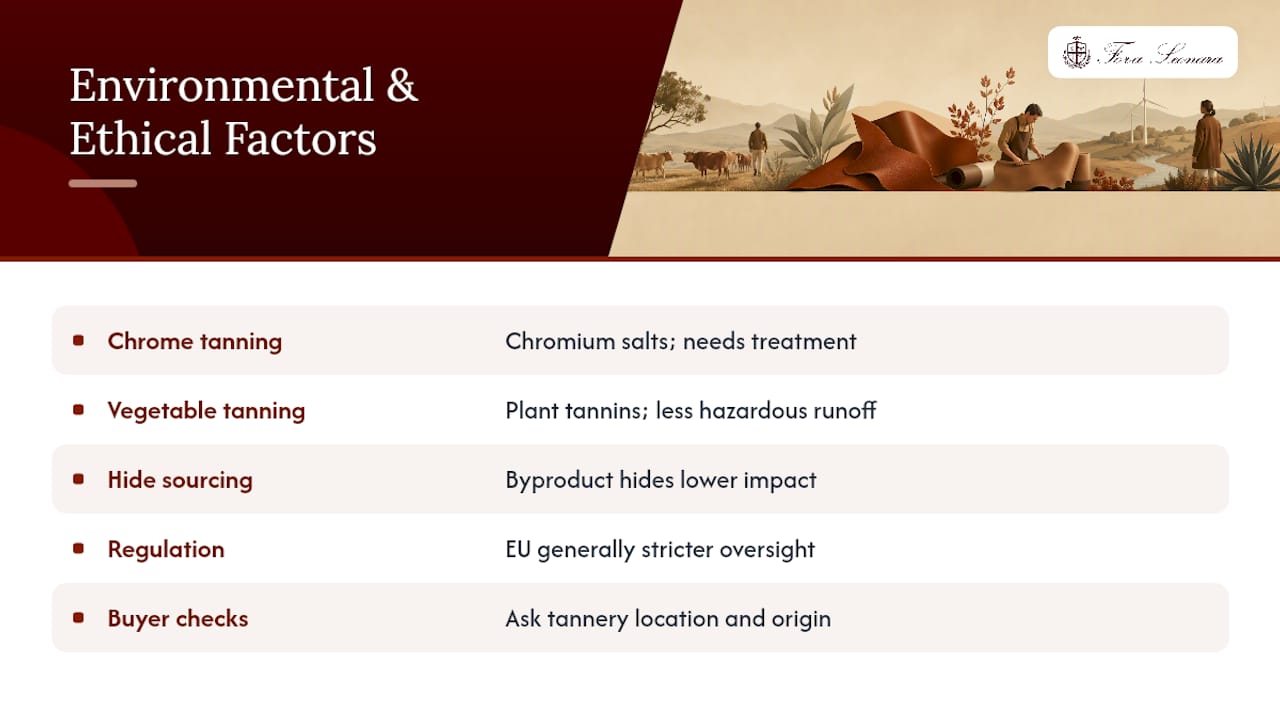
Leather’s environmental footprint depends heavily on the tannery, not just the animal or the finish name. Chrome tanning, the method behind most Nappa leather, uses chromium salts that require careful wastewater treatment; poorly regulated tanneries can let chromium runoff contaminate local water supplies, a well documented concern in regions with lax oversight. Vegetable tanning, more common in traditional calfskin production for dress goods, uses plant-based tannins and generally produces less hazardous runoff, though it takes longer and costs more.
Sourcing transparency matters as much as the chemical process. Hides sourced as a byproduct of the food industry, rather than raised specifically for leather, carry a smaller standalone environmental burden since the animal was already headed for the food supply chain regardless of hide use. Buyers looking for lower-impact leather should ask two direct questions: where was the hide tanned, and under what environmental regulation, and was the animal raised as a dedicated leather source or as a byproduct of food production.
Animal welfare standards also vary widely by country and supplier, with EU-regulated facilities generally operating under stricter oversight than unregulated tanneries elsewhere. Neither Nappa nor calfskin is inherently more or less ethical; the finish name and the hide name both describe the material, not the supply chain behind it. The responsible move is checking the tannery and origin claims on a label rather than assuming either term guarantees a cleaner process.
What Nappa and Calfskin Actually Cost
Price in this category tracks finishing complexity and hide scarcity more than brand markup alone. Aniline Nappa sits toward the higher end of soft leathers because the dyeing process demands nearly flawless hides. Any scar or blemish shows through the transparent dye, so tanneries reject more raw material to get finished aniline Nappa to market, which pushes the per-unit cost up even before a maker touches it.
Calfskin’s premium comes from a different constraint: yield. A calf hide is smaller than an adult cowhide, so a maker gets fewer wallets, fewer shoe panels, fewer square inches of usable leather per animal, which drives the price gap tanneries and retailers consistently point to. Pigmented or corrected-grain leathers, by contrast, sit at the lower end of the market in both categories, since a corrected surface hides blemishes and lets tanneries use hides that would otherwise be downgraded.
In practical terms, a finished good made from genuine aniline Nappa or fine calfskin will almost always cost more than one made from pigmented, corrected-grain leather of either type, and both will cost considerably more than bonded or synthetic alternatives marketed under similar-sounding names. Price alone isn’t proof of quality, but an unusually low price on a piece marketed as “genuine Nappa” or “full-grain calfskin” is worth questioning before buying.
Luxury Goods vs Everyday Products: Where the Line Falls
The gap between luxury and everyday leather goods usually comes down to grain selection and finishing tier, not the raw material category itself. Full-grain calfskin and pure aniline Nappa, the versions that show the hide’s natural surface without heavy correction, dominate the luxury tier: fine dress shoes, structured handbags, small leather goods meant to develop character over a decade of use.
Everyday and mass-market goods typically rely on corrected-grain or heavily pigmented versions of the same base materials. A budget wallet might technically be “genuine leather” and even carry a “Nappa” label, but if the surface has been sanded, corrected, and coated to hide imperfections, it won’t develop the same patina or last the same number of years as an uncorrected hide.
That distinction explains why two products can share a material name and sit at wildly different price points and quality tiers. The determining factor is how much of the hide’s natural grain survived the finishing process, and how much of the sale price reflects labor and hide scarcity versus marketing.
Fora Leonara’s Leather Goods, Chosen for the Long Run
Fora Leonara exists for exactly the confusion this article just cleared up. Instead of chasing whichever leather term sounds most luxurious on a label, the company selects hides for what they’ll actually do over years of wear, then finishes them to match. That’s a different starting point than most retailers, who buy finished leather from wherever it’s cheapest and let the label do the persuading.

If you’re shopping for a piece that needs to hold structure and polish for years, like a cardholder or wallet built from dense, fine-grained hide, browse the small leather goods collection or the full product catalog for the current range. Readers who want guidance matched to their specific wardrobe and material preferences can book a session through The Atelier, Fora Leonara’s personal styling service, and get a recommendation suited to how the piece will actually be worn rather than how it photographs on a shelf.
Sources
For deeper technical detail beyond this comparison, the Wikipedia entry on Nappa leather covers its California origin, while tanner-authored pieces from Hoplok Leather and Stridewise go deeper into tanning chemistry and calfskin strength testing, respectively.
- Nappa leather - Wikipedia
- What Is Nappa Leather? The Definitive Guide - Hoplok Leather
- Calfskin vs Cowhide Leather - An Expert Tanner Explains the Difference | Stridewise
- Calfskin vs Cowhide: A Tanner Explains the Difference - Beltley
FAQ
What are the disadvantages of Nappa leather?
Nappa’s biggest drawback is surface vulnerability: aniline-dyed versions in particular show scratches, stains, and water spots more readily than firmer, heavier-finished leathers because the dye sits in the fiber rather than under a protective coat, according to Hoplok Leather’s technical overview. It can also cost more than standard cowhide, since tanneries need near-flawless hides to dye it evenly.
What is the lowest quality of leather?
Bonded leather sits at the bottom of the quality spectrum. It’s made from scrap leather fibers glued together with a polyurethane coating, which lacks the fiber structure of genuine hide and tends to peel or crack within a year or two of regular use, unlike full-grain calfskin or genuine Nappa.
Which leather is better than Nappa leather?
“Better” depends entirely on the use case rather than one material outranking another universally. For structure, polish, and resistance to scuffing, full-grain calfskin generally outperforms soft aniline Nappa, while Nappa remains the better choice for cushioned, flexible goods like gloves or slouchy bags. Fora Leonara selects between the two based on which quality the specific piece needs most, not on chasing a single “best” leather label.
Is Nappa leather fake leather?
No, genuine Nappa is real animal hide, typically calf, lamb, or kid, finished through chrome tanning and aniline dyeing. The confusion comes from synthetic materials marketed as “faux Nappa” or “Nappa PU,” which mimic the look but lack real hide’s breathability and long-term durability, a distinction worth checking on any label before buying, as Foley + Corinna notes.
