

Pick stitching is a small hand or machine stitch that runs just inside the edge of a lapel, pocket flap, or facing, holding layers of fabric together while shaping how the edge sits. It anchors canvas and cloth so a lapel rolls instead of lying flat, and it leaves a faint line of visible dots as a byproduct of the construction. Hand-sewn pick stitching, done one stitch at a time with a needle and thread, remains one of the clearest signs that a suit was built rather than assembled.
TL;DR:
- Hand pick stitching engages internal layers more deeply, providing better long-term shape retention and durability compared to machine AMF stitching.
- Variations in stitch size, placement, and thread color influence whether pick stitching appears subtle or decorative, affecting the suit’s formality and style.
- Proper inspection involves checking stitch consistency, tension, and the lapel’s resistance under tension, with irregularity indicating hand craftsmanship.
- For longevity, avoid heavy pressing on pick-stitched edges and have loose threads repaired promptly by a tailor to prevent unraveling.
- Choosing hand pick stitching on a suit is most beneficial for garments expected to last a decade, especially custom or made-to-measure pieces emphasizing structural quality.
Table of Contents
- What Is Pick Stitching and How Is It Made by Hand?
- Where Pick Stitching Appears on a Suit
- Hand Pick Stitching vs. Machine (AMF): How to Tell the Difference
- Why Pick Stitching Matters Beyond Looks
- How to Inspect Pick Stitching When Shopping
- Care and Maintenance for Pick-Stitched Edges
- When Pick Stitching Fits Your Wardrobe
- History and Origins of Pick Stitching in Tailoring
- Variations and Styles of Pick Stitching
- How Pick Stitching Affects Durability and Longevity
- Common Misconceptions About Pick Stitching
- When to Request Pick Stitching Customization
- Consider Fora Leonara for Suits Finished to Atelier Standards
- Sources
- FAQ
What Is Pick Stitching and How Is It Made by Hand?
A pick stitch is a variation of the backstitch used in couture, sometimes called a stab stitch because the needle passes straight down and back up rather than gliding forward like a running stitch. It catches only a few threads at a time, which is why the visible mark on the outside is so small.
The basic hand technique follows a repeatable rhythm:
- Push the needle up through the fabric near the edge, catching the canvas or interfacing underneath.
- Pull the thread through, then insert the needle back a few threads behind the exit point.
- Advance the needle forward roughly a quarter inch under the fabric and bring it up again, repeating the sequence down the length of the seam.
- Keep tension even so the stitch doesn’t pucker the cloth or sit too loose.
This is strongest on mid-weight wools and suiting fabrics, where the cloth has enough body to hold the stitch’s shape without showing every pull. Machine versions, often called AMF stitching, replicate the surface look with a zigzag pattern but skip the manual needle path entirely.
Where Pick Stitching Appears on a Suit
Pick stitching shows up in a handful of predictable spots, and its job changes slightly depending on where you find it.
- Lapel edges: anchors the canvas layer so the lapel holds its roll instead of collapsing flat against the chest.
- Pocket flaps and welt pockets: keeps the outer fabric and lining aligned so the pocket doesn’t shift or bubble.
- Vents: stabilizes the layers at the back so the vent lies correctly when the jacket moves.
- Facings and hems: secures internal structure that never shows from the outside but keeps the garment’s shape intact over years of wear.
Visibility varies by fabric. On a fine worsted wool, the stitch reads as a subtle texture you notice only up close. On a heavier flannel or tweed, it can show more prominently, which is part of why some tailors treat pick stitching as a deliberate style choice rather than a hidden structural detail.
Hand Pick Stitching vs. Machine (AMF): How to Tell the Difference
The two methods can look similar from three feet away and completely different up close. Hand pick stitching shows slight irregularities in spacing and depth because no two hand-pulled stitches are identical. Machine AMF stitching is mechanically uniform, every stitch the same length, the same distance from the edge, repeated without variation.
The technical gap matters more than the visual one. Hand stitching typically engages the canvas and seam allowance directly, which is part of what shapes the lapel roll. Machine AMF stitching often sits closer to the surface and may not grab the internal layers the same way, meaning it mimics the aesthetic without doing the same structural work.
- Hand pick stitching: slower to produce, higher labor cost, engages internal layers, shows organic variation.
- Machine AMF: fast and consistent, an economical way to achieve a premium look on mid-tier garments, but usually decorative rather than structural.
Machine stitching is a reasonable choice on a budget-conscious suit meant for occasional wear. Handwork earns its price on a garment you expect to wear for a decade, where the stitch is doing real shaping work under the cloth, not just dressing up the edge.
Pro Tip: Bend the lapel back on itself and look at the stitch line under tension. Hand pick stitching will show tiny inconsistencies even under stretch; machine stitching stays perfectly even no matter how you flex the fabric.
Why Pick Stitching Matters Beyond Looks
Pick stitching survives in modern tailoring because it still solves a real problem: keeping a lapel’s roll consistent through years of wear, dry cleaning, and movement. Without it, the canvas and outer cloth can separate slightly over time, and the lapel starts to lie flatter and look tired.
It also works in tandem with canvassing. A fully canvassed suit depends on internal stitching, pick stitching included, to keep the horsehair or wool canvas floating correctly between the outer fabric and lining. Remove that anchoring and the canvas can shift, bubble, or sag.
Aesthetically, the stitch adds a quiet texture along the edge, a frame that catches light differently than the flat cloth around it. Done in matching thread, it reads as refinement rather than decoration. Pushed too far, with oversized stitches or mismatched contrast thread on a formal suit, it can tip a garment from understated to gimmicky. Where it lands depends on the formality of the piece and the thread choice.
How to Inspect Pick Stitching When Shopping
You don’t need a tailoring background to spot the difference between decorative stitching and structural stitching. You need a checklist and a few minutes with the garment in hand.
- Look at stitch spacing along the lapel edge. Perfectly even spacing across the entire lapel suggests machine work; slight variation suggests hand work.
- Check thread tension. Overly tight stitches pucker the fabric slightly; overly loose stitches look sloppy and uneven.
- Confirm the thread matches the fabric closely unless contrast stitching is an intentional design choice.
- Roll the lapel between your fingers and feel for resistance from the canvas underneath. A tactile check like this tells you whether the stitching is engaging internal structure or just sitting on the surface.
- Ask to see the lapel roll unassisted, draped over a hand or hanger rather than pressed flat on a table. A canvas-engaged lapel holds its curve; a fused or surface-stitched one goes flat.
If you’re shopping online, request close-up photos of the lapel edge and pocket flaps rather than relying on the standard product shot. A retailer confident in its construction will usually have these on hand.
Red flags worth noting: stitching that looks painted on rather than raised, a lapel that springs flat the moment you release it, or pick stitching that appears only on the front-facing parts of the jacket and disappears on the underside. That pattern usually signals a cosmetic detail with no structural job to do.
Care and Maintenance for Pick-Stitched Edges
Pick-stitched edges need less intervention than people assume, but the wrong pressing habit can undo the effect fast. Tell your cleaner to use light steam on lapel edges rather than heavy pressing, since flattening the roll under a hot press reduces both the shape and the visible texture of the stitch.
If a thread loop starts to loosen, resist the urge to pull it. Trim any obviously frayed end close to the fabric and get it to a tailor before it unravels further down the seam. Hang the jacket on a proper shaped hanger rather than draping it over a chair, since repeated folding at the lapel accelerates wear exactly where the stitching does its work. For a loose section longer than an inch or two, or stitching that’s pulled away from the canvas entirely, that’s a repair job for a tailor, not a home fix.
When Pick Stitching Fits Your Wardrobe
Pick stitching in matching thread reads as refined in nearly any professional context, from a boardroom to a client dinner. It’s subtle enough that most people register the effect without consciously noticing the stitch itself.
Contrast thread and larger, more visible stitching lean toward creative or fashion-forward settings rather than conservative business environments. In most professional wardrobes, the safer and more versatile choice is matching thread that stays close to invisible at a glance.
Fabric matters too. Fine worsted wool tends to suit discreet, closely spaced stitching. Heavier cloths like flannel or tweed can carry a bolder stitch without looking overdone. If you’re working with a tailor on a custom order, ask specifically for hand pick stitching on the lapel and pocket edges if structure and longevity matter more to you than price, and specify matching thread unless you have a clear reason to go bolder.
History and Origins of Pick Stitching in Tailoring
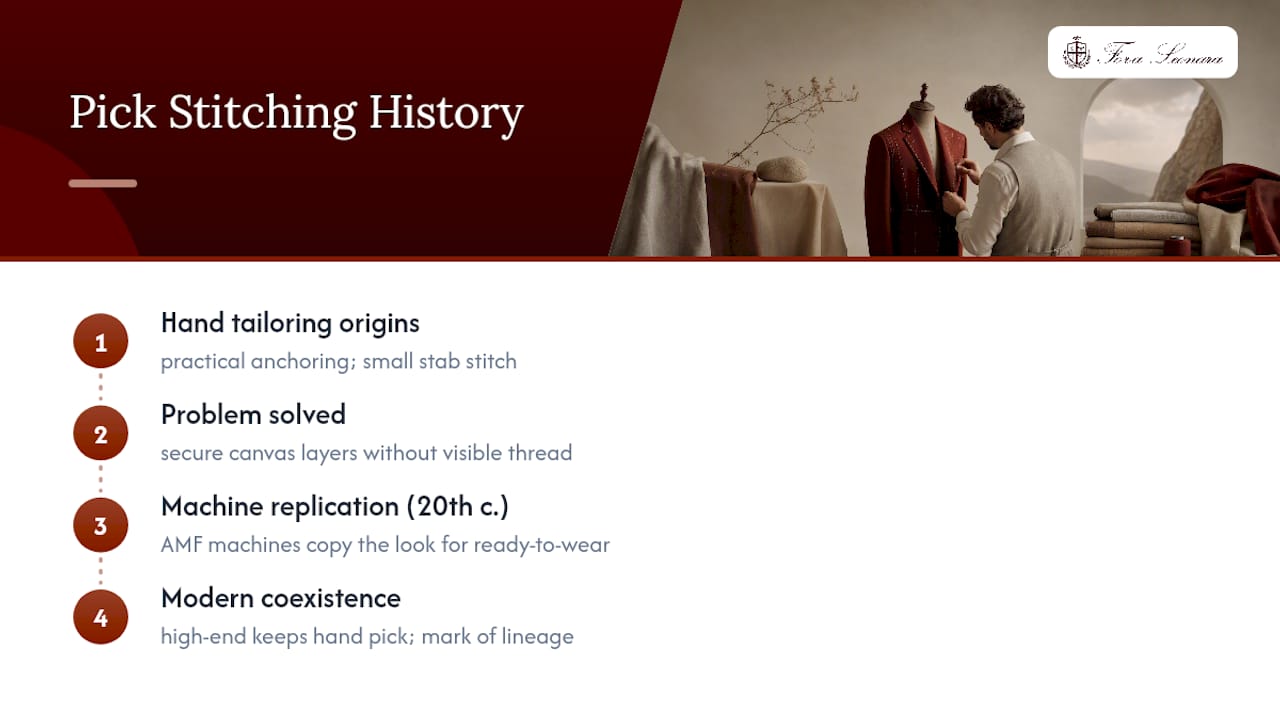
Pick stitching traces back to hand tailoring traditions in Savile Row and the broader European bespoke trade, where every seam, edge, and lapel roll was shaped entirely by hand long before sewing machines existed. In that era, pick stitching wasn’t a stylistic flourish. It was one of the only tools tailors had for anchoring a lapel’s canvas without stitching visible from the front of the coat.
The stitch’s origins are practical rather than decorative. Coat makers needed a way to secure multiple layers of canvas, wool, and lining without the thread showing prominently on the outside. A small stab stitch that caught only a few threads at a time solved that problem elegantly, leaving just enough of a trace to suggest the work happening underneath.
As ready-to-wear manufacturing scaled up through the twentieth century, machine methods emerged to replicate the look without the labor. That’s where AMF stitching comes from, named for the machine originally used to produce it. The visual signature of hand pick stitching became so associated with quality that manufacturers wanted the appearance even when they couldn’t justify the hours of hand labor.
What’s notable is that the technique never disappeared from high-end tailoring, even as machine alternatives became widespread and cheap. Bespoke and made-to-measure houses kept it because it still does the job better than any machine substitute, particularly on the lapel roll. The stitch has effectively become a marker of tailoring lineage. Seeing it done well tells you something about where in that history a particular garment sits, whether it followed the fast, mechanized path or the slower one rooted in old-world coat making.
Variations and Styles of Pick Stitching
Not all pick stitching looks the same, and the variations aren’t accidental. They reflect deliberate choices tailors make about formality, texture, and how much attention they want the stitch to draw.
Stitch size is the first variable. Fine, closely spaced stitches, sometimes barely a sixteenth of an inch apart, produce a nearly invisible texture suited to conservative business tailoring. Wider stitches, spaced closer to an eighth of an inch or more, create a more visible dotted line that reads as intentionally decorative rather than purely structural.
Thread color is the second major variation. Matching thread, dyed to blend with the shell fabric, is the standard choice across most tailoring, especially in professional wardrobes where the goal is quiet reinforcement rather than visual statement. Contrast thread, often a shade or two darker or lighter than the fabric, shows up more in creative or fashion-forward tailoring, where the stitch becomes a visible design line rather than a hidden structural one.
Placement density varies as well. Some tailors run pick stitching only along the lapel edge. Others extend it around the entire front edge of the jacket, down the lapel, across the chest opening, and along the pocket flaps, creating a continuous frame around the coat’s silhouette. A few extend it to the edge of the collar too, a detail closely associated with traditional bespoke construction.
None of these variations changes the stitch’s underlying mechanics. They change how much the finishing choice announces itself, which is really a question of how loud or quiet you want the garment to read.
How Pick Stitching Affects Durability and Longevity
Pick stitching does real structural work, and that work shows up most clearly over years of wear rather than on day one. A lapel anchored by hand stitching holds its roll through repeated wear, dry cleaning cycles, and the general stress of being folded into a garment bag or draped over a hanger. Without that anchoring, the canvas and outer fabric can gradually separate, and the lapel starts to lie flatter with each cleaning.
The stitching also distributes stress across pocket flaps and vents, areas that see constant movement and friction. A pocket flap without internal stitching to hold its layers together is more prone to shifting, bubbling, or the lining working loose from the shell fabric. Over a few years of regular wear, that difference becomes visible even to someone with no tailoring background.
Hand-sewn pick stitching tends to age better than its machine counterpart specifically because it engages deeper layers of the garment. If a single hand stitch loosens, it’s typically an isolated failure a tailor can repair in minutes. Machine AMF stitching, because it’s produced as a continuous mechanized line, can behave differently when damaged. A snagged thread sometimes unravels further along the row before it’s caught, since the stitch pattern wasn’t built with the same segment-by-segment reinforcement.
None of this means a machine-stitched suit falls apart quickly. Plenty of well-made, moderately priced suits use AMF stitching and hold up fine for years of normal wear. But if you’re buying a suit you expect to wear for a decade or more, hand pick stitching is one of the details that pays off specifically in the garment’s later years, not its first season.
Common Misconceptions About Pick Stitching
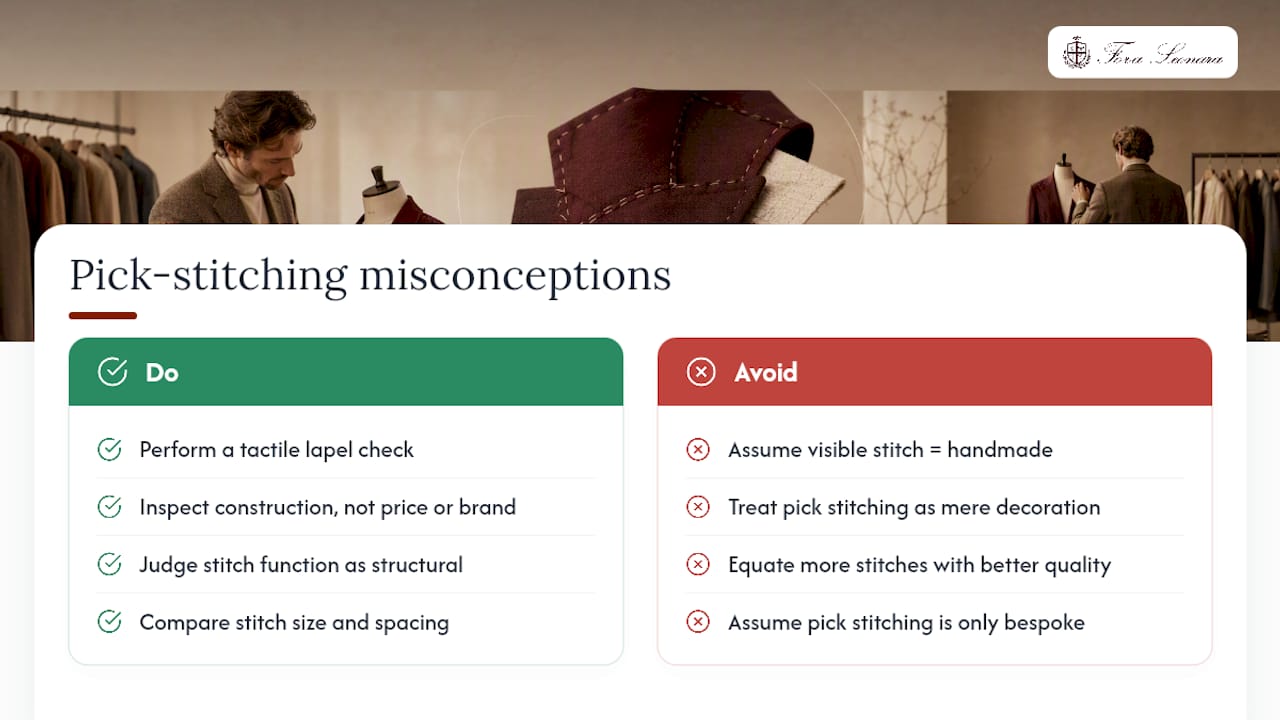
The most common mistake shoppers make is assuming any visible dotted stitch line automatically means hand craftsmanship. It doesn’t. Machine AMF stitching can look convincingly similar from a normal viewing distance, and plenty of mass-market suits use it precisely because it delivers the visual cue of quality without the labor cost. The stitch line alone isn’t proof of anything, which is exactly why the tactile lapel check matters more than a glance.
A second misconception is treating pick stitching as purely decorative. In most quality tailoring, it’s doing genuine structural work, anchoring canvas, stabilizing pocket layers, keeping facings in place, even when a shopper never consciously registers that function. Dismissing it as “just a stitch” ignores what happens to a lapel’s shape over years without that anchoring.
A third mistake is assuming more stitching automatically signals more quality. A lapel covered in oversized, widely spaced pick stitching isn’t necessarily better made than one with fine, closely spaced stitching. Stitch size is a style choice as much as a quality signal, and an overly aggressive stitch on a conservative business suit can actually look like it’s trying too hard rather than showing restraint.
Finally, some buyers assume pick stitching is exclusive to expensive bespoke suits and irrelevant to anything off the rack. That’s not accurate either. Some ready-to-wear and made-to-measure houses use genuine hand pick stitching on key edges even at accessible price points, while some expensive labels lean on machine AMF stitching to cut production costs. The only reliable way to know is to inspect the actual garment rather than assume based on price tag or brand name.
When to Request Pick Stitching Customization
If you’re working with a tailor on a custom or made-to-measure order, the moment to raise pick stitching is early, during the initial fabric and construction conversation, not after the first fitting. Ask specifically whether the lapel and pocket edges will be finished with hand pick stitching or machine AMF stitching, since the two aren’t always disclosed by default.
It’s worth requesting hand stitching specifically if you’re commissioning a suit meant to last a decade or more, where the lapel’s long-term shape matters more than shaving cost off the build. For a suit meant for occasional or seasonal wear, machine AMF stitching is a reasonable compromise that still delivers a clean finished look.
Thread color is the other decision point worth raising deliberately. If you want a genuinely quiet, professional finish, ask for thread dyed to match the shell fabric as closely as possible. If you’re commissioning something with more personality, a sport coat for a creative role or an event, contrast thread in a complementary shade can be a deliberate style statement, as long as you and the tailor agree on it upfront rather than discovering it at the final fitting.
Also ask where the stitching will run. Some tailors default to lapel-only pick stitching unless you request it extend around pocket flaps, the front edge, or the collar. If you’ve seen a particular finishing style you like, on a well-constructed reference suit or elsewhere, bring a photo. It removes ambiguity and gives the tailor a concrete target rather than a verbal description.
Consider Fora Leonara for Suits Finished to Atelier Standards
If you’d rather skip the guesswork of inspecting stitch spacing under store lighting, some tailoring brands build that judgment into every suit before it ships. Every jacket in The Wall Street Reserve and the wider ready-to-wear collection is finished with matching-thread pick stitching along the lapel and pocket edges, sewn as part of the a European atelier process that treats canvas engagement as a construction requirement, not an upsell.

Fora Leonara was founded by Rafael Zard the idea that quiet luxury means investment-grade pieces without logos shouting for attention, and finishing details like pick stitching are part of how that quality shows up on close inspection rather than from across a room. The brand’s own European tailoring approach reflects that same discipline: full canvassing, proprietary fabric sourcing, and finishing choices made for how a suit wears in year five, not just how it photographs on day one.
Pick stitching is one of several finishing details worth weighing when you’re deciding on a new suit, alongside canvas construction and fabric weight. Browse the ready-to-wear collection to see close-up finish photography, or book a virtual atelier appointment to talk through construction details before you commit.
Sources
For readers who want to go deeper on technique and terminology, Threads Magazine covers couture hand-stitching methods in trade-press detail, Sew Guide offers a practical stitch tutorial, TREASURIE breaks down needle path and care guidance, and Wikipedia’s entry on pick stitch provides a concise technical reference.
- Pick Stitch: Tailoring Stitch for Jackets & Lapels | TREASURIE
- Couture Hand Stitches: The Backstitch and the Pickstitch - Threads
- Pick Stitch – How to do it & where to use it beautifully | Sew Guide
- Pick stitch — Wikipedia
FAQ
Is Pick Stitching on a Suit Good?
Yes, particularly when it’s hand-sewn. It reinforces the lapel roll and internal structure while signaling a higher level of construction than a plain machine-finished edge.
What Is Pick Stitching on a Suit?
It’s a small hand or machine stitch placed just inside the edge of a lapel, pocket flap, or facing that holds fabric layers together and leaves a faint visible line along the seam.
Is Pick Stitching Still in Style?
Yes, especially in matching thread, where it reads as understated craftsmanship rather than a visible trend. Contrast-thread pick stitching cycles in and out of fashion in more creative tailoring circles, but subtle matching-thread stitching has stayed a constant in quality tailoring.
What Is the Purpose of Pick Stitching?
Its primary purpose is structural: anchoring canvas and fabric layers so a lapel holds its roll and pocket flaps stay aligned. The visible stitch line is a secondary, decorative effect of that construction work.
